Trump’s first 100 days of chaos

“We only seek to find the truth and set it free,” reads the slogan of the nonpartisan public affairs forum, San Francisco-based Commonwealth Club. Before the Club moved to temporary headquarters, en route to its brand new offices which are set to open sometime this year, I always loved riding the elevator to the meeting rooms – and reading that message in large script on the entry wall.

Today, finding the truth is a tall order.

Warning: This is a political column. Despite my avowed intention to stay out of politics until there is at least a ray of hope somewhere, politics just won’t go away.

cclub-panel-3-13-17

Recently the Commonwealth Club hosted a program titled “Trump’s First 100 Days: Part One.” Panelists included two women: Zahra Billoo, Executive Director of the SF Bay Area Council on American-Islamic Relations (a US-born citizen); and retired CA Supreme Court Judge LaDoris Hazzard Cordell, Chair, Santa Clara Jail Commission (and the great-granddaughter of slaves, she mentioned at one point.) They were two impressive citizens. This writer would have been happy to spend an hour listening to their understandings and perspectives.

Also on the panel were two white male gentlemen who dominated (unless the Moderator intervened) the conversation: Steven Fish, Professor of Political Science, University of California Berkeley, and Sean Walsh, GOP Political Strategist.

Riding herd on this well-informed, and certainly passionate about their positions, quartet was Scott Shafer, Senior Editor, California Politics & Government, KQED – which is partnering with the Commonwealth Club on these programs.

If I were covering this extremely interesting event for a non-fake news outlet, it could be effectively done in about 10,000 words. Instead, I offer here the excerpted (wildly condensed)  responses each panelist had to Shafer’s opening question: In this bizarre beginning – it was 38 days in when this program aired – to the Trump presidency, “what jumps out at you?”

Steven Fish: “It is not clear that the president of the United States is completely loyal to his own country, or the ideals of democracy.”

Judge Cordell: “We should be talking about the first 100 lies.” (She expounded on that at some length, and with clear, concise accuracy, ticking off the lie and the truth.)

Samara Billoo: “There is a sense of fear in my community,” spurred by “racist, misogynistic, homophobic, Islamophobic” messages coming from the White House and its Republican allies.

Sean Walsh: “He does not have his advisers, transition people, in place. He (our president) is in the process of putting his administration in place.”

Shafer: “Chaos.”

It’s going to be a long 100 days, and then some.

Breathe Deeply, Make New Resolutions

If you are a regular follower of this space – which would put you in a small but extremely erudite and observant group – you will have noticed an extended silence. An absence of Opinion. A voicelessness, one might say.

hope-v-despair-sign

It happens. For writers of a certain sort, it has come to this.

Waking up at 3 AM worrying about the erosion of our fragile democracy, the destruction of our fragile planet, the disappearance of civility, decency, respect and understandable syntax from our fragile public discourse – that’ll do it: render the brain unable to create. Plus, I don’t like writing about meanness, misogyny and narcissism, and what else is there in the un-fake news? Alternative facts?

Recently I decided to emerge from this bleak doldrum. OK, it happened accidentally, at my daughter’s beautiful winter wedding in Jackson Hole, Wyoming, where we sent wish lanterns into the night sky, and who can resist coming back to life amidst snowy mountains, wishes and true love?

wedding-lanterns-1

I’m not going into the specifics of the brightly lit wish turned resolution. But here are a few thoughts on Springtime resolutions – for what they’re worth, and/or for anyone who wants to consider making Springtime resolutions of their own.

Resolution #1: Calm down and do less. This space will now be the only space for this writer’s random thoughts. Goodbye, Huffington Post. This will please writer friends who were furious about my writing for Huffington Post (contributors’ pay? Zero) in the first place – but hey, I was trying to sell books when I started. My page remains up, but I noticed the last post (12/20/16) was titled “Talking Your Way Into a Better Death” – which seems a fitting final exit message.

Resolution #2: Revisit long-abandoned good ideas. Like that short story collection I keep saying I’ll publish if I live long enough. Or maybe some other brilliant projects. Several days ago a friend asked if she could buy a copy of my excellent Cooking for the Dentally Impaired book. Well, no. I never sold it. But after an exhaustive search I did find the hard copy. Maybe I’ll find some geek person who can help me find the computer files from whenever that was – 15+ years ago. I still think it’s a great idea, even if no publisher agreed and my agent thought I’d gone bonkers. Self-publishing has gotten downright respectable.

march-crowd

Resolution #3: Breathe deeply, stay vigilant. At the Women’s March, author Melissa Febos reportedly talked about the purpose of a vigil: “To keep awake during a time when usually asleep.” Until recently, this writer had drawn the line at marches, protests and vigils. Letters, emails, talks, phone calls etc okay – but showing up in person? Nahh. In the past year, however, I joined a vigil for black kids shot and killed just a few miles from my safely comfortable neighborhood and it was both a blessing and an eye-opener. Then I broke down and marched with the Women’s March in San Francisco and that’s the most fun I’ve had in years. So now? I plan to stay vigilant with StandUpSF among other groups, because I believe democracy, decency, inclusion, respect – all those things – are worth preserving.

This space has also always been about optimism. Resolution #4 is to keep that optimism. There will always be goodness, good intentions, good people – including good people with whom we disagree and whom we should listen to and respect. For the sake of my grandchildren, I will continue to search out them all.

Signs of Our Marching Times

march-crowd

The March was intended to be about women’s rights – workplace rights, immigrant and minority rights, the right to make our own reproductive decisions, all those rights that suddenly seem threatened. It turned out to be a celebration of the spirit.

march-tired-poor-better

It was hard to separate rights & purposes from our new president, and hard to ignore the mean-spiritedness that most marchers hope at least to diminish. But it turned out to be a celebration of everything he disdains.

march-umbrella

This writer has traditionally drawn the line at protest marching. In the past I’ve done talks, workshops, phone calls, emails, office visits and the occasional vigil; this year felt like it called for showing up. So along with several friends from the geezer house where I live, I struck out into the rainy San Francisco late afternoon along with a few hundred thousand others. Estimates vary, but we spilled into so many adjoining streets that 50,000 seems a minimal number.

march-im-with-her

The signs say it all. Or a lot of it.

march-super-callous-etc

If anyone’s spirits were dampened by the cold rain, you couldn’t tell. What you can tell, from the smiling faces among the umbrellas, is how it felt. Most of all, it was just heartening to be among all of the above, and among the many scattered signs saying “This Is What Democracy Looks Like.”

6331468167_d7742a8583_b
Yossi Gurvitz on Flicker

A similar sign was photographed by Yossi Gurvitz in St. Paul’s Square during the Occupy London movement several years ago, a darker view of that phrase. But with enough joyful, celebratory gatherings such as those all around America on January 21, perhaps democracy will survive its current challenges — and look like government by the (sometimes jubilant) people.

justice

Immigrants, Refugees, Human Beings

ice-xcheckii-3cops1arrest

“It would just be like my life ending,” he said. He was an attractive 20-something with piercing black eyes and a neatly trimmed beard. “I was a Dreamer,” he added, “but now I just have nightmares. I’ve lived here since I was 8. I did really well in high school and am halfway through college. But I could be sent back to a country I hardly know, to a very dangerous situation. I’m afraid for my whole family.”

His name is Antonio, and he is an undocumented immigrant. He is one of at least 11 million people in the U.S. today who go to bed with the fear they might wake up to their worst nightmare, deportation. It’s a fear that will be multiplied many times over with installation of an administration that came to power with more than a little help from ripples of xenophobia.

Immigrants. Refugees. Migrants. Humans.

refugees-uganda

Worldwide, well over sixty-five million people have been forced to flee their homes, with one source reporting that 24 people were displaced from their homes every day in 2015. By now, most of us have an overload of images in our heads – Syrian children fleeing war-torn cities, terrified people clinging to the sides of capsized boats, acres of tent cities housing human beings facing an unknown future.

Some hope for the hordes of migrants and refugees in Europe lies in the countries and organizations – UNICEF, Save the Children, other nonprofits – that provide shelter in the form of “temporary” camps. The people there, many of whom spend years of their lives simply existing, at least receive food and minimal care. But it’s hard not to consider how little the U.S. is doing (and how much less we’re likely to do in the coming years)

Among the organizations working to ease the burdens of undocumented immigrants on our own soil is the Interfaith Movement for Human Integrity. Senior Program Director Rev. Deborah Lee was speaking of her group’s work at the interfaith event where Antonio told his own story.

“What is our unique role, as religious communities, and how can we put it into practice?” Lee asked. “Does our faith require us to provide sanctuary for those who feel threatened?”

The IMHI maintains the answer to that latter question is a loud Yes. “There is a growing need for faith communities to be a part of the (sanctuary) map,” she says, “which already includes college campuses and cities around the country – responding to God’s law of offering protection to the vulnerable.”

Her organization, Lee explains, hopes to enlist one (or more) “sanctuary congregations” in cities across the U.S. where someone facing final deportation orders can find protection. There are also migrant families arriving in the San Francisco Bay area, Lee says, “who are seeking protection from deportation and applying for asylum, but who are without official refugee status and resettlement services.” For these, IMHI seeks congregations that can provide either support or hospitality housing.

Welcome.many languages

The idea of sixty-five million+ people forced to flee their homes looks like a tragedy too big to consider. But listening to Deborah Lee talk about how every human being is sacred, or having coffee with Antonio, puts a face on possibility.

Farewell to a Not-All-Bad Year

2016

Farewell to 2016? People all over the globe are saying good riddance.

There are those of us in the U.S. who believe that climate change is real, that the vast majority of Muslims are peace-loving and the vast majority of Mexicans are neither rapists nor murderers, that women deserve better than to be denied rights and casually groped. Even those who believe otherwise admit reason and decency suffered some killer blows in the past year.

Poor 2016. Throw in global goings-on with the Brexit vote and the tragedies in Syria, Venezuela and too many troubled spots to mention, and it would seem there’s not a lot good to be said for the year. But it actually wasn’t all bad.

For openers, there are the things that didn’t happen: Nobody let loose a nuclear missile that would have begun the destruction of the planet. The Mosul Dam didn’t fail. Northern California didn’t have the devastating earthquake for which it is overdue. Even the luxury tower set to zoom up and block this writer’s 7th-floor balcony view of the far-off San Bruno mountains didn’t materialize. (OK, we know it’s coming. New York developer has the right to build to 240 feet, but so far the city says he can’t have an exemption to go 200+ feet higher.) So from the frivolous – which a 7th floor view certainly is – to the horror scenario, 2016 could surely have been worse.

good-news

And as for the good news? Glancing back over the posts on this site over the old year is one way to find a lot of it. A random few:

Mutual support and understanding among different religions was alive and well in 2016, as it will continue to be in the new year – at least in much of the U.S. Several times I wrote about events sponsored in San Francisco by the S.F. Interfaith Council, such as the Thanksgiving Prayer Breakfast – at which an overflow crowd representing people of all faith communities reaffirmed their commitment to human rights, social justice and world peace before launching into a rousing chorus of Leonard Cohen’s “Hallelujah.”

Philanthropy is alive and well too. In May, a 3-year-old friend of ours decided to open his piggy bank and give the money ($32.60) to his two favorite charities: the local library and the hospital where he and his baby-sister-to-be were born. His philanthropy spurred several matching gifts. Who says you have to be a zillionaire to be a philanthropist and do good in the world?

More than once I wrote about one of my real life heroes, Dr. Willie Parker, an African American physician determined to keep abortion access available to those who are denied reproductive healthcare: most often poor women of color. Nothing will slow down Willie Parker.

justice

And speaking of heroes, In January I was fortunate to be part of a collaborative celebration of Martin Luther King Day, with a predominately white church and its predominantly black partner church, affirming King’s message that only light can drive out darkness, and only love can drive out hate. It’s only a small effort in one small part of the globe, but as members of the two communities work (and play and sing) together, light shines on racial injustice.

There have been other optimistic highlights, such as the Internet Archive celebrating its 20th anniversary. The IA is a mind-bending, increasingly successful effort to make All Knowledge Available to All, for free. Impossible? Believe. Another blog highlighted another impressive physician, Dr. Angelo Volandes, who was touring the country last year with his new book The Conversation. Volandes is on a campaign to end aggressive, unnecessary, unwanted and often cruel end-of-life treatment. What happens in emergency rooms and intensive care units during the last few days of life for millions of Americans is an expensive disgrace; Volandes’ efforts will help change that.

In August I was caught in the middle of Delta’s computer meltdown, and spent some interesting hours trying to get from Atlanta to San Francisco. What was worth writing about were the many acts of kindness among airport crowds. They reminded me of flying from San Francisco to Portland OR several days after 9/11, when it seemed everyone in America wanted only to be kind to everyone else.

That spirit is still here, somewhere; we just need to recover it after a bruising year.

world-peace-1


Russia — and Nuclear Arms Racing

moscow-cathedral

Russia occupies a soft spot in my heart.

It grew out of the boundless enthusiasm for everything Slavic exuded by my Russian-major college roommate – or may have been seeded earlier by the cloth-covered storybooks full of babushkas, snow-covered cottages and deep forests that I so loved as a child. It expanded through and beyond the one time I was lucky enough to visit the country. I love the vastness of its countryside, the majesty of its ancient cathedrals, the intriguing complexity of its history, the wonder of its literature, the no-nonsense hospitality of its people.

I especially love every single one of those non-English-speaking Russians who helped me find the Dostoesvsky Museum in St. Petersberg one day, as I wandered a very long boulevard, counting canals, clutching my map and repeatedly smiling at perfect strangers, pointing to the spot and saying “Dostoevsky Musee?” More than a dozen of them patiently took turns guiding me along. The last took me by the arm and walked me several blocks and down the steps to the obscure doorway through which I entered the last apartment inhabited by one of my literary heroes. (I would never have found it!)

Dostoevsky Museum.jpg

Many friends and strangers across the U.S. share this affection. Much travelled scientist/author Jo Anne Valentine Simson writes in her small, lovely new book Russia Revisited: Come Take a Tour with Me that it “is one of my favorite countries in the world – huge and beautiful, with a complex and tortured history and a culture to match.”

But we do not love Mr. Putin. From this vantage point, he is among a handful of dangerous tyrants determined to centralize power and increasingly restrict the freedom of ordinary citizens. Simson puts it this way: “Unfortunately, in 2016 the political power seems to be devolving once again into a form of aristocracy, with Vladimir Putin behaving like an autocrat.”

We also don’t like the prospect of nuclear annihilation. Or another dangerous arms race destined to increase the supply of nuclear weapons in the U.S., Russia and who knows where else. Which is why we find the “bring it on” tweets of our president-elect more than a little scary.

nuclear-bomb-explosion2.jpg
by Snoron.com

According to the good people of Ploughshares Fund, there are currently 15,375 nuclear weapons held by nine countries. The U.S. and Russia have 93 percent of them. That means each of us already has enough nukes to destroy the planet several times over. A small dispute between Mr. Trump and Mr. Putin, whom our president-elect admires but seems eager to challenge, could unleash a few and end life as we know it on this fragile planet.

A little less trash-tweeting and a little less talk about building nuclear stockpiles would be a nice Happy New Year gift for Russians and Americans alike.

Talking Your Way into a Better Death

Angelo Volandes
Angelo Volandes

“If you do something to my body that I do not want,” says physician/author Angelo Volandes, “it is assault and battery. But if I do the same thing to you in (a medical situation,) it is standard of care.”

Volandes thinks this last is a bad idea. He is on a campaign to change the way American doctors and patients, and indeed the country at large, understand what is done to American bodies at life’s end. He spoke of this campaign, and his new book The Conversation that outlines it, at a recent Commonwealth Club event in San Francisco. When he’s not taking time out to promote the book and the campaign, Volandes practices internal medicine at Massachusetts General Hospital in Boston and is on the faculty at Harvard Medical School. He is Co-Founder and President of Advance Care Planning Decisions, a non-profit foundation dedicated to improving patients’ quality of care.

“Ninety percent of people want to die at home,” Volandes says; “most die in hospitals. There is a misalignment between the type of medical care they want and what they get.” About this unwanted care? “If you’re in the hospital and get unwanted care you never bargained for, I still get paid for it.”

After watching too many patients endure end-of-life treatments he was sure they would not have chosen, Volandes started an unusual practice: taking every one of his patients to visit the intensive care unit, and some to visit the dialysis unit. Once they gained a better understanding of what some of the aggressive treatments – CPR, breathing machines, etc – actually looked like, the patients almost always moved away from “Do everything” to comfort care as their choice.

The basic change Volandes believes is needed begins with a conversation between physician and patient. Those conversations do happen, and there is now Medicare reimbursement, but few physicians find them easy, and few patients know how to inaugurate them or what to say. “Never did a senior physician have to certify that I could talk to a patient,” Volandes says. “The patient needs to know ‘What are the questions I need to ask? What are my options?’ Life’s final chapter needs to be written – but the problem is, I’m writing it (instead of the patient.)”

This writer has been advocating for individuals to write their own final chapters for over two decades. With others writing those chapters instead, the costs are monumental and unnecessary – and millions of Americans die after undergoing painful indignities they would never have chosen. Physician aid-in-dying – approved by a majority of doctors and 7 in 10 Americans and now legal in five states – is one key piece of the puzzle. But the elephant-size puzzle piece is how to get every one of us to make known, well before those “end-of-life” days arrive, what medical care we do or do not want.

Volandes’ conversations could put that piece in place. Every person alive who takes time for the conversation (and for writing it all down) will likely die a better death.


Prayer, Peace & Song to Start the Day

world-peaceOK, this is San Francisco: love and peace reign. But it’s also Thanksgiving: gratitude and community. Celebrations of love, peace, gratitude and community are taking place not just on the left coast but across the country, as we begin to exhale after a bitterly troubled few months. Exhalation in community can be a great way to start the day.
“Hope,” said one speaker at the recent Interfaith Thanksgiving Prayer Breakfast, “is right there where it’s always been, between faith and love.” There was plenty of all three. Some 385 early-risers were gathered for the event, sponsored by the San Francisco Interfaith Council and billed as “The Soul of the City: Faith and Social Justice in San Francisco.”

Marsha Attie
Marsha Attie

It all began with the sounding of a Buddhist Ceremonial In Kin Bell – a successful attempt to bring a little quietude into the amiable masses – followed by Pacifica Institute’s Fatih Ferdi Ates’ recitation of the Muslim Call to Prayer, in a voice that certainly reaches to the heavens. Brahma Kumaris Sr. Sukanya Belsare read the interfaith statement of the sponsoring SFIC, which is read at all board meetings and events and says, in effect, “Whatever your faith or faith tradition, it’s okay. We’re here to learn, and understand.”

Led by Cantor Marsha Attie of Congregation Emanu-El, the crowd then launched into a rousing rendition of Leonard Cohen’s “Hallelujah.”

Throughout the two-hour scrambled-eggs-&-mixed-fruit breakfast there were songs, honors, laughs and commentaries. Not to mention prayers in virtually every known faith tradition. A few highlights are encapsulated below:

SFIC Executive Director Michael Pappas: “The interfaith community will always stand for human rights, social justice and equality for all.”

San Francisco Mayor Ed Lee (to a standing ovation): “San Francisco will remain a sanctuary city.”

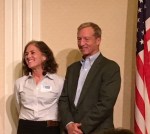
Kat Taylor & Tom Steyer

Rt. Rev. Marc Andrus, Bishop, Episcopal Diocese of California, introducing event honorees Kat Taylor and Tom Steyer to the audience and audience to the honorees (loosely paraphrased): “Bringing the mind effectively into the heart to do good works can result in reverence, compassion, forgiveness and courage.” Andrus then did a warm-up exercise, reciting a litany of actions such as feeding the hungry, protecting the oppressed and helping the poor, to an enthusiastic audience response of “We’re Still In!”

Honoree Tom Steyer, Founder and President, NextGen Climate (and major donor to progressive political causes – San Francisco is still San Francisco): “Troubled times give everyone a chance to lead a meaningful life. (A) challenge is to embrace our full humanity. The. U.S. didn’t start with full humanity for everyone.” Steyer then deferred to the co-honoree, his wife Kat Taylor, Co-Founder and Co-CEO, Beneficial State Bank and a ferocious advocate for changing the food and banking systems for good through business models and philanthropy.

Mark Leno
Mark Leno

Honoree Taylor: “You knew I would sing” – launching into the Christian hymn standard “Here I Am, Lord,” with several hundred of the guests joining in.

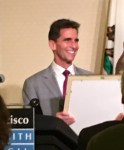
Presented a proclamation by SFIC Board Chair G. L. Hodge – who said he relished the opportunity, since the recipient was famous for issuing proclamations himself, termed-out California State Senator Mark Leno: “I recognize this frame, from something I sent earlier. But I always say, ‘Reuse, Recycle, Re-elect.’”

Nancy Pelosi
Nancy Pelosi

House Minority Leader Nancy Pelosi, after leading the crowd in reciting “The Prayer of St. Francis”: “Ministering to God’s creation is an act of worship. We must affirm the dignity and worth of every person, and we all have to be instruments of God’s peace.”


1 5 6 7 8 9 45