Bridging the Poverty Gap

On a recent cross-country flight I sat one row ahead of a family I had first noticed in the gate area: a young mother with one child about four and a baby, none looking as though they’d had a bath, a new pair of shoes or a good night’s sleep in some time. They were one row behind me, and I was one row behind six rows of excited high school kids accompanied by several adults from Salinas, California, heading off for spring break. (It was not a quiet trip.)airplane interior

The child was hungry, the baby cried, and the mother looked helpless. Mother and child wore ill-fitting clothes and sandals not well suited to the 40-degree weather. The baby might have needed changing and the mother made me feel sad. In fact, the entire family made me feel sad. At what cost, I kept wondering, could they be flying all the way across the country, to find what relief?

It could have been my imagination, but it seemed as if everyone managed to make them invisible in a way more extreme than how we generally avoid noticing each other when strangers are in close quarters. It felt as if there were two parallel universes – the Regular People one degree removed from the First Class people, and the ignorable family.

airline snacksWhen the flight attendant came by with snacks I was grateful to be able to pass my caramel-filled wafer to the child. This was nothing magnanimous on my part; I’m gluten-intolerant and couldn’t eat it. But what balanced my sadness for the little family happened after we landed. As the exiting unfolded, a young man in an Ivy League college jacket wound up right behind the mother. She was struggling with baby, small child, huge diaper bag and a canvas bag retrieved from the luggage rack. “Here,” said the young man; “Let me help.” With that he slung his duffel bag onto his back, grabbed both diaper bag and canvas sack and smilingly sent mother and brood ahead of him down the aisle. When I passed them at the end of the jetway he was pulling something out of his duffel bag – presumably a snack of some sort – for the 4-year-old.

This flight ended in Washington D.C., where a lot of millionaires are working to cut their own taxes and eliminate funding for a variety of services to people like my fellow-traveling family.

The day after my arrival I had a joyous reunion with one of my best friends from long ago college days, whose daughter drove her several hours through stormy weather so we could visit. Her daughter’s name is Lisa.

Lisa and her husband Gary, it turns out, are moving to the unincorporated hamlet of Lucketts, Virginia. Four miles south of the Potomac River, Lucketts features trailer parks and very fancy new upscale homes, an old schoolhouse now on the National Registry of Historic Places, one gas station, and a stoplight at the intersection of Route 15 and Stumptown Road. Vineyards developing nearby partially explain the fancy new homes; according to Wikipedia, you can hear distant train whistles, and bluegrass music every Saturday night at the community center (former schoolhouse) from October to April. Lucketts manse

Lisa and Gary, who have already met with community members from both ends of the Lucketts economic spectrum, will live in an old (built in 1924) manse across the road from a recently-closed (built in 1885) Presbyterian church. They plan to hold open house – you’ll know you’re welcome to drop in if the porch light is on – at (well, almost) all hours. If it turns out that people get to know one another and eventually feel so inclined, they will reopen the church. Gary had a successful career in business before going into nonprofit work in search of something more meaningful; with their children now grown the couple see this as an exciting new chapter in life.Lucketts church

The point of these two stories – interrupted by an observation on our current political scene that is simply too pertinent to ignore – is not that all shabby travelers are poverty-stricken, or that you have to be very rich to wear a Yale jacket (though you might) or that all baby boomer couples should seek new career paths. The point is: while the rich get rich and the poor get poorer in this divided country, it’s going to take a lot of random acts of kindness to keep us together. And that, happily, they do occur.

Breast Cancer? Ask questions!

In honor of International Women’s Day (even if I didn’t quite get it finished in time,) this brief message is about a book recently re-issued by Dr. William H. Goodson III that should be in the hands of every woman with breast cancer, wanting to understand breast cancer or helping someone who is going through breast cancer.

Pink flower

It’s Your Body . . . ASK is a guidebook for talking with your doctor about breast cancer. I would’ve given anything to have had it when I had breast cancer, and a mastectomy, a dozen years ago. Maybe I would’ve made different decisions, maybe not. But the reality is this: most women, unless they have had medical training, would never think to ask a question like “What are the side effects of removing axillary nodes?” Personally, I didn’t think to ask about nodes at all. Other than considering the size of my cancer, in fact, questions I might have asked about its rate of growth, alternative treatments, follow-up therapies – – were mostly not discussed because I didn’t know to ask them.

This is a book that gives not just answers (it offers many answers about families, about hormone-based therapies and other issues) but more importantly: questions. If you, a breast cancer patient, know the questions, your doctor needs to give you the answers. What’s that lump about? What about these other pains and symptoms I have? What are all of my treatment options?

(I would say, here, Full disclosure: Dr, Goodson is a friend of mine. But it would be more braggadocio than disclosure. Bill Goodson and I shared a few discussion program podiums It's Your Bodyseveral years ago when his gripping novel about sexual violence against women, The Blue-Eyed Girl and my Perilous Times: An inside look at abortion before – and after – Roe v Wade were both newly released. I’m a writer. He’s a Senior Scientist at California Pacific Medical Center Research Institute; a recognized leader in breast cancer care who has been (among other things) a Professor of Surgery at the University of California San Francisco and President of the San Francisco Medical Society, and is listed in The Best Doctors in America.)

Credentials aside, It’s Your Body . . . ASK is worth a look. It offers a pathway through turbulent times, which can be far less turbulent if you have some help in steering your own ship.

Check it out.

Breathe Deeply, Make New Resolutions

If you are a regular follower of this space – which would put you in a small but extremely erudite and observant group – you will have noticed an extended silence. An absence of Opinion. A voicelessness, one might say.

hope-v-despair-sign

It happens. For writers of a certain sort, it has come to this.

Waking up at 3 AM worrying about the erosion of our fragile democracy, the destruction of our fragile planet, the disappearance of civility, decency, respect and understandable syntax from our fragile public discourse – that’ll do it: render the brain unable to create. Plus, I don’t like writing about meanness, misogyny and narcissism, and what else is there in the un-fake news? Alternative facts?

Recently I decided to emerge from this bleak doldrum. OK, it happened accidentally, at my daughter’s beautiful winter wedding in Jackson Hole, Wyoming, where we sent wish lanterns into the night sky, and who can resist coming back to life amidst snowy mountains, wishes and true love?

wedding-lanterns-1

I’m not going into the specifics of the brightly lit wish turned resolution. But here are a few thoughts on Springtime resolutions – for what they’re worth, and/or for anyone who wants to consider making Springtime resolutions of their own.

Resolution #1: Calm down and do less. This space will now be the only space for this writer’s random thoughts. Goodbye, Huffington Post. This will please writer friends who were furious about my writing for Huffington Post (contributors’ pay? Zero) in the first place – but hey, I was trying to sell books when I started. My page remains up, but I noticed the last post (12/20/16) was titled “Talking Your Way Into a Better Death” – which seems a fitting final exit message.

Resolution #2: Revisit long-abandoned good ideas. Like that short story collection I keep saying I’ll publish if I live long enough. Or maybe some other brilliant projects. Several days ago a friend asked if she could buy a copy of my excellent Cooking for the Dentally Impaired book. Well, no. I never sold it. But after an exhaustive search I did find the hard copy. Maybe I’ll find some geek person who can help me find the computer files from whenever that was – 15+ years ago. I still think it’s a great idea, even if no publisher agreed and my agent thought I’d gone bonkers. Self-publishing has gotten downright respectable.

march-crowd

Resolution #3: Breathe deeply, stay vigilant. At the Women’s March, author Melissa Febos reportedly talked about the purpose of a vigil: “To keep awake during a time when usually asleep.” Until recently, this writer had drawn the line at marches, protests and vigils. Letters, emails, talks, phone calls etc okay – but showing up in person? Nahh. In the past year, however, I joined a vigil for black kids shot and killed just a few miles from my safely comfortable neighborhood and it was both a blessing and an eye-opener. Then I broke down and marched with the Women’s March in San Francisco and that’s the most fun I’ve had in years. So now? I plan to stay vigilant with StandUpSF among other groups, because I believe democracy, decency, inclusion, respect – all those things – are worth preserving.

This space has also always been about optimism. Resolution #4 is to keep that optimism. There will always be goodness, good intentions, good people – including good people with whom we disagree and whom we should listen to and respect. For the sake of my grandchildren, I will continue to search out them all.

Signs of Our Marching Times

march-crowd

The March was intended to be about women’s rights – workplace rights, immigrant and minority rights, the right to make our own reproductive decisions, all those rights that suddenly seem threatened. It turned out to be a celebration of the spirit.

march-tired-poor-better

It was hard to separate rights & purposes from our new president, and hard to ignore the mean-spiritedness that most marchers hope at least to diminish. But it turned out to be a celebration of everything he disdains.

march-umbrella

This writer has traditionally drawn the line at protest marching. In the past I’ve done talks, workshops, phone calls, emails, office visits and the occasional vigil; this year felt like it called for showing up. So along with several friends from the geezer house where I live, I struck out into the rainy San Francisco late afternoon along with a few hundred thousand others. Estimates vary, but we spilled into so many adjoining streets that 50,000 seems a minimal number.

march-im-with-her

The signs say it all. Or a lot of it.

march-super-callous-etc

If anyone’s spirits were dampened by the cold rain, you couldn’t tell. What you can tell, from the smiling faces among the umbrellas, is how it felt. Most of all, it was just heartening to be among all of the above, and among the many scattered signs saying “This Is What Democracy Looks Like.”

6331468167_d7742a8583_b
Yossi Gurvitz on Flicker

A similar sign was photographed by Yossi Gurvitz in St. Paul’s Square during the Occupy London movement several years ago, a darker view of that phrase. But with enough joyful, celebratory gatherings such as those all around America on January 21, perhaps democracy will survive its current challenges — and look like government by the (sometimes jubilant) people.

justice

Prayer, Peace & Song to Start the Day

world-peaceOK, this is San Francisco: love and peace reign. But it’s also Thanksgiving: gratitude and community. Celebrations of love, peace, gratitude and community are taking place not just on the left coast but across the country, as we begin to exhale after a bitterly troubled few months. Exhalation in community can be a great way to start the day.
“Hope,” said one speaker at the recent Interfaith Thanksgiving Prayer Breakfast, “is right there where it’s always been, between faith and love.” There was plenty of all three. Some 385 early-risers were gathered for the event, sponsored by the San Francisco Interfaith Council and billed as “The Soul of the City: Faith and Social Justice in San Francisco.”

Marsha Attie
Marsha Attie

It all began with the sounding of a Buddhist Ceremonial In Kin Bell – a successful attempt to bring a little quietude into the amiable masses – followed by Pacifica Institute’s Fatih Ferdi Ates’ recitation of the Muslim Call to Prayer, in a voice that certainly reaches to the heavens. Brahma Kumaris Sr. Sukanya Belsare read the interfaith statement of the sponsoring SFIC, which is read at all board meetings and events and says, in effect, “Whatever your faith or faith tradition, it’s okay. We’re here to learn, and understand.”

Led by Cantor Marsha Attie of Congregation Emanu-El, the crowd then launched into a rousing rendition of Leonard Cohen’s “Hallelujah.”

Throughout the two-hour scrambled-eggs-&-mixed-fruit breakfast there were songs, honors, laughs and commentaries. Not to mention prayers in virtually every known faith tradition. A few highlights are encapsulated below:

SFIC Executive Director Michael Pappas: “The interfaith community will always stand for human rights, social justice and equality for all.”

San Francisco Mayor Ed Lee (to a standing ovation): “San Francisco will remain a sanctuary city.”

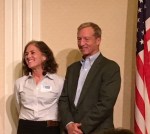
Kat Taylor & Tom Steyer

Rt. Rev. Marc Andrus, Bishop, Episcopal Diocese of California, introducing event honorees Kat Taylor and Tom Steyer to the audience and audience to the honorees (loosely paraphrased): “Bringing the mind effectively into the heart to do good works can result in reverence, compassion, forgiveness and courage.” Andrus then did a warm-up exercise, reciting a litany of actions such as feeding the hungry, protecting the oppressed and helping the poor, to an enthusiastic audience response of “We’re Still In!”

Honoree Tom Steyer, Founder and President, NextGen Climate (and major donor to progressive political causes – San Francisco is still San Francisco): “Troubled times give everyone a chance to lead a meaningful life. (A) challenge is to embrace our full humanity. The. U.S. didn’t start with full humanity for everyone.” Steyer then deferred to the co-honoree, his wife Kat Taylor, Co-Founder and Co-CEO, Beneficial State Bank and a ferocious advocate for changing the food and banking systems for good through business models and philanthropy.

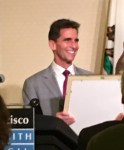
Mark Leno
Mark Leno

Honoree Taylor: “You knew I would sing” – launching into the Christian hymn standard “Here I Am, Lord,” with several hundred of the guests joining in.

Presented a proclamation by SFIC Board Chair G. L. Hodge – who said he relished the opportunity, since the recipient was famous for issuing proclamations himself, termed-out California State Senator Mark Leno: “I recognize this frame, from something I sent earlier. But I always say, ‘Reuse, Recycle, Re-elect.’”

Nancy Pelosi
Nancy Pelosi

House Minority Leader Nancy Pelosi, after leading the crowd in reciting “The Prayer of St. Francis”: “Ministering to God’s creation is an act of worship. We must affirm the dignity and worth of every person, and we all have to be instruments of God’s peace.”


Age, Agility and National Stamina

It is a little known but verifiable fact that this writer is a graduate of Circus 101. Well, I completed the course, that is, some five or six decadespast my turning-cartwheels-in-the-backyard days.

The author and sister Mimi, circa 1940

This comes to mind because of all the recent stamina talk. At the time of my circus experience I was several years younger than the current candidates for president of the United States. I am still the age of Ruth Bader Ginsberg, and frankly, Justice Ginsberg and I (I am not officially authorized to speak for my 1933-babe sister) resent the stamina talk. She, of course, is making her debut (speaking only, opening night) with the Washington National Opera this year; I’m afraid opera performance is not on my bucket list. But still.

Stamina-wise there is at least the circus thing. As I recall, my late-life circus experience began with an article in the San Francisco Chronicle about a class offered by the San Francisco School of Circus Arts (now Circus Center) titled Circus 101. It sounded interesting, and at least worth undertaking for a good story. So I called the Circus School.

“Could a reasonably flexible 60-something woman be eligible to take your Circus 101 class,” I asked the nice lady at the other end of the line? She replied, essentially, if you’ve got the money we can work you in. “You can set your own limits,” she said.

So I showed up for the first class, raising the median age by two or three decades, and quickly learned my limits: upside-down is not for 60-somethings. Oh, I could still do upside-down, headstands with my feet on the wall or the occasional cartwheel; but then I tended to get dizzy and throw up, which is not in the curriculum. I found I was very good, though, at balancing the peacock feather on my chin and at being part of the human pyramid; I always got to be the top of the pyramid because nobody wanted to step on the little old lady. I was also quite good at the Ooze – a sort of backward roll-over with a collapse at the end.

In my class was a lovely Chinese-American girl named Yvonne, who measured approximately 24-18-24 and could juggle three balls before we even started. By the second class her husband Ken had been talked into joining. Ken and Kit, another husky young man who showed up at the same time, could perform great feats of strength and skill, but because they had all those muscles getting in the way I could beat them at grabbing my ankles and doing bend-overs and such that they couldn’t even approximate – which made me feel initially quite superior.

Rola-bola performer, not the author

All feelings of superiority quickly disappeared. We learned the egg roll, the diablo and the rola-bola, that last being a balancing act on a board set on a large pipe, which when circus people do it looks easy as pie. It is not. (Nor is juggling four balls.)

I did discover that I really shone at the human caterpillar. This begins with a base person on all fours (hands and feet, not knees.) The next person rests on top of the base person, feet crossed, hands on the floor, and additional caterpillar people are similarly arranged. The rear legs and all hands move in unison, theoretically, until somebody giggles.

Is any of this relevant to today’s world, nearly two decades later? Well, it provides food for thought and some great metaphors.

One can only hope that everyone on the political spectrum will have the stamina – not to mention agility – required for running the country at all levels and branches of government. And that our collective community can master the rola-bola without turning into one great Ooze.


Vin Scully Leaves Us With a Smile

Vin Scully
Vin Scully

What’s not to love about Vin Scully?

Born and raised in the Bronx, where he delivered beer and mail, pushed garment racks, and cleaned silver in the basement of the Pennsylvania Hotel in New York City. Lost his first wife – of 15 years – to an accidental medical overdose. A year or so later, married Sandra, to whom he remains married 40+ years later. At the age of 8 – this would’ve been in 1935 – he decided he wanted to be a sports broadcaster. And in 67 seasons of broadcasting Dodgers baseball games he has accumulated a long list of awards – without ever being profane, boorish, self-serving or fodder for the scandal mills.

This writer cannot claim to be any reputable sort of baseball fan. But admirable public figures are in short enough supply that one has to be grateful for Vin Scully.

Giants fans loved having Scully wind up his illustrious career in San Francisco recently, in a stadium with more “Thank You Vin!” signs than orange rally flags. Several signs in the stands read “This Once We’ll Be Blue” – in honor of Scully’s beloved Dodgers. (The Giants went on to win the game.) But it was up to the New York Times to publish the entire transcript of his narration of the top of the ninth inning – his final words to the listening baseball public, headlined Vin Scully’s Final Call: I Have Said Enough for a Lifetime. Enough to include a few nuggets in between the calls (“And the strike . . .”)

“There was another great line that a great sportswriter wrote, oh, way back in the twenties,” Scully ruminated on air. “A. J. Liebling. And it said, ‘The world isn’t going backward, if you can just stay young enough to remember what it was like when you were really young.’ How about that one?

“Ground ball foul. 0 and 2 the count to Yasiel Puig . . .”  And later –

“That was awfully nice. The umpire just stood up and said goodbye, as I am saying goodbye. Seven runs, sixteen hits for the winning Giants, 1-4-1 for the Dodgers. …I have said enough for a lifetime, and for the last time, I wish you all a very pleasant good afternoon.”

It was an elegant departure for a good man, ending a long and distinguished career. But this writer’s favorite snippet, among all the short tales and one-liners that wound through the reportage, was this:

“I’ve always thought it was attributed to Dr. Seuss, but apparently not. It’s still a good line, and it’s one certainly I’ve been holding onto for, oh, I think most of the year. … ‘Don’t be sad that it’s over. Smile because it happened.’”

What a treat to have something – someone – to smile about on the national stage today.

Loss, Love and Loyalty

broken-heart

Several decades ago a close friend of mine lost her only son in a senseless, tragic accident. He was in his late teens, on his motorcycle, on his way to work at a part-time Christmas season job. All of which added to the unspeakable sadness: a promising life cut short amidst the merriment of a season of joy.

Her friends gathered around to do what we could. We brought food, made lists of callers, tried to keep track of daily needs. My friend’s daughter, a best friend of my own daughter, suddenly found herself the middle child of three girls, all bereft of the one brother they had so loved.

In the large, shifting, changing, sorrowing group of those who came to the house  were a number of young men also in their late teens who had been friends of the one now gone from their midst. They said to the bereaved parents, “We’ll always be here for you. We’ll always remember Mark, and represent him in your lives.” The kind of thing people often say at such times.

These were teenagers. Ordinary kids starting out in life – who had been in their own share of ordinary teenage mischief. In the ensuing years they had their own share of ups and downs. But as it turned out, they were true to their word. They were there for Mark’s parents at Christmas and New Year’s, graduations he would have shared, special times he would have been a part of.

Time passed, Mark’s friends matured as his parents (and this writer) aged.

Recently, Mark’s father died. I happened to be back in town at the time – though like many of those young people I had gone on to life elsewhere – and was happy to be able to be with my old friend and her daughters at his memorial service. It was a bittersweet time: he had lived a full and honorable life; old friends had come to celebrate that life and talk of the good times we had shared. My daughter, still best friends with Mark’s sister although they live on opposite coasts, was there with me.

As I looked around the gathering after the service I slowly began to recognize middle-aged men I had known all those years ago. Several had married women I recognized — also from all those years ago. They were now telling stories of their own children who are starting college or launching their own new lives. They were Mark’s representatives. The stand-ins for their long-ago friend whose memory they would not let die, whose presence they would certify to the mother who lost him so long ago.clouds-stock-image

How to make sense of it all, young life cut short, long life come full circle? How, indeed, to make sense of life and death and loss and continuity?

Mark’s friends, I think, help answer those questions. Out of loss and tragedy come love and loyalty. Out of singular death comes communal life. Out of anguished sadness comes humanity. We all come and go, but we’re all in it together. For a few years or a few decades – but together.


1 4 5 6 7 8 31