

City walks rock.
Parks, mountain trails, beaches, all those other walks — wonderful. But city walks are in a class by themselves. It’s just a small matter of mastering the art. It helps (IMHO) to live in San Francisco, but I suspect anyone who loves his or her city might agree: walk with your eyes and mind open, listen for the life behind the sounds, look up and down and all around, and there you have: COVID-free (masks, distancing, no problem) exercise, unique entertainment, an educational and uplifting activity of however many hours you can spare. Totally free. Nighttime walks can be times of wonder, but given the weirdness of today’s pandemic realities, this addresses the joy of daytime city walking.

Cities everywhere have, tragically, people with no home, forced to confront the virus and the cold in whatever ways they can. Some, like the above San Franciscan reduced to tent life, stake out kingdoms of their own. Walking by people on the street — many struggling with addiction or mental health issues — is the saddest part of City Walking, sending you home (hopefully) with a renewed commitment to working harder to find solutions. But if you look, you find homeless citizens are really just fellow Americans with problems, bad luck, and often a good measure of ingenuity.
And then there are the trees. Even in the most urban of urban areas, trees survive. Sometimes on their own (look into corner parks or corner lots that have been abandoned.) You can find trees that are trying to save us from ourselves by storing carbon, preventing flooding & erosion, staving off climate change — or just standing there being beautiful.

The good people of SFTrees.com occasionally go around chalking the sidewalks with little Look! signs that point to trees like the one pictured at right and generously ID them for you.
Some of the most interesting sights of City Walks are down the alleyways. Granted you may find strange and unpleasant surprises, but you may often find the products of graffiti artists’ most elegant endeavors. Alleyways offer other surprises: hidden houses and back entries and flower boxes on third-floor fire escapes you’re delighted to have noticed, plus a few ground-level sights you’re happy to pass by as quickly as possible. It’s a city, after all.
Most City Walks — thanks often to the work of the Trust for Public Land, which has a goal of every urban dweller living within a 10-minute walk of a park — pass an urban park or two. Some are so small as to go unnoticed. But if you can work your city-walking paths by a park, possibly the happiest faces of the day will be found there. Where there are basketball nets you can watch the action but rarely get any interchange.

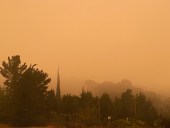
But kids on jungle gyms will smile for the camera at the slightest invitation. Search for urban parks in your city and you might be surprised to find tiny treasures. In San Francisco, also, almost anywhere you’re willing to climb upward will lead to another kind of park — glorious spaces with views and dogs and picnickers and more views. An unbeatable way to conclude a City Walk. Which brings us back to the vista from Alamo Square at the top of this essay.
This essay appeared earlier on Medium.com




 “You can neither lie to a neighbourhood park, nor reason with it,” wrote Jane Jacobs in The Death and Life of American Cities. Jacobs knew a thing or two about parks – and cities. These days we are learning things of our own about parks and cities, a mish-mash of the good, the bad and the ugly. Cities are where many of our hearts lie, but they aren’t so good for containing viruses. But parks? Parks are the totally good. You can’t lie to your neighborhood park because it knows the truth: I’m a space you need. That may not be exactly what Jacobs meant, but close enough.
 The park itself borders on Mountain Lake, a spring-fed lake from which the Spaniards, and Native American tribes before them, happily drank. But in the 20th century thoughtless pet owners dumped their turtles and goldfish into the lake, and the gunk and runoff from an adjoining stretch of Highway 101 finished off the job of turning it into a virtual cesspool by the 1990s. Because Mountain Lake is part of the Presidio though, now a national park itself, your tax dollars helped restore it to a haven for natural grasses, native fish and wildlife, and varieties of birds and waterfowl. Mountain Lake Park is approximately what I envision as paradise.
 Macauley and Mountain Lake are just two parks in just one city, which is blessed with dozens of others in between, of every size and imaginable variety. But maybe they represent our hope for the future: spaces with no entry fee, no barriers according to race, gender, politics or fitness level.

 But mostly we wandered the endlessly wandering streets. It was in Bruges that we perfected the phrase employed for so many years throughout so many other cities, from Chicago to Shanghai: “Let’s just walk.”
 My experience of China was one two-week excursion with the Oakland Museum Art Guild, which clearly makes me an expert on all things Chinese including its cities. So. While I loved the bustle (and the leafy former French Concession) of Shanghai, and marveled at the frenetic pace of both Shanghai and Beijing, Dunhuang stole my heart. Maybe because it’s been around since – oh, 2,000 B.C., there was something casually settled about Dunhuang. Everyone seemed to move more slowly, wrapped in the desert air, smilingly unconcerned with invading tourists, of whom there were not so many as elsewhere. When I asked one colorfully-dressed woman, through several bungled words and a lot of stupid gestures, if I might take a picture of her adorable tiny daughter, she grinned, pulled me to her side and insisted in a flurry of rapid-fire instructions to a passerby that he take a picture of the three of us, the toddler nestled happily in my arms. How could I not love Dunhuang?
 So I set out on my own, equipped with a map by which I planned to count bridges and a total ignorance of the Cyrillic alphabet. My secret weapon was the ability to approach perfect strangers, point to my map and say, “Dostoevsky Musee?” in my most beseeching Southern accent. Six or seven instructors in I wound up with a polite gentleman who suggested, in severe Slavic gestures, that it would be best if he lead me there. I would never otherwise have found the nondescript entry into the apartment where the great man himself lived his last months, a small but remarkable museum that leaves one feeling as if Fyodor just stepped out for a drink. I was mesmerized by St. Petersburg.
 A discussion about New Yorkers could’ve been a discussion of city people anywhere. My New Yorker friend argued that his compatriots are rude and insensitive. I said, “I can stand at the top, or the bottom, of any flight of stairs anywhere with my carry-on bag, and within 30 seconds someone will appear and ask, ‘Would you like help with that, ma’am?’ Never fails. People are people, just more densely so in cities.