Joining the MLK Day March

A FINE DAY FOR PEOPLE-WATCHING, SIGN-READING . . . & REMEMBERING

Marchers gathering on a sunshiny San Francisco morning (Author photo)

Walking shoes? Check. Sunglasses? Check. Enthusiasm? Check.

The annual Martin Luther King Day San Francisco celebration kicked off on a balmy holiday morning with a walk of a mile or so ending at downtown’s Yerba Buena Gardens, site of the city’s waterfall memorial to King. (Speeches, music, politicians, Check . . .) The march commemorates the 1965 Selma-to-Montgomery march; that one, though, was 54 miles.

(Author photo)

Sign-spotting was almost as much fun as running into old friends among the several thousand walkers. The sign above, waved with gusto by a four-year-old getting a free lift in his dad’s wagon, features an MLK quote, “The time is always right for doing what is right.”

Many of my favorites were on the T-shirts of young walkers, or piggy-back riders like this one testing the strength of another energetic dad (below.)

(Author Photo)

The event, co-sponsored by the San Francisco Interfaith Council for several decades, was held for the first time post-pandemic last year, but this year’s celebration brought out enthusiastic crowds and voices reminiscent of earlier, multi-thousand-crowd days.

MLK Day became a national holiday in 1986, celebrated on the third Monday of January. This year’s observance, though, fell on his actual January 15th birthday; King would have been 95.

Not to be outdone, I occasionally hoisted my own sign (Thanks, Alice Walker, for this good quote.)

(Friend-of-author Photo)

But I really wanted this one:

A Monument to Peace

AS ELUSIVE TODAY AS IT WAS FORTY YEARS AGO

Golden Gate Bridge seen from just below the Monument (Author Photo)

“We are grateful . . . for the infinite gifts of heaven and earth,” reads the inscription. It acknowledges “the true fundamental of the human soul that pursues the truth, implements the good, creates beauty and renews his will to step forward.”

The monument, installed in San Francisco’s Golden Gate Park in 1984, references the artist’s Buddhist path, or “way.”

“Great Nature” by Bundo Shunkai (Author photo)

“This way,” it explains, “brings about peace in mind and on earth by mutual understanding, encouragement and help . .” The carved stone replicates Japanese calligrapher and Buddhist priest Bundo Shunkai (1878–1970)’s “Great Nature.”

Its adjacent explanatory stone proclaims that it is “in recognition of the continued quest for world peace by all people.”

“Great Nature” dedication stone (Author photo)

The quest continues.

What Your Tote Bags Say About You

Do you really, really need one more?

I recently, happily became a Friend of Medium, which comes with a limited edition tote bag. I’ve actually been a Medium friend for several years — it’s a great platform with interesting writers and readers — but now I’m a Friend, capital F. That is to say, I increased my membership fee.

It’s not a ton of money in the grand scheme of things. I like the fact that now I can send stories, via Friend Links, to non-member friends who have long grumbled from behind the impenetrable paywall, and Medium writer friends will benefit from my attention to their stories.

But I asked them to hold the tote bag.

Not that I don’t love tote bags!! Cloth bags, canvas bags, reusable paper bags. Grocery bags, destination wedding swag bags.

But I can’t throw them away. I have, by rough estimate, 572,364 of them. I think there is a law somehwere prohibiting the disposal of a reusable bag — even for people who don’t live in California.

Here’s the inescapable truth: your life is in your tote bag collection.

This may be why, other than fear of criminal indictment, you can’t throw them away.

Speaking of criminals. In a very long history of parking my car in sketchy areas of San Francisco, only one time did thieves break in. I know enough never to leave ANYthing in a parked car. But a canvas bag containing a few of my favorite canvas bags, just so as never to be without a bag? Who’d have thought. Sure enough, some evildoer smashed my back window and snatched my bag of bags. Hopefully they are still in circulation . . . somewhere.

When toting stuff around on miscellaneous errands my mind often drifts toward existential questions. Foremost among these is the speculation that today’s endless catastrophies often feel like the End Times.

But somehow, if the planet implodes or whatever weary planets do, I have a sense that our tote bags will survive — relics to be pondered over when some new civilization looks back on us eons hence.

Maybe I’d better get the Medium Friend Tote just in case.

World Peace – for a Couple of Hours

Thankfulness in every known faith tradition, a peculiar blessing

Photo by Anne Nygård on Unsplash

There it was, peace on earth: Jews, Muslims, Protestants, Mormons, Catholics, Buddhists, Brahma Kumaris and assorted others hanging out together around bountiful breakfast tables and offering prayers in every known faith tradition. . . beginning with an Ohlone Prayer in the Four Directions because “we acknowledge we are on the unceded ancestral homeland of the Ramaytush Ohlone . . .”

OK, it’s San Francisco.

But in addition to all that doom loop stuff you’ve been reading about, in the City of St Francis there is a powerful interfaith community that works and shares and agitates for good even when it’s not being called upon to fight a specific instance of antisemitism or racial violence or Palestinian hate (or homelessness.) The several hundred gathered for this purely celebratory event were members and supporters of the San Francisco Interfaith Council, now in its 35th year.

Photo by Joshua Sortino on Unsplash

The 23rd Annual Interfaith Thanksgiving Prayer Breakfast happened in the early morning of Tuesday the 21st, and for those few hours there was peace. And a lot of joy, some hearty group singing, minimal politicking (in San Francisco, politics manage to sneak in everywhere) and a closing song with accompanying harp.

In the beginning: after that acknowledgment was read, local Ohlone Andrew Galvin (whose day job is curator of Old Mission Dolores) explained he was not of the Ramaytush Language — Ohlone tribes of old identified with the separate languages they spoke — but it mattered not. Galvin helped us express gratitude to the grandfather spirits of North, South, East and West — plus Earth and Sky. How can you miss?

Prayers for the meal (“saying grace,” in olden-days terms) were offered by Islamic School teacher Kashif Abdullah, Methodist pastor Staci Current and Rabbi Amanda Russell.

Speaker Emerita Nancy Pelosi (Author photo)

Politics only mildly intervened, with Nancy Pelosi — referred to among this gathering as ‘Speaker,’ and don’t bother with the ‘Emerita’ — quoting a little scripture and a little St Francis. Plus, the Mayor spoke, because that’s what mayors do.

But about that closing song — “Blessings Upon Blessings ” — a solo/sing-along which has been traditional for this occasion since long pre-pandemic. The singer was my Brahma Kumaris friend Sr Elizabeth, whom you might have seen onstage as Snow White in Beach Blanket Babylon a few decades back. She has the voice of an angel, even when not accompanied by a fellow Brahma Kumari harpist.

The author with Brahma Kumaris friends Sr Sukanya and Sr Elizabeth

I could be a Brahma Kumari — if I could sit still long enough. They believe in stillness and meditation and peace, plus, they have women leaders. As a finale to this event Sr Elizabeth’s traditional send-off captured the spirit of the occasion:

“Blessings Upon Blessings” is about being friends, understanding one another, living in peace, all those quaint notions that appear from time to time as possibilities. This was just one time to celebrate possibilities, among a multitude of good folks from a multitude of faiths.

I’m thankful for the celebration, and the multitudes.

Super Moon, Super Blue Moon

A SUMMERTIME OF MOON WATCHING COMES TO A SPECTACULAR CLOSE

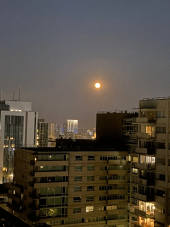
The Super Blue Moon, after shining spectacularly over San Francisco Bay and the surrounding mountains and countryside, continued doing its spectacular thing as it soared majestically over my skyscraper neighbors. The sight above was glimpsed from the roof of my building.

A spectacular summer’s end for the moon.

My summer began with this moon over Decatur, encircling itself with a gauzy Georgia haze.

And later, an August moon shone over Montana’s Bridger Mountains, clearly trying to outdo itself.

Speaking of which . . . when it appeared above St Mary’s Cathedral, as seen in mid-summer from my balcony window, the moon or the phone or an eerie phenomenon (I choose that last) created a nifty blue dot as a prophecy of moons to come

And sure enough, the Super Blue Moon, in all its brilliance, rolled across the late August sky.

Good night, moon.

Treasures With A Thousand Faces

WHAT MATTERS AFTER ALL: ALMOST A CENTURY OF FRIENDS

(Written in response to a Medium.com invitation to write about one’s treasures)

What would you grab if you had ten minutes before a coming disaster?

In earthquake-prone, wildfire-wary California, this is a sometimes parlor game. More than once, I’ve used it as an icebreaker or had it come up in conversations with friends and strangers alike.

I think: My passport? My laptop? My cellphone? But invariably, I go back to the now-famous Guest Book Collection. I would grab the guest books.

When I married my Final Husband, sometimes referred to as the Last Best Husband, a few decades back, I moved from a lifetime on the east coast into the San Francisco Victorian he had bought twenty years earlier. He had had no siblings or close relatives, and though he’d been married before had never had children. But he had friends around the globe. I had more relatives — children, grandchildren, sisters, cousins — than could be easily counted, plus friends scattered everywhere myself.

We needed space. So the first major project we undertook was to convert the ground-level area behind the garage into a guest room with a small kitchen and bath. It was seldom empty for the next quarter-century.

A favorite niece started this tradition: as a wedding gift, she personalized a small notebook, transforming it into a guest book. It began life in the upstairs extra room of the Victorian, moving happily into the downstairs mini-suite within a year.

Guests were invariably greeted with a hug and an admonition: “If you leave without signing the Guest Book on the coffee table, you may never be invited back.” To a person, our guests obeyed.

They also quickly got creative. The book became the repository of reflections, photos, poems, cocktail napkins, ticket stubs, playbills, and more. As soon as Guest Book #1 was filled, it was succeeded by #2 — and by the time we downsized, the stack had grown to include Guest Book #6.

The little books came to tell the story of a happy marriage: illustrations by grandchildren, notes from favorite friends — they also grew to include pages for parties or special events, when I would invite everyone to sign with a name or a comment. My son and daughter-in-law came for my MFA graduation. A Parisian friend pasted in a photo from a trip we’d shared . . .

They’re just books, most costing less than $10. But they hold images and remembrances of literally hundreds of people I love.

And having those people in my heart? Priceless.

Watching an Urban Mall Die

Downtown America stares into a challenging, unknown future

Westfield Mall’s main entrance on a Saturday afternoon

To be clear: I love San Francisco. I love Union Square. I love Market Street, the whole every-shifting stretch of it from the Ferry Building southward through the gritty blocks of too many drug deals and doorways inhabited by the down and out. Of course I particularly love the beautiful parks and hilltop views of the Pacific Ocean or San Francisco Bay, the museums, the stately homes and funky ones, the great food and most of all the people. San Francisco people, despite the influx of too many rich and techie, are still a wondrous mix of every color, creed and national origin — not to mention political opinion, which few citizens of San Francisco are shy about expressing. To be further clear, I never loved malls. I spent a lot of time in them in the 1970s and 80s, the glory days of retail when I was writing for (among other somewhat more interesting magazines) National Real Estate Investor and Shopping Center World. I would often spend a week or so before a major mall opening just hanging out, gathering details, interviewing store managers and PR people. Fun times for a writer!

Looking down on near-empty escalators from the top of Nordstrom’s multiple floors

In the glory days of malls there were innovations such as waterfalls and lush greenery. In downtown San Francisco, Westfield (originally San Francisco Centre) boasted a spiral escalator connecting the multiple floors of anchor store Nordstrom with the Market Street entry floor and a top-floor restaurant. On opening day in 1988 this was the nation’s largest Nordstrom store. And despite my anti-mall proclivities, I loved Nordstrom from the moment of my arrival in San Francisco in 1992. But it’s closing now. There’s a lot of sadness, though little surprise. Inside, there are theoretical sales designed to keep a few customers coming, but for the most part the closing is in full swing. Plywood sheeting and yellow tape are scattered everywhere. It’s hard to imagine that the smaller shops on each floor will survive. Or Westfield Mall in any form.

Many of the smaller shops have ‘gone dark’

Westfield Mall is hardly an exception. Since the glory days of the 1980s, when some 2,500 malls dotted the urban/suburban landscape, that number has dwindled to around 700. One estimate is that only about 150 will still be around in another decade. Which leaves both sadness and an uncertainty tinged with a tiny excitement. Something new will evolve. As in many other cases, the pandemic helped hammer in the nail of Westfield’s coffin. But more nails were provided by the city’s struggle to find solutions to homelessness and drugs on the street. Increased security presence can’t really stop the ever-growing problem of thievery.

Not-so-busy Security guys

I’m not saying goodbye, only farewell. Downtown San Francisco will return. And here’s a rebuttal, meanwhile, to all that bad press: The waterfront is still a wonder. The Ferry Building and its surroundings remain a great place to spend the day. The parks and museums and tree-shaded hillsides are still unequalled for urban strolling. Shopping areas like the Fillmore, Polk Street, Hayes Valley, Potrero, the Mission, the Castro are scattered everywhere and are still enchanting. The Presidio is a national treasure. History is just around every corner. Do you really travel the globe just to visit another mall exactly like the one at home? Downtown San Francisco won’t come back as it was. Change happens. Change doesn’t happen overnight. But when the city’s core does revive it may well be more interesting, more vibrant and more inviting than the 1980s mall scene ever imagined.

Walking out the door, into the cool, sunshiny summer air, I had no shopping bags but a lot of memories. Give us time. San Francisco has risen, all new, from the ashes before.

People-Watching at the Museum

VIEWERS CAN SOMETIMES BE AS INTERESTING AS THE ART ON VIEW

(View of the water, and Holocaust Memorial, from in front of the Legion of Honor Museum)

People-watching at its best: looking at strangers looking at art!

I visited San Francisco’s beautiful Legion of Honor Museum recently just before the opening of the next big show — The Tudors: Art and Majesty in Renaissance England opens June 24 to great fanfare. Between shows is a fine time to avoid the crowds, enjoy the rest of the art — and people-watch.

At this more leisurely time you can find a fascinating mix of the casual and the hard core viewer.

(Close examination of Mary Cassatt pastels)

The hard cores are easy to spot. They include members of the Close Examination school who push the boundaries of musuem-advised social distancing by studying selected works up close and personal. 

Also among the hard cores are the Group Discussion clumps. They are inclined to hang out in front of a particularly intricate work and discuss every possible tiny detail until you wonder if they might have rooted themselves to the floor.

(Intense group discussion underway)

Group discussion clumps are frowned upon (and generally impossible unless they are with a docent) in the major shows. But when the galleries are sparsely populated you’ll find these groups standing, pointing, arguing, laughing and enjoying the art, which is, after all, what museums should be about.

Somewhere within a hard core/casual mix are the families — who particularly enjoy a museum in between major shows because they have the place pretty much to themselves. If nobody’s around to bother you, it’s open season on shouting about displays and putting your nose to the glass.

(Introducing baby sister (barely visible) to ancient art)

But often the casual art watchers are the most fun of all to watch:

(Casual viewer taking an art break during a bike trip)

This one was biking to meet some friends but took a detour to see the small show of recent works-on-paper acquisitions. “It’s the best part of my day,” he said in a museum-quiet voice; “any time I can stop by the Legion.”

(Lone looker in the Porcelain Gallery)

Also having a lovely day was this solitary visitor to the Porcelain Gallery, studying the Worcester teapots. Having the whole place to oneself is a secret treat not common to museum-goers.

But for this people-watcher, here was the prize:

(A little art, a little fashion)

Carolyn Hadley, spotted in the museum cafe with her mom, had chosen a place mat to take home so she could continue art-watching at her leisure. It was hard to switch the eye from one artwork to the other. But Carolyn, in her museum-quality dress, holds the promise of a bright future for art and people-watching alike.

1 2 3 4 5 6 16