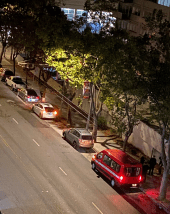
(All photos by the author, from her 7th floor balcony across the street)
A city dweller is alarmed by the terrible sounds drifting into her window. Dark, guttural cries. No words, just frightened, frightening cries. They seem to be coming from below ground, probably the stairs that go from the sidewalk to an entry into the garage of the building across the street, below her seventh-floor balcony.
Finally, the watcher calls 311. 311 is unquestionably the best thing the City of San Francisco has going for it. An actual, real person answers your call, and sends it to the appropriate other real person. “Someone’s in distress,” says the caller, watching (and holding the phone out) from the balcony window. “It’s been going on for some time and I’m worried about him.” Within minutes a red van and a white car quietly approach.
Four men get out of the van. They begin talking in soft voices to the stranger in distress. The watcher only picks up occasional words, but it’s clear they are trying to talk him into coming up. He’s no longer shouting.
Eventually, a forlorn figure emerges from below. The would-be rescuers gather around him, keeping far enough away that he won’t be frightened further. For 10 or 15 minutes they plead with him to let them take him somewhere for shelter, perhaps medical attention. He is having none of it.
Finally the figure shuffles off into the darkness, into the streets of the city which are, the watcher suspects, his only familiar. The red van and the white car drive away. The watcher goes back inside her warm apartment, feeling grateful for her city’s resources, but sorrowful for humankind.
I’m simply in love with the San Francisco Main Library. Yes, THAT library, with the rotating cast of questionable characters on one side and tent encampments on another. But how about the gleaming dome of City Hall lending a little majesty to the third side, just across the street from the proper front door?
City Hall from in front of the library (Author photo)
It’s more of a crush, this thing I have with the Main. Presidio Branch was my true love for decades. It took some wrenching away when we finally broke up, after I downsized to the Western Addition’s neighborhood. But one should love one’s neighbor, and Western Addition and I have built a respectable relationship. It’s far more multicultural, as this new love offers affection in Chinese characters that Presidio barely knew. Plus, proud little Western Addition stakes its sixties-funk architectural claim to my affection in defiance of the multitude of branches in the classic Carnegie style. (Is there a Carnegie style? Well, Carnegie money built a bunch of those lovely branches. They’re just a few of the 1,689 libraries Andrew Carnegie built with his accumulated millions. Hardly an admirable man, but you’ve got to appreciate all those libraries.)
Old meets new: Computer monitors & books – books are forever – & Carnegie architecture at Noe Valley Branch (Author photo)
The Main, though, behind its politely classic exterior, has nothing but shiny, multi-floored open arms waiting for love. I mean. Not only the real people just sitting there ready to answer your questions or check out your books, those smiling faces also featured in my other librarian loves. Free wi-fi, with nobody spilling coffee on you! But at the Main are multi-story stairs descending (or ascending if you really want exercise) into floor after floor of collections and attractions. When this brief story appeared on another site (I get sidetracked onto Medium.com) one reader observed, about elevators at the Main, “You can’t get there from here.” I think the architect just intended for everyone to roam. Talking Books & Braille Center on the 2nd floor. Deaf Services Center on the 1st. Music on the 4th floor, History on the 6th. LGBTQIA on floor 3, Jobs & Careers on 4. What’s not to love about The Main Library of San Francisco?
Real people checking out real books! (Author photo)
Altogether, the Main is magic-making. Professor Harold Hill, though he might not find his Marian the Librarian, could stage a Music Man for the ages in the heart of downtown San Francisco. I’d be first in line for auditions.
“Cupid’s Span” by Claes Oldenberg (Author photo July 2022)
While the art world mourned the recent death of Claes Oldenberg (1/28/1929–7/18/2022) San Franciscans went right on appreciating his local work the best way we know how: resting on the green grass of its base, dog-walking all around it, sitting meditatively near its bow while gazing across the blue waters into brilliant blue skies . . . Or maybe driving home across the Bay Bridge and smiling at a familiar marker in front of the skyline. Just one more joyful, unique piece of a unique city.
I want to believe Oldenberg would be pleased. While I never met him (though I did happen to see him at the Guggenheim in Manhattan one day and edged around nearby as if we were really best friends) I think anyone who could create great art from a minds-eye view of hamburgers, typewriter erasers, men’s ties and birdhouses — just to name a few — had to have had both genius talent and a whimsical view of the world. For years he collaborated with his second wife, Coosje van Bruggen (who died in 2009) on works such as Cupid’s Span. Ours is one of a number of massive public sculptures in cities across the U.S. and the globe — “Free Stamp” in Cleveland, “Dropped Cone” (as in ice cream cone) in Cologne. Cupid’s Span remains this writer’s favorite.
Author photo taken at San Francisco Museum of Modern Art, 2019
Cupid’s Span, which commands a territory on the Embarcadero at the foot of Rincon Hill, was a gift to the city from Gap founders, art collectors and Oldenberg admirers Don and Doris Fisher. They commissioned the 70-foot sculpture in 2002 when historic Rincon Hill was beginning one of those often-in-San-Francisco rebirths. As anyone old enough to remember those times will attest, some people loved it, some hated it, but almost nobody had no opinion. On a Commonwealth Club city walk a few years after Cupid’s Span settled in this writer heard a tourist comment, “I know exactly how he feels.” Which was an enigmatic statement too good to explore.
Author photo, July 2022
According to Cupid’s Span’s own Wikipedia page, “the piece resembles Cupid’s bow and arrow, drawn, with the arrow and bow partially implanted in the ground; the artists stated that the piece was inspired by San Francisco’s reputation as the home port of Eros, hence the stereotypical bow and arrow of Cupid.” Rest in peace, Mr. Oldenberg, and thanks again from the City of Love.
You can easily walk by it and never notice. But if you look up into the six eucalyptus trees planted more than a century ago by namesake Mary Ellen Pleasant, you might want to look down at the plaque that marks San Francisco’s smallest park. Worth a walk-by if you’re ever in the city.
Mary Ellen Pleasant Park (at 1501–1699 Octavia Street) comprises, in total, six giant eucalyptus trees and a concrete plaque adjacent to the sidewalk — all of which measures less than an acre. Nevertheless, the small green space still offers the best of park qualities: quiet shade, vistas (if you look up,) and a unique piece of San Francisco history. The park is a small stretch along Octavia Street between Bush and Sutter.
Its namesake, though, has an outsized story.
Author photo
Ms. Pleasant’s mansion no longer graces the property, but her spirit remains. It’s a spirit of freedom and entrepreneurship, enduring questions — her story is a mixture of legend and fact — and the remarkable effect of one woman on her time.
Born in Georgia in 1814 — most likely into slavery — Mary Ellen Pleasant had her way to Boston and/or Rhode Island before her adulthood. Over several decades there she married an abolitionist and several subsequent others.
She worked tirelessly with the underground railroad. And by the time the hazards of that activity prompted her to come to San Francisco, sometime around 1850, Pleasant was an accomplished cook and housekeeper, and those were for many years either official or unofficial employments. But her first husband had left her a substantial sum of money and she was, meanwhile, investing shrewdly and increasing her wealth through businesses — laundries, restaurants, brothels, boarding houses — and reinvestments.
Pleasant established black schools, fought for rights for blacks as well as Chinese, brought the underground railroad westward, became a behind-the-scenes political powerhouse and a friend of John Brown, established the 1,000-acre Beltrane Ranch in Sonoma County, co-founded (possibly) the Bank of California and earned the title of California’s first Self-Made Black Woman Millionaire. She left the mansion (replaced later by what is now the Healing Arts Building) for a six-room apartment on Webster Street which would be her home until she died in 1904.
Watching the news, as some of us compulsively do, is hazardous to my optimist health. The virus may be in retreat here, but death and destruction overseas overshadow all.
Still: sunflowers in shop windows, blue and yellow everywhere. Flags, banners, whatever anyone finds. Two women, one in a blue coat, the other in yellow, walk arm in arm just ahead of me. A friend with an overseas relief nonprofit says everyone she knows is putting in 18-hour days — without complaint.
Author photo from across the street
San Francisco City Hall has gotten into the act. From Symphony Hall across the street, I listen to soaring music before walking back into the blue and yellow glow. Optimism survives.
Wisdom is afoot. Well, actually, underfoot. Celebrate peace, seek justice. Make love, not war. Be here now. Those are three of my favorite etched-in-the-sidewalk messages so far. They may not cover everything, but it’s a good start.
A confirmed cloud freak, I am constantly staring at the sky. But in between sky-watching episodes I like to study the sidewalks. It may have started the day I noticed, etched into the California Street concrete, this cryptic message: I love you anyway. How many stories could be written around those four words? If the sidewalk and its message had not shown the wear and tear of many feet over many years I might have been frantically knocking on doors for the full story. Why was someone kneeling over wet concrete, carefully carving those four words into eternity? What went on between the two of them?! Or were there others involved here? And is he or she still loved, anyway? Maybe there was a happy ending. One wants to believe.
Sands of time, circa 1993
Most of us have seen or done the traditional sidewalk declaration – two names encircled within a heart. Or “Jamie 12-14-08,” – whatever child happened to live in the house above at the time of new sidewalk installation. Tiny handprints or footprints immortalizing some now teenager. It happened in front of my new old (1905 Victorian) San Francisco house in 1992 and 1993 as renovations required tearing up and replacing sidewalk squares. For the record, the San Francisco property owner whose pipes are being replaced, or whose tree roots have buckled the concrete bears the cost of the new squares. In 1993 that came to $50 per square. Therefore, when the concrete people told me to stay away from their smooth surfaces I smiled politely and reminded them of how much this job was costing us. And as soon as they drove off we went to work. My two eldest grandchildren, then about two & three years old each contributed a toy (dump truck for the grandson, horse for the granddaughter) to embed beside their footprints. We sold the house in 2013, but the memorial sidewalk squares remain. They are carefully supervised by the current owner, whose three children have now scratched their own names into nearby sidewalk sections.
Black Lives Matter Plaza in Washington DC
Sidewalk etchings combine the historic with the enigmatic: Everything will be OK, for instance, will remain a favorite of mine – as it certainly was on walks throughout the pandemic. Across the country from that one was an all-caps query that took up almost one entire sidewalk square: IS THAT SO? it asks. On that same visit to our nation’s capitol, I paused to do a selfie with Black Lives Matter stretching across the plaza behind me. But it’s my walking-shoes-clad toes that appear in the majority of the other photos in my Sidewalks album. Including the philosophical: If I cannot do great things, I can do small things in a great way. That one took a lonng time, as anyone who’s ever worked in wet concrete can affirm. Someone also spent a long time on the careful scripting of Love Thy Neighbor plus a few hearts etched onto a downtown city sidewalk where a lot of homeless neighbors currently live.
A small thing done in a quasi-permanent way
With the advent of colored chalk, sidewalk wisdom took on a bright new life. On one San Francisco block, where the lack of rain guarantees a fairly long sidewalk-shelf life, a collection of drawings and slogans appeared virtually overnight. It had to have been a group effort – a group advocating for reproductive rights, adoption, contraception and peace, in no particular order. But as the peace signs were prominently scattered among symbols for ovaries and women’s rights, this group doesn’t seem to want to go to war over the issue(s.)
Photographing sidewalk wisdom in the sunshine
But San Francisco’s “Slow Streets” campaign brought things to a once unimaginable new level. The campaign closed multiple blocks of streets throughout the city to vehicular traffic (excepting bikes and skateboards and assorted other people-movers.) This opened up miles and miles of pavement to kids of all ages. Presumably the illustrations that quickly covered long stretches of macadam are mostly kid-driven (the skill level seemed roughly third grade; I hope I’m not hurting any community feelings here,) but adult-supervised just in case. Whatever the age, these 21st century street decorations skip all efforts to preach, argue, convert or grumble and go straight to optimism: hearts, smiley faces, love, joy predominate.
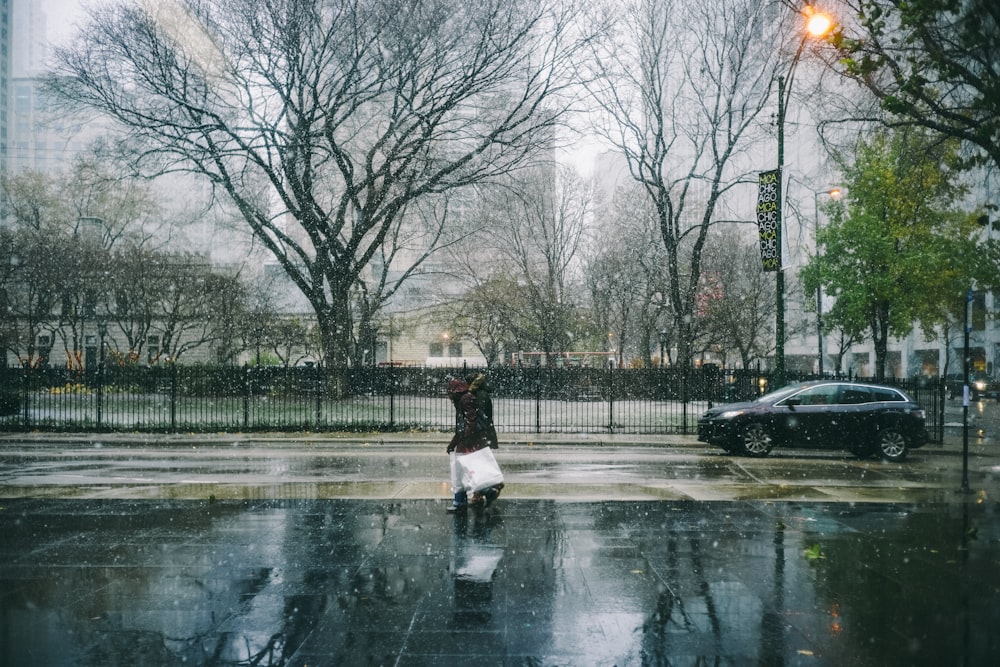
A walk in the rain! Among all glorious, inspirational, free things to do, I rank walking in the rain somewhere close to the top. I am admittedly a walking-in-the- rain nut; I don’t remember a time when sloshing along wet street and pathways, watching the ever-changing reflections, blinking away the water in my face wasn’t all-out delight.
Well okay, maybe not Hurricane Ida. There are differences between walking in the rain and trying to stay upright in a hurricane. As it happened, I arrived in Manhattan last September at the exact same moment as did Hurricane Ida. There being nowhere in the place I was staying to get anything at all for dinner – and because I just never turn on TV sets – I struck out in search of a pastrami reuben. Not smart. My 120-pound self was no match for THAT rain, and I barely made it back to the lobby and the streaming admonitions everywhere: Take Shelter. Stay Indoors. Stay Away From Windows. But I scored a pastrami reuben from one not-yet-closed shop. Walking in hurricanes and deluges is, for the most part, outside the scope of this essay.
The author preparing for a walk in her Do Not Hit Little Old Lady raincoat
Walking in today’s rains, if you’ve lasted through the parched months of the American west, is somewhat of a sacred experience: heightened rain appreciation. The trees drip heavenly mist. Delicately-scented moisture cocoons you. What can I say?
Nearing Rain Time recently, my friend Bob Dodge, who lives a few miles south in Portola Valley, began to despair. Downpours were predicted, but he waited throughout the night “for the sound of rain dripping from the oak leaves outside our bedroom window. Silence. I got up at right around 7:00, looking out to see overcast skies but no rain falling from those clouds. 8:00 came and San Francisco was hidden from view but the walkways were still dry . . . Where is the promised rain?!?” He thought first it might be that his fancy rain gauge on the roof was in the wrong spot, “but I am no longer allowed to go up on the roof of the house due to my advancing age.” At last report he was looking for volunteers to climb up onto the roof and move the rain gauge.
I have now checked in once more with the Portola Valley Rainman.
“The rains arrived in sheets and torrents and lasted for what seemed endless hours. Our total rainfall was about 8 inches, almost the total rainfall for the winter behind us,” he replied. I thought, knowing my reporter from the south pretty well, that he would have been out sploshing in puddles for sure.
“Alas, I did not walk in the rain. But I did walk this morning in Lake Dodge, which appeared on our garage roof during the storm. The primary drain was clogged with leaves and other debris and needed to be opened up else the whole roof might collapse. So this 85 year older got out the ladder, informed his wife of his intentions and climbed up to do his job as he has done for the past 51 years at this location. Mission accomplished. Ladder put away. Rubber boots removed and stored again. Back inside to refill my coffee cup before sitting down with my latest book. Life is good.”
“We’re calling about your claim,” the pleasant voice said; “about the hit-and-run collision you were involved in on March 17.” This is a really bad way to start your day. While I was still catching my breath the pleasant voice mentioned my car rear-ending the other car but then leaving the scene of the crime.
I knew, of course, that I’d not been in any collisions recently – the last being over a year ago when a 16-wheeler turned right from the center lane as I was turning right from the turn lane. The 16-wheeler won that one. But as my reaction had been swift; only the front of my car and the rear portion were demolished while I managed not to get demolished in the driver’s seat.
This is critical back story to the current episode: I lost my beloved, snazzy green 2000 Volvo S40. It was immediately replaced by a slightly less snazzy silver 2001 Volvo S40 with about 100,000 fewer miles and with my bank account about $4,000 lighter.
But my new old car was thoroughly repainted and sort-of like new, and my learning curve (I’ve declared myself too old to deal with gadget-filled computerized new cars) remained flat.
Hearing one’s insurance representative declare you were involved in a hit-and-run collision is, nevertheless, unsettling. I assured him they had the wrong car, that I didn’t think I’d even driven anywhere that day. That my trusty Volvo S40 lives in a locked garage in a building with 24-hour security and really doesn’t go out rear-ending other cars without my permission.
Would this not have been a good time to say, “Oh, sorry; we’ll fix that”? I felt so. Instead, I was referred the “the adjuster of my claim.” Then I was asked to make a recorded statement, after which I was asked to email photos of my car from all sides. Which I did. Thanks to its having been all painted and spiffed up when I bought it, the little silver auto was quite emphatic about being without a scratch. I, though, was not undamaged. Beginning with the spike in my blood pressure from the original call, continuing through a trip to the garage to make sure I wasn’t crazy, recording my statement which felt like pleading innocent in a court of law and doing a photo-shoot in the garage – there went my day.
Eventually I received a copy of the “pending” file with assurance that it would soon be “settled” and nothing would appear on my record. It noted that the Vehicle Identification Number of the car involved didn’t match my car’s VIN, and – by the way – the car involved was green, so clearly not my car. This is “actually quite common,” the adjuster assured me, which was not reassuring in the least. Since no one seemed inclined to answer my emailed questions, I finally called the adjuster to ask.
The accident happened in Oakland, across the Bay from San Francisco and you couldn’t pay me to drive across the Bay Bridge. None of the streets in Berkeley or Oakland make sense to me any more, and BART does. How did the other insurance company (the one covering the car that was rear-ended) get my insurance information? “Oh, the driver of the other vehicle probably wrote down a license number one digit off, or something; that happens all the time. We were just doing our job.” Would it not have been simple to check the VINs and immediately know the car involved was not my car? “A lot of times we do not have the VIN on file . . . We were just doing our job.” I wanted to check out my now secret suspicion that my old car had somehow been put back together and sold to a careless driver in Oakland, but by this time I did not want to hear once more that my insurance company – which will remain nameless here to avoid further damages – was just doing its job. Does its job not involve trying not to drive its clients nuts?