Smarter Scams, New Victims Every Day

frowny face

My “grandson” and I talked for a full several minutes before I determined he was no one I knew. Despite a few clues – my grandchildren don’t call me “Grandma,” his voice could have been the 21-year-old I hadn’t seen in nearly a year, but it wasn’t perfect – I found the caller convincing enough to trade three or four questions and answers before I hung up the phone.

“Grandson” never got around to the pitch. I want to believe I would never have fallen for a story that would separate me from several thousand dollars, but I surely could have. Today’s scammers – especially those preying on seniors or the socially isolated – are incredibly skilled.

One very smart senior in the San Francisco Bay Area was recently taken in by a call from a fake grandson – and had the courage to tell the story to the local newspaper. Retired physician/author Walter Bortz, who has a real and well-loved grandson, listened with shock and sorrow to an entirely plausible tale that wound up costing him $5,000. The “grandson” told of having had too much drink the night before, of drugs found in the cab he unfortunately took, going to jail, getting beaten up and having his nose broken. Then he gave the phone to a “police officer” who explained how bail could be arranged……..

Elements of the scam – eloquently told to local reporters by the victim – are widely used. The “relative” is often caught up in an arrest involving drugs and/or guns (through no fault of his or her own) and often in another state or country. The need is always urgent, to avoid some terrible consequence like jail time or to cover medical expenses. Transactions are made through prepaid cards available almost everywhere today. Once cashed, the money is impossible to trace.

It’s the meanness of these scams that is almost as bad as the financial loss. Rose, a young businesswoman, tells of her own grandmother getting a call from someone pretending to be Rose and spilling out a tale of disaster that had her grandmother frightened and sobbing. Long after the ruse was uncovered and explained – “I was calling my grandmother, saying, ‘Look! I’m here at my desk. I’m sending you a photo! ’” – the targeted victim was still in distress over the fears she had had for her beloved granddaughter.

JoAnn (a pseudonym,) a friend of this writer in Louisiana, fell victim – almost – to one of the oldest scams around. It began with an official-looking notice of her having won a Canadian lottery. JoAnn lives alone and has withdrawn from friends – but she plays the lottery; she thought one of her tickets had paid off. The notification included a “Certified check” for her seven-figure winnings. All she had to do was deposit the check, wire $1,279 to cover out-of-state taxes, and live in luxury. JoAnn was saved by an alert teller who had not seen her come into the local bank for a long time. The teller began asking questions about the sender, and JoAnn finally told her about winning the lottery. “If you don’t mind,” the teller said, “let me see if this check clears before you do anything further.”

My friend suffered not from financial loss but from the embarrassment factor. JoAnn was in tears by the time she got through telling the story over the phone. “How foolish did I look?” she said. “Suppose word gets around that I fell for such a thing. I have a PhD, for heaven’s sake.” The teller turned everything over to federal agents and it’s highly unlikely that word got around.

But word should get around. Bortz deserves high praise for going public, proving that no one is exempt from the possibility of being scammed. “I like to think that I am worldly wise,” he told The Almanac, “(and yet) I got snookered into this one. But I guess it shows that I’m a nice grandfather.”

Nice grandfathers, and grandmothers, and gentle people everywhere, are being targeted today. The Federal Trade Commission has a fairly complete list of current scams, and how to deal with them, on its Consumer Information page.

The schemes are old, the twists are new, the advice is age-old and two-fold: (a) Keep asking questions; and (b) If it seems too good (or even bad) to be true, it probably is.
Hobby Lobby, 1 – Women, 0

(This first appeared on Huffington Post)

It is hard not to despair.

A woman entering a clinic for personal healthcare now must wade through potential hordes of obnoxious strangers getting in her face with stuff – often angry stuff, often misinformed and always unrequested. Where is the right to privacy, to lead one’s own life without the interference of obnoxious strangers?

And now, a woman working for Hobby Lobby, or for that matter any other corporation headed by a religious fanatic who believes his employees must submit to his beliefs, can be denied healthcare coverage for the most basic, most personal reasons: the need to control her own body, to make her own reproductive choices and family decisions.

Following the Supreme Court these days is hazardous to one’s health.

But let’s hear it for Ruth Bader Ginsburg.

Ginsburg read the riot act to the five men – surprise, surprise, all of them were men – who dealt this latest blow to the women of America.

Saying that religious freedom demands “accommodation of a for-profit corporation’s religious beliefs no matter the impact that accommodation may have on third parties who do not share the corporation owners’ religious faith,” Ginsburg wrote in her dissent, is likely to wreak havoc. The havoc is only beginning. And only a small part of it will be the suffering of Hobby Lobby employees. No contraceptive coverage, no abortion coverage, no options, and – because we are not talking about rich people here – no justice.

One wonders. Are mandatory burqas next? Stranger things have happened than corporate CEOs whose religious sensibilities are offended by women’s uncovered heads. There are serious concerns that the ruling could lead to other corporations denying coverage for things that bother other religious groups – blood transfusions (Jehovah’s Witnesses, Christians Scientists), psychiatric treatment (Scientologists) for example.

Freedom of religion? Bah, humbug, Ginsburg says in so many words. “(Y)our right to swing your arms ends just where the other man’s nose begins.” She might more properly have said, “where the woman’s uterus begins;” because indeed the religion-guarding gentlemen are swinging directly at women’s guts.

Call it what you will – religious freedom, protecting the unborn, freedom of expression, social conservatism – the denial of women’s rights will always, eventually run up against the voices of women who will not be denied.

Thanks, Justice Ginsburg

The Intriguing Invisible Audience

The questions were sharp, incisive. The comments were poignant, sometimes wrenching, sometimes funny. But the really funny thing was that I couldn’t see a soul in the audience.

This was a recent talk and group discussion with the Senior Center Without Walls. I was on the phone in my living room, the moderator was somewhere else, and some 20 to 30 seniors – most of them old, if unseen, friends by now – were sitting comfortably in their San Francisco Bay Area living rooms. Who knew?

This particular discussion dealt with end-of-life issues, although I got in (with advance permission) an introductory plug for Perilous Times: An inside look at abortion before – and after – Roe v Wade, and my current soapbox about preserving reproductive justice. I talked briefly about my longtime involvement with Compassion and Choices, about the work of that excellent organization, and the multiple benefits of considering one’s own mortality before one’s own death is knocking at the door. From the various phones came personal tales – “My husband died exactly as he wished…” “one member of the family wanted to contradict what (the dying person) explicitly wanted…” And questions about what C&C can do (counsel, advocate, support) and even – every nonprofit representative’s favorite: “Where can I send money?”

Audience members come and go at will, during Senior Center Without Walls discussions, and the pretty constant beeping that heralded the comings and goings made the entire event feel like a free-wheeling open house. Which is, in fact, not far from the truth.

Senior Center Without Walls participants play bingo, read plays, join support groups for everything from low vision to LGBT issues, bird-watch (guided help with identifying the birds seen from your window) and share in adventures that range from armchair travel to sing-alongs.

I hope they learned a little from this discussion leader; I learned a LOT from the scattered seniors of Seniors Without Walls.


Good genetic news for geezers

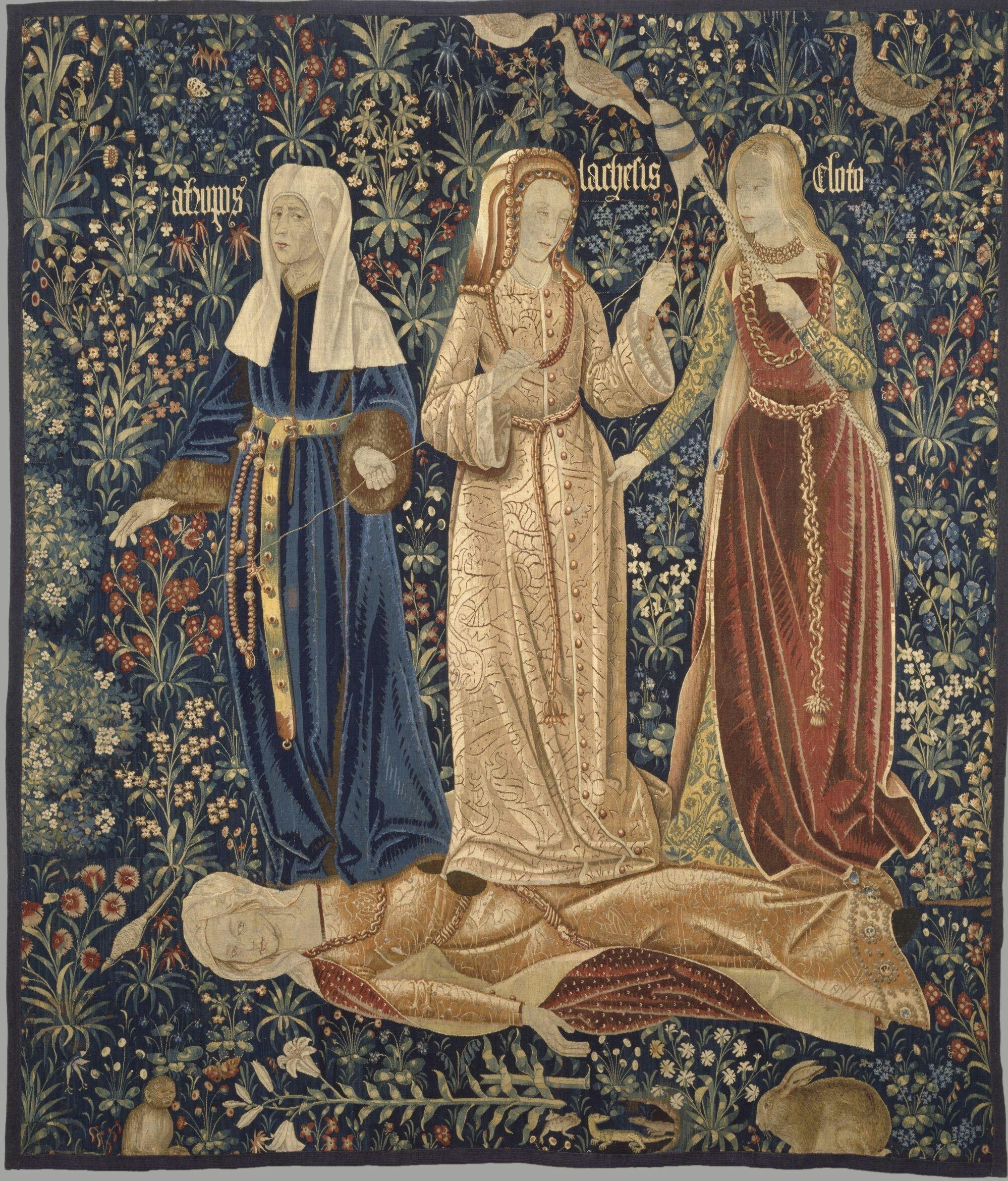
http://upload.wikimedia.org/wikipedia/commons/1/1a/The_Triumph_of_Death%2C_or_The_Three_Fates.jpg

The Three Fates, Flemish tapestry (probably Brussels ca 1510-1520) Victoria and Albert Musem, London. (WikiMedia)


Live longer, get smarter? We wish.

And this wish could some day come true, thanks to the gene variant KL-VS, whose friendlier name is the klotho gene. The klotho gene was already known to be associated with longer life. But a team of scientists at UCSF and the Gladstone Institutes, found that it also seems to make people smarter.

One in five of us has the klotho gene. As this writer is definitely older I had hoped to get in on the smarter, although I never cancelled the dementia provision of my advance directives. But in an interview with San Francisco Chronicle health writer Erin Allday Dr. Lennart Mucke, director of neurological research at Gladstone, said, “Klotho increases cognition but doesn’t replace aging-related decline. You’re just coming down from a higher level.” So much for immediate — or personal — optimism.

UCSF Assistant Professor of Neurology Dena Dubal was lead author of the study, findings of which were published recently in the journal Cell Reports. Dubal and Mucke say more studies are needed, but the  hope is that eventually klotho could help old brains — old human brains; so far we’re talking about mouse brains — function better.

This writer, having an old brain far too right-brained to follow neurological research very far, did at least complete several years of Greek at Randolph-Macon Woman’s College some years before Dena Dubal was born. But as my class notes are not handy I turned to Theoi.com, an online encyclopedia of Greek mythology, to find more about Klotho. (For the record, her name is more commonly spelled Clotho in classical texts, but most of all this pre-dates Spellcheck.)

Klotho and her sisters Lakhesis and Atropos where the daughters of Zeus and Themis, and in Greek mythology one couldn’t ask for better parentage. They were known as “The Fates,” or “The Moirai,” the goddesses who determined everyone’s destiny. According to Theoi, “They assigned to every person his or her fate or share in the scheme of things.” Clotho (on the right in the tapestry above) was “the Spinner,” who spun the thread of life. Lakhesis (in the center)  measured the thread of life and Atropos (on the left) cut the thread. Presumably they are arising from Themis; birthing in mythology was somewhat less complicated than today.

(It’s tempting to speculate on what it would mean to have too many Atropos gene variants, but that is going too far with all this.)

No amount of Googling turns up the scientist who named the KL-VS gene variant after Klotho, but he or she had an appropriate understanding of Greek mythology. If Klotho can indeed eventually lead to reactivating old brains, she will have spun us all a golden thread.


Ahead for women: good news & bad

The years ahead could be not good times to be a woman.

Childcare support? Abortion access? Equal pay? Contraception coverage?

How we will fare in the years ahead — those of us who are females of the species — is an open question; and some of the answers being bandied about are not pretty.

Paul Ryan’s budget would repeal benefits and protections currently enjoyed by millions of women, forcing us to pay out-of-pocket for potentially life-saving things like mammograms and cervical cancer screenings. Cuts in food stamps would hit women disproportionately, cuts in Medicaid would have a similar impact: women make up 70 percent of Medicaid’s adult beneficiaries. Prescription drug costs? Up, thanks to the re-opened Medicare drug coverage gap, the late and un-lamented donut hole. The list goes on, almost as glaringly as the list of benefits to the super-rich goes up. There are not a lot of women, especially single head-of-household wage earners, among the super-rich.

At a recent Planned Parenthood Shasta Pacific (CA) gala, former Michigan Governor and Current TV host Jennifer Granholm ticked off these and other ways GOP policies take from women and give to the super-rich. But Granholm, in a conversation with CA Attorney General Kamala Harris moderated by San Francisco Chronicle columnist Carla Marinucci, framed the opposing political policies as overall good news. With the GOP’s social and economic attacks on women in such sharp focus, she said, they can be seen for what they are — and defeated.

One can hope.

There are plenty of smart, honorable registered women Republicans. Whether they will worry about senior women having to pay more for drugs, or low-income women losing health benefits, or all women continuing to have to work three months more per year just to make what men make, that’s one of the questions still open. Reproductive justice? All women lose when reproductive rights diminish.

But at another meeting last week the focus was on distaff good news. The National Abortion Federation held its annual meeting, complete with continuing medical education for physicians, nurses and all those who will enable the progress and preservation of reproductive rights in the years ahead. This writer was fortunate to be invited to the Membership and Awards Luncheon, surrounded by extraordinary men and women including several award winners I am privileged to call friends. NAF President and CEO Vicki Saporta was among the speakers, and her report was one of optimism. My own optimism about the future for women in the US.is centered in three of the award winners whom I quite fortunately happen to know. They include:

Maggie Crosby, Senior Staff Attorney with the ACLU of Northern California, honored for her decades-long fight for reproductive justice — or, more accurately, her repeatedly successful fights for reproductive justice wherever it was about to be compromised.

Beverly Whipple, an extraordinary woman whose story — at least some small snippet of it — is included in Perilous Times. Whipple was leaving immediately after the NAF meeting for an extended motorcycle trip around Europe with her partner, but they slowed down long enough for a table-full of us to celebrate at the awards luncheon. More on Beverly Whipple in a few days.

Sarp Aksel, Past president of Medical Students for Choice and current Executive Clinic Chair of the ECHO Free Clinic at Albert Einstein College of Medicine in New York City. For those of us in despair about the future of abortion rights, Sarp Aksel is the face of hope. Bright, highly skilled and highly trained, and totally committed to women’s health and autonomy, Aksel is representative of the men and women determined to protect women’s reproductive rights.

Those who would take away women’s right to choose or ability to earn might well make gains for the super-rich in the near future. But they will have to contend with people like Saporta, Granholm, Crosby, Aksel and a host of other fighters for justice… including most of the women of America.

More on kindness…

This essay first appeared on Huffington Post

Some favorite people – okay, my daughter and daughter-in-law – recently posted a link to a heartwarming story from “Prank it Forward,” about a waitress who clearly deserved some good luck getting a LOT of it from her co-workers and friends: $1,000 cold cash, two airline tickets to Hawaii, a dream job and a new car. It was hard to follow without laughing and crying all at once.

Clicking around for the source revealed an originating site heavy into pranks of all sorts, apparently good-natured ones even if not always winding up life-changing good news for the prankee. The site originators seem committed to bringing moments of joy, and if there’s anything this world needs right now it’s moments of joy.

Clicking farther led to another site surely worth visiting, DoSomething.org. Over at DoSomething.org, members are doing things like collecting jeans for homeless kids, recycling cans to save the planet, or campaigning to stop bullying. You have to love the DoSomethingers. Their avowed purpose is “to make the world suck less.” This writer, unfortunately, can’t join them, as their members are between 13 and 25 and everybody over that is Old People in whom they are pointedly not interested. And who can blame anyone under 25 for that?

But it’s still the personal random acts, those small kindnesses anyone can do and no one organized, that most warm this writer’s heart. The little things: picking up the neighbor’s overturned trash can, handing the grocery checker a $20 for the food stamp buyer behind you in line, giving away roses from your garden, sending a snail-mail note to a perfect stranger in a nursing home.

Catherine Stern, co-founder, with Carole Mahoney, of Project Grace and herself an act of kindness, shared one such story about a Project Grace participant. The young family had just moved into a new house in a new community when their three-year-old was diagnosed with a rare and deadly form of cancer, forcing them to spend long hours driving to the hospital many miles distant. They were faced with juggling care for their other young children alongside the overwhelming needs of the sick child. Every time the exhausted parents pulled into the driveway of their new home they worried about what the neighbors must think of their unkempt yard, overgrown with weeds and scraggly grass. But one day, coming home after another long and exhausting time at the hospital, they were astonished to see their front lawn fully landscaped, grass mowed and flowers planted by their unseen neighbors who had somehow learned what was happening with the new family in the community.

Which is what kindness is all about: the community of humankind.

The Guns-Everywhere Law Comes

This essay first appeared on Huffington Post

Some of my favorite people live in Georgia. Old friends, family, two gorgeous pre-teen granddaughters, some greatly beloved others. As far as I know none of them are currently packing heat — but it does look like everybody else in Georgia will be doing so if they choose, as soon as Gov. Nathan Deal signs the Guns Everywhere law recently passed by the Legislature.

Is this the new reality for American weaponry?

Photo Courtesy: Steve LaBadessa/ZUMA Press

Probably so. Those who hold the Second Amendment holy have a ferocity unmatched by all the peaceable kingdoms of the world combined. This writer, a peaceable Pollyanna if there ever were one, posted an essay suggesting stricter gun control laws might not be all bad several years ago on a news aggregate website. The response was immediate and overwhelming. Threats were made. So taking on the Georgia guns-everywhere legislation has little appeal.

Pieces of it, though, do invite consideration. The following is offered purely as food for thought.

For example, the law will not necessarily mean the worshipers in the pew behind you have brought along their AK-somethings — unless your church or synagogue “opts in.” Having sat on a few governing boards of religious organizations, this writer can only imagine the discussions ahead. They are not likely to focus on What Would Jesus Do. One appropriate comment did come from Episcopal spokesman Dan Plummer, who was quoted in a Los Angeles Times story as saying that allowing guns in churches was “bad theology.”

At kids’ schools? Why not. Schools will be authorized to arm their staff members. This assumes that staff members will be quicker on the trigger than recent school shooters, and hopefully will shoot the shooters rather than innocent others. Still…

If you want to hang out in a gun-free bar, no problem. Just find one that has opted out and posts a No-Guns-Here sign. Otherwise, the law is fine with your carrying a loaded Glock into a crowded bar, you are just not supposed to drink alcohol. This law, therefore, will be easy for all those teetotalers who like to go to bars.

Best news of all, for the 75.9 million people who go through Hartsfield-Jackson Atlanta International Airport every year, there will probably be a stranger packing a loaded gun nearby in case you need one. He or she is not supposed to go past the security people, but if it happens — and you know, gun-carriers can be forgetful — it’s only a misdemeanor.

None of this is to imply that the Georgia law is a bad thing! Please, NRA and gun enthusiasts don’t come after me again.

The Brady Campaign is still at work in Georgia.

Random Acts of Kindness

This article first appeared on Huffington Post

One particularly gray day, the kind of day writers have when their brains fog over and their vocabularies vanish, I had an email from the irrepressible Anne Lamott. Lamott is a longtime friend whose writing and gumptious spirit I greatly admire — but not someone from whom I would have sought literary endorsement in a million years.

“I can’t wait to blurb your book,” she wrote. Clouds vanished, vocabulary returned, book was soon published with a classic Lamott remark on the back cover proclaiming Perilous Times “rich in (the author’s) trademark blend of stories, history, knowledge and passion… an important contribution to (the fight for reproductive rights.)” Unsolicited kindness from a casual friend: an incalculable gift.

The kindness of strangers, though, is priceless. And might surely be a movement whose time has come.

Susan Johnson Nelson is up for starting the movement. She is also anxious to change the image of America and Americans from the ugly to the kind, as is her husband Andy. A few years ago the Nelsons traded in a comfortable life in San Francisco, where he was well established in a career in law, to join the U.S. Foreign Service. Having just completed a two-year tour in Managua, Nicaragua, he is now in an immersion program in Washington preparing for their next assignment in Hanoi. The Nelson family — which now includes 3-year-old Bode and 1-year-old Lake — is one you would want to represent the U.S. abroad. (The Nelson boys already enjoy love and adoration from fans on several continents.)

Susan Nelson decided recently to celebrate the Christian season of Lent not with the traditional giving up of one thing or another but with a daily act of kindness. Jesus would probably be fine with this. The inspiration actually came, she wrote in an initial social media post, from being on the receiving end of a double act of kindness herself not long ago. While negotiating the streets of downtown Washington with two screaming toddlers who had just received immunization shots, she ducked into a sandwich shop on a cookie diversion mission. A long queue of tired, hungry people let her jump to the front of the line (kindness #1), where the lady behind the counter smilingly offered not one cookie but two (double kindness #2.) Nelson’s first random act of kindness: a bouquet of flowers delivered to the lady behind the sandwich shop counter.

Others follow daily. They have included homemade cupcakes for Pete at the front desk, a basket of flowers painting by Bode for a post-surgery teacher, pick-up and delivery of recycling left in hallways (double kindness: gift to building residents and anger aversion for the maintenance workers who would otherwise have to deal with it.) There was babysitting for a friend in need, banana bread baked and delivered to the local firehouse. There was Andy’s kindness to Mother Earth, buying toothbrushes from all-recycled materials (hey, credit where credit is due; Andy also does extraordinary acts of fatherly kindness when Mom is wearing down) and on one dark and snowy Saturday morning both boys slept in until 9 a.m. — duly reported in the online exchange as a great kindness on their part.

The digital saga has also prompted reports of other acts of kindness elsewhere, such as the story of a woman with cancer, having her head shaved in a beauty salon as chemo-induced hair loss began and then finding her bill had been paid by an earlier customer.

They may be small acts of kindness, but who knows how large their effects? For many of us, frustrated with what seems the impossibility of world peace, tiny moments of joy bring renewed hope. It’s a start.

1 … 8 9 10 11 12 … 31