Ummm. About this robotic car business. Everyone says its day is near, and halleluia. Governor Jerry Brown, with a recent stroke of his pen, made it legal in California. According to the Los Angeles Times, driverless cars are already legal in Nevada anyway, and under consideration in Arizona, Hawaii, Oklahoma and Florida. (Further recent news from MVTrac suggests that if you fall behind in the payments on your robocar the repo guy might send a robotrack to snatch it back home. Clearly, people may become extinct.)
I am all in favor of driverless cars that allow passengers to catch up on business en route to that urgent presentation, or finish dressing the kids on the way to school. Computers are certainly less likely to kill me in the crosswalk than all the drivers loose in the land today who are eating hamburgers, concentrating on cellphone conversations or texting their buddies while I’m trying to cross the street and wishing they would notice.
But there are bugs to work out. Have the robocar people ever gone on vacation with two preschoolers who need to go to the bathroom right that minute? Do they have any idea how frustrating it is already to argue with the obnoxious GPS lady who insists you take Geary Blvd wherever you’re traveling east-west in San Francisco, when you know darned well the lights are timed on Bush and Pine? And can they figure out how to program a sudden rainbow, or the view of the beach just several blocks away, or even an aberrant pull-over to watch goats grazing in a field?
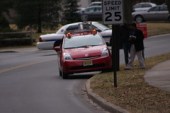
The Driverless Car Gets Stuck on a Curb (Photo credit: Melody Kramer)
The car manufacturing people say not to hold our breath for driverless vehicles. They’ll figure it all out, I’m sure, before this latest wonder comes to American roadways. But in case they need a consultant on really important details, I could make myself available. For a fee. And perhaps a drive down the coast.
Since about 1900, when the average lifespan for U.S. citizens was somewhere around 50, we’ve been pushing that boundary ever upward. Today, depending on exactly where you live and other factors like cigarettes and French fries, you can expect to hang on into your eighties and beyond. That’s fine with most of us, especially if our brains stay functional too – and therein lies the problem.
There is reason to believe, if neurological studies on worms prove out, that humans could live to be 300 with a little genetic tinkering. If you sign up for this, a possibility predicted by University of California San Francisco neuroscientist Dena Dubal, you might want to have Dr. Dubal and her colleagues nearby for your brain care.
At a recent luncheon in San Francisco, Dr. Dubal and fellow UCSF research scientist Wade Smith talked of the work going on in their labs as if it were simply what they do for a living. To a spellbound audience, however, it sounded more like miracle-making. “Just a little genetic tinkering.” Altering the aging process, staving off dementia… it’s all in a day’s work. A little extra Clotho (so designated for the anti-aging Greek goddess of the same name) blocked memory loss in mice, Dr. Dubal said; it’s reasonable to project that similar treatment might some day be made available to mammals.
This reporter came home, followed a few of those links and was quickly lost, which is attributable — in part, at least, we hope — not to short-term memory loss but to my degrees in Art and Short Fiction vs the very long list of degrees plus other academic and scientific credentials of Drs. Dubal and Wade.
For those of us already worried about the relentless increase in dementia among the 65+ population, the possibility of living to be 300 is not altogether good news. But fortunately our brains are the concern of the brains at UCSF.
Paul Krugman, Laureate of the Sveriges Riksbank Prize in Economic Sciences in Memory of Alfred Nobel 2008 at a press conference at the Royal Swedish Academy of Sciences in Stockholm (Photo credit: Wikipedia)
Paul Krugman says call it what it is: a depression. “A recession is when things are going down; a depression is when things are down, and stay that way for a long time.”
Krugman offered this opening comment to a sell-out crowd in San Francisco, where he was highlighting a Commonwealth Club event and promoting his new book, End This Depression Now. Ending this depression now is entirely possible, if you believe Nobel Prize-winner Krugman, and this writer believes Paul Krugman. Aside from in-house economist Bud Johns, who has accurately foretold so many economic events as to be spooky even if he hasn’t yet won a Nobel Prize, Krugman is the only living person able to make economic sense to my mathematically-challenged right-brained self. During his San Francisco talk he ticked off enough data to paint the picture — and it is not a pretty picture. Krugman compared the problematic impasse to a family car that had broken down. Its battery was dead. A new battery would make it run. But the man of the house refused to recognize the bad battery or consent to getting a new one, suggesting instead that the rest of the family just walk or take the bus. “You have a problem,” Krugman noted, “but the problem isn’t with the battery.”
So how to fix it? Before offering the answer, Krugman said first we have to understand that “government workers” aren’t the evil bureaucrats in Washington, but are the teachers, firefighters, service workers everywhere who are out of work, with their numbers threatening to be increased. Then he listed steps he would recommend:
First, a huge infusion of money (none of this timid stuff, which Krugman reminds us is what had FDR triggering a double-dip depression in the late 1930s) from the feds to the states, so they can start re-hiring those teachers and public sector workers.
Second: debt relief, starting with mortgage debt and soon extending to other areas like student loans.
Third — then we get into monetary policy, and not even Bud Johns and Paul Krugman can explain that to yours truly in adequately simplified terms.
So the national debt remains staggering and everybody worries about what we’re bequeathing our grandchildren. At least we might keep the country afloat, mass desperation relieved and families together, and that would be something to bequeath.
Paul Krugman did not approve this over-simplified message. But he still gets my vote.
Would soccer catch on in the U.S if our TV screens were bigger? Maybe so, but I still doubt it. Twenty-two — until you start tossing them out for misbehavior — guys kicking a tiny ball up and down a field at warp speed without even the excitement of racking up a goal in regulation so you can stop and catch your breath, or a commercial break so you can go to the bathroom, I’m just not sure soccer will ever make it in America. Of course, your TV screen is probably bigger than ours, which is OK. On the giant screens at bars and coffee shops all along San Francisco’s Fillmore Street Sunday there was an awful lot of hoopla. There may have been some business for the restaurant owners, but it looked like a great deal more hooping and hollering than drinking.
It is safe to say that this space has been into soccer longer than any other T/S space. Dating, actually, from the day that #1 son came home from hanging out at some local playground circa 1968, and we said, “You’ve been doing what? A round, black-&-white ball you just kick? Soccer moms had not yet been invented, but this one was, at that moment. Three kids, a combined total of about 36 years at a minimum of 2 or 3 games per week; you do the math. The in-house soccer dad coached so many of them that he and his co-coach had to coach the local high school coach, who had never heard of soccer until then either. But our scruffy, inner city team beat the hoity-toity suburban high school for the state title in 1970-something (it’s all a blur) so it was certainly worth it.
Pro soccer, though, that’s another whole deal. By now every kid in the U.S. has kicked around a soccer ball, half of them are addicts, and still they grow up to be non-fans. Go figure. I think it boils down to the screen size, the warp speed and the lack of bathroom commercial time.
And it’s too bad. The primary emotion I recall from about a century-worth of soccer-game watching was empathy: everybody felt sorry for the goalie’s mom. Didn’t matter if your team scored the goal, you still felt sorry for the goalie’s mom.
The world needs a little more empathy. Meanwhile this space has to quit typing and send condolences to our good friends in Amsterdam.
Radiation from the A-bomb test witnessed by my then-Marine husband in the early 1950s was registered on a small badge worn around his neck. They double-timed from foxholes toward the site of the blast. As far as we and the U.S. government know, all of those guys went on to lead long and healthy lives — and we went on to deadlier bombs anyway. We do now know a little more about those sorts of radiation damage.
We don’t know much about the tiny emissions from cellphones, iPhones, cellular antennas, texters, Skypers, whatever. The suggestion that any of those cyber-issues could possibly cause harm draws scoffs and derision and denials, but the truth is we simply don’t know. Some folks would still like to find out; maybe even find out before harm is done rather than after. An ongoing mini-battle in San Francisco is typical of such citizen struggles everywhere:
The increasing popularity of smart phones is pitting companies looking to expand their coverage against city residents concerned about the dangers presented by a growing number of cellular antennas.
Nearly every week, the city Planning Commission hears from a company looking to add to the thousands of cellular antennas already in the city. And, like clockwork, local residents turn out to fight the plans.
“These towers should be away from residences, away from schools and away from other vulnerable populations,” said Doug Loranger, who, as founder of the San Francisco Neighborhood Antenna-Free Union, has been fighting the cellular companies for a decade.
That’s not easy to do in a city as densely packed as San Francisco, where hills and tall buildings have long made radio transmission a challenge.
The crowds that jammed local stores looking to buy the new Apple iPhones last month demonstrate another part of the problem. San Francisco has a reputation as one of the most tech-savvy cities in the country, and the people buying the various new smart phones want fast and easy access to the Internet on their handheld devices, which means more demand for service.
This demand for service drives the rush to install more antennas and modify the existing ones. As long as they meet emission standards set in 1996, they are deemed fine, and cannot be challenged on the basis of health, a frustrating reality for potential challengers. Because that actually is the issue: whether — or at what point — emissions can indeed become damaging to one’s health. And though radiofrequency radiation emitted by the antennas has not been proven to have any damaging effects, activist Beverly Choe, whose children attend school near one such installation says, “it doesn’t seem prudent to add more radiation until we’re sure of the effects.”
“People want service where they live, where they work and where they play,” said Rod De La Rosa, a spokesman for T-Mobile. “We’re trying to roll out more high-speed data transmission by increasing the size of the pipe and not just for voice.”
T-Mobile is just one of the service providers looking to boost their presence in San Francisco. Just last week, Clearwire, a new company providing wireless data service only, came to the Planning Commission with requests to add antennas to existing sites in Bernal Heights and by San Francisco General Hospital.
“Starting last year, we’ve had a big increase in requests for modifications (of existing sites) and for new antennas,” said Jonas Ionin, who oversees cellular antenna requests for the city’s Planning Commission. “What we’re finding today is that the increases aren’t necessarily based on voice traffic, but on data downloads.”
The city already is home to 709 cell sites, some with as many as 12 separate antennas. Although many of the recent requests have been for upgrades and additions to those existing sites, there is also a growing call for new spots for cellular antennas, which means more battles to come.
Those continuing battles have one interesting aspect that other battles can’t always claim. No one is waiting to find out who’s right. “The funny thing is that people call me on their cell phones to complain about the new installations,” said Diego Sanchez, a city planner. We may all be addle-brained from telecommunicating before we find out where it’s coming from. A lot of us grew up in asbestos-infused schools and homes, and we’re probably all eating mercury-infused seafood (not to mention drinking petroleum-infused water); life is hazardous to one’s health.
Healthy San Francisco, the city’s healthcare-for-all program, remains firmly in place after the Supreme Court’s dismissal of a suit by the Golden Gate Restaurant Association last week. It may or may not be the model for everywhere else, but a lot of reassured folks here are happy with it. Many are also healthier in the bargain. PBS NewsHour correspondent Spencer Michels talked with several Healthy SF participants for last night’s report, while outlining how the program is working.
Until recently, San Francisco, a diverse city with a population of nearly 800,000, had more than 60,000 adult residents with no health insurance. They were not poor enough for Medicaid, nor old enough for Medicare.
While the nation struggled with reforming health care, this city began a program of its own that so far has enrolled more than three-quarters of its uninsured. It’s called Healthy San Francisco, and it is not, strictly speaking, health insurance. Rather, it’s a way to provide health care, but only within the city limits.
The plan was not particularly radical. It used mostly existing resources, like city clinics and nonprofit hospitals, to supply and coordinate care. Instead of flitting from one clinic or emergency room to another, enrollees choose a medical home, one of 30 public or private health centers in the city, where they go for low- or no-cost health care.
Once you choose your “medical home,” you can’t walk into another and get treatment. But the two Healthy San Francisco participants this writer asked (along with the patients and clinic directors Michel featured on the PBS show) indicate that customer satisfaction with the system — and with their one medical home — is high.
As to the costs, and who covers them, most San Franciscans other than the restaurant owners are fine with the plan. Restaurant-goers have gotten used to the friendly, small-print message at the bottom of the menu that lets them know an amount added to the tab goes to help pay for Healthy SF.
Each patient in Healthy San Francisco costs the city about $300 per month. That’s in line with insurance costs. It totals $126 million a year.
Depending on their income — and most are below the poverty level — enrollees pay nothing or from $20 a month up to about $200, plus co-payments. But that doesn’t pay for it all. The city has mandated that businesses with 20 to 100 employees spend at least $1.23 an hour per worker for health care, and that larger companies pay more.
That money can be used to reimburse employees for health care costs, to buy them health insurance, or it can go to Healthy San Francisco.
The Restaurant Association’s argument before the Supreme Court was not on Constitutional grounds, but rather that the city’s mandate that employers pay into the program violated federal law. The Court declined to deal with it all; the mandate stays. Susan Currin, CEO at San Francisco General, says emergency room use is slightly down. Director Hali Hammer of San Francisco General Hospital Family Health Center (one of the more popular medical homes) says they have hired new providers and expanded hours. The number of participants is growing at about 700 per week, and the Kaiser Family Foundation recently found that 94 percent of those participants are satisfied with the program. Paying that small extra amount for dinner out makes at least a few of us occasional diners-out feel a slight good-citizen glow. Something’s working.
New York City seems to be all aglow in being named by the World Health Organization to its Global Network of Age-friendly cities. As Clyde Haberman reported about the event in the July 1 New York Times,
“It makes us members of a club of people who are struggling, in their own and perhaps much different ways, with learning about and thinking about and approaching this issue,” said Linda I. Gibbs, the deputy mayor for health and human services. “It’s really a lovely recognition.”
One reason for the acknowledgment was a plan that city officials and the New York Academy of Medicine announced last year to improve life for older New Yorkers. All sorts of ideas were put forth, on matters like transportation, housing, health care, job training, nutrition and cultural activities. To a large degree, it was more a wish list than a concrete program. But at least it showed that the city was thinking about issues that will only become more dominant.
Like other cities, New York has a population that is aging, if you will forgive a somewhat meaningless word that we are stuck with. After all, everyone is aging. It’s called living. The only people not aging are dead.
WHO says, of its Global Nework of Age-friendly Cities, that the problem lies with the fact that too many of us are aging and not dying.
Populations in almost every corner of the world are growing older. The greatest changes are occurring in less-developed countries. By 2050, it is estimated that 80% of the expected 2 billion people aged 60 years or over will live in low or middle income countries. The Network aims to help cities create urban environments that allow older people to remain active and healthy participants in society.
To that end, the Network got off the ground a few years ago, and now lists a few cities across the globe as having been accepted for membership. This week’s bulletin (excerpted above and below) lists the Big Apple as the first U.S. member, although the PDF of member cities also lists Portland, and one has to wonder how Portland’s going to feel about all of New York’s hoopla.
The WHO Age-friendly Cities initiative began in 2006 by identifying the key elements of the urban environment that support active and healthy ageing. Research from 33 cities, confirmed the importance for older people of access to public transport, outdoor spaces and buildings, as well as the need for appropriate housing, community support and health services. But it also highlighted the need to foster the connections that allow older people to be active participants in society, to overcome ageism and to provide greater opportunities for civic participation and employment.
The Global Network builds on these principles but takes them a significant step further by requiring participating cities to commence an ongoing process of assessment and implementation. Network members are committed to taking active steps to creating a better environment for their older residents.
A few years ago (2006) the Sperling’s Best Places people came out with a “Best Cities” list about which do the best job of caring for their aging folks. The “Best Cities for Seniors” study examined the state of senior care in the 50 largest metropolitan areas in the United States.
“This is different from the usual studies of retirement living,” said Bert Sperling, the study’s primary author. “When we first retire, we have the energy for traveling and sightseeing. At some point, we will all need specialized resources and facilities to help us cope with aging. That’s what this study examines.”
This unique new study, produced in partnership with Bankers Life and Casualty Company, identifies cities that offer the best resources for less active seniors. The study analyzed nearly 50 categories such as various senior living facilities, comprehensive medical care, specialized transportation services, and a significant senior population.
Top Ten Cities for Seniors
Portland, OR
Seattle, WA
San Francisco, CA
Pittsburgh, PA
Milwaukee, WI
Philadelphia, PA
New York, NY
Boston, MA
Cincinnati, OH
Chicago, IL
Haberman takes issue with that ‘Senior’ word along with the ‘aging’ word. “What does that make the rest of the populace — juniors?” This space (an unabashed fan of Sperling’s #3 city — sorry, #7; but you’re my #2) concurs. But Great Geezer Towns probably wouldn’t cut it with WHO.
Can we have a functional, effective transportation system in the U.S.? Can we afford not to? Those were the questions addressed by former Secretary of Transportation Norman Mineta and a panel of experts at a full-house 9 AM event at San Francisco’s Commonwealth Club Friday. Oh — and how are we going to pay for it all? The program was titled “Funding the Transportation System of the Future.”
“Within the next two decades,” Mineta said in his introductory remarks, “the Census Bureau estimates that the U.S. population will increase by as many as 50 million people. This population growth, combined with a growing backlog of overdue maintenance work on roads and transit systems, creates a need for significantly expanded transportation revenues. However, the current political climate is generally unfavorable to tax increases.”
The ensuing discussion continually returned to two general points: first, that our parents and grandparents funded the transit infrastructures and systems we now enjoy and it is incumbent upon us to do the same for our children and grandchildren; and second, as Mineta and others repeatedly said, that there is no political will anywhere to do the latter. One illustration of the first point was cited by panelist William Millar, president of the American Public Transportation Association, who observed that “the New York subway system was built 106 years ago for $35 million — and you couldn’t get a feasibility study today for $35 million.”
Given the fact that most cities and counties could spend $35 million on overdue maintenance alone, most panelist comments and audience questions concerned the issue of finding funds at a time when tax increases are not very popular. “Creative funding” solutions appear to be the answer, even if there is currently far more creativity around than funds.
Asha Weinstein Agrawal, Director of the Mineta Transportation Institute‘s National Transportation Finance Center, cited a public opinion poll released yesterday (“one of those phone calls at dinner time…”) that surveyed 1500 people in English and Spanish to test receptiveness to eight variations of a possible gasoline tax. In general, opposition to such a tax is high, she said, but acceptance increases in proportion to benefits which individuals can see: tie the tax to emissions per vehicle and thus reduce greenhouse gases, for example. Agrawal recommended consideration of taxes linked to environmental effects.
Panelist John Horsley, Executive Director of the American Association of State Highway and Transportation Officials, said that because of funding cuts and declining revenues (from road usage fees etc), the U.S. Highway Fund will be insolvent some time between August and October of 2011, with the resultant loss of approximately 1 million jobs. He cited a few bright spots such as several states going ahead with high speed rail projects, “four states have actually raised gas taxes, Kansas has increased the sales tax, and New Hampshire sold itself a bridge” (which will get paid off through tolls.) High occupancy toll lanes were another potential funding source Horsley said could help until “fiscal sanity returns: investing in something good (rather than) borrowing forever.”
The consensus was aptly covered in one summation by California Senator Alan Lowenthal: “It’s a very difficult time for transportation.”
Whereupon this reporter got back on the #1 California Muni bus (catch a back seat, work on your computer for 30 minutes, no parking fee, no traffic hassle) and went home.