When the Glaciers Melt Away . . .

WATCHING THE PASSAGE OF TIME AT THE ENDS OF THE EARTH

Svalbard 2019 (Author photo)

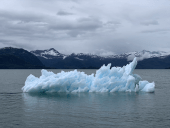
There were polar bears — though far fewer than we’d hoped; there were walruses and seals and the occasional reindeer or Arctic fox. But what took my breath away was the beauty: shimmering white and muted azure as far as the eye could see. 

I visited the Svalbard archipelago, between the coast of Norway and the North Pole, in June of 2019 on a trip sponsored by Climate One. Spotting wildlife and taking in the beauty of the scenery were high on everyone’s list, but the main purpose of the expedition was to see — up close and personal — what the warming climate is doing to this northernmost cap of planet earth. It is not pretty.

Everywhere were the signs of melting sea ice and shrinking glaciers. Probably the most dramatic moment of the entire trip came when we witnessed glacier calving, as a giant chunk of a nearby glacier sliced off and into the sea. (Climbing on land was its own additional reward.)

Hiking the Svalbard mountains (Author photo, 2019)

Today there’s an expedition underway — this one seriously scientific and definitely not for tourists — at the other end of the world. They are already gathering important data and with a little luck they’ll be able to leave instruments in place deep under the sea that can prove invaluable to climate scientists (and others) going forward.

I’ve been following independent journalist Miles O’Brien (you can too!) who is aboard the South Korean icebreaker Araon near the Thwaites Glacier in Antarctica. Thwaites is also known as the Doomsday Glacier, for reasons you probably don’t want to focus on right before you try to go to sleep. Hint: Thwaites is melting faster than we might wish, especially any of us living on a coast that would vanish under a ten-foot sea level rise.

It’s been several weeks since the Araon left New Zealand, and much success has been recorded, including arrival at Thwaites on a crystal clear day. But the weather didn’t cooperate long enough for helicopters stashed onboard to fly to the glacier itself and stay long enough for scientists to drill deep into the ice and position their instruments.

According to O’Brien’s latest interview with crew members, the window of opportunity will close in another three or four days. Those of us following along are crossing fingers and sending up prayers to the weather gods. The expedition won’t be a failure if scientists are unable to leave instruments on the glacier — but that’s the holy grail and everyone’s hope.

Remembering lessons of the North Pole seven years ago, and watching these fascinating scenes at the other pole in real time reinforces the bottom line to this observer: climate change is here; it’s happening. The more we know, the better we understand.

Meanwhile the current administration pushes ahead with policies to boost fossil fuels, cut funding for clean energy and renewables, eliminate environmental protections . . . as if there were no tomorrow.

Which will some day be true.

Truth Demands Our Attention

MURDER, INTRIGUE, CORPORATE GREED, CLIMATE CRISIS — THEY’RE ALL IN THIS REMARKABLE NEW BOOK. YOU MIGHT WANT TO CHECK IT OUT

Author Reyes onstage at Climate event (Fran Johns photo)

Your young partner is found murdered, his bullet-riddled body abandoned in a Venezuelan cow-field? You could be forgiven for falling apart, clamoring for answers and possibly seeking revenge . . . But after a few years, somehow putting your life back together and moving forward, the terrible darkness eventually receding into the past.

Not so Abby Reyes.

Abby was in her early 20s, just before the turn of the last century, when she met Terence Unity Freitas; both were deeply committed to environmental justice and to addressing the critical global crises that existed then and continue today. Terence was making a serious, complicated presentation on the day they met when he stopped, mid-sentence, and asked her for a date that night. Their love story underlies the larger story told in her new book, Truth Demands, and manages to make its unspeakable tragedies somehow more bearable to anyone who has ever loved.

In 1999 Terence was working in the Indigenous U’wa territory in Colombia, listening to U’wa community needs and trying to help preserve the centuries-old ways of life that were being imperiled by multinational oil interests. As he and two companions, Ingrid Washinawatok El-Issa (Menominee), and Lahe’ena’e Gay (Hawaiian) were on their way to the airport they were kidnapped and subsequently murdered.

For decades there were no answers.

Reyes recounts her journey through the grief that was made more terrible over the next two decades for lack of justice. A still-youthful woman who is closer to the earth than most, she found healing through its trees and grasses and waters, and through spiritual practices of meditation and self-care. Moving back and forth in time throughout the book, she tells the story in a lyrical language that also keeps hopelessness, for the reader (as the pathway did for Reyes herself), at bay.

Twenty years after the murders, Reyes, alongside Terence’s mother, with whom she has remained close, became a central part of Case 001 of Colombia’s truth and recognition process. Now there were others who sought some sort of justice, who wanted to hear her stories and promised to seek answers for her questions.

Johns & Reyes (who had to be nudged to show the book) at the Climate One event (Fran Johns photo)

Truth Demands is newly released. It gives no linear pathway from tragedy to solution, and it would be a disservice to readers to share here what it does (and does not) reveal. It’s simply a story for our time.

Actually, a two-part story for our time. One part is the journey through grief that will resonate with — and offer gentle assistance to — anyone who has suffered loss. If sometimes similar, all such journeys are unique; Reyes’ is unlike any this writer has encountered in many years of working with end-of-life issues and people in pain.

The second, and clearly atop the author’s lists of concerns, is the work that needs to be done if the planet itself is to survive. Currently Director of UC Irvine Community Resilience Projects, Reyes has a unique understanding of the state of the planet and particular insight into the effects of multinational oil corporations on today’s politics and tomorrow’s health.

Reyes spoke of it all at a recent Climate One event at San Francisco’s Commonwealth Club World Affairs building, interviewed by Climate One Co-host and Producer Kousha Navidar.

These issues — overwhelming grief, overstressed earth, and all the complex peripheral problems accompanying them — are not going to be solved tomorrow. Regularly, they get distorted by twists and turns and lies.

Truth Demands is on the side of truth.

Nature Bats Last

BUT WE ARE ALL MEMBERS OF HER TEAM

(This essay appeared first on my new Substack page, The Optimistic Eye, where every Friday I’ll be highlighting individuals or nonprofits working to protect & advance truth, justice & the planet over the coming years. Some that aren’t too political will be copied here. Or, you’re invited to follow – &/or circulate to anyone you think might be interested – The Optimistic Eye. )

Sunrise over San Francisco Bay (Author photo)

Palm trees and alligators in the Arctic Circle? It could happen (again.)

Planet Earth has made its way through periods of melting glaciers and tropical forests throughout its history, which is generally thought to be about 4.5 billion years – give or take some 50 million. Our human descendants aren’t likely to be around to enjoy this much-revised scenery.

Today’s question is about what scenery our great-great-grandchildren might enjoy.

Preparing to leave office, President Biden recently announced new climate goals; he may have had an eye on what his own great-great-grandchildren will inherit. Those goals are aimed at limiting greenhouse gases and in other ways slowing our journey toward arctic palm trees. They are encapsulated in the Paris Agreement that went into effect in November, 2016, signed by 194 countries and the European Union.

President Trump immediately pulled the U.S. out of this legally binding agreement as soon as he took office – but it took him most of his first term to unravel everything, and President Biden then reinstated it.

The bad news is that Mr. Trump will quickly pull us out again – “drill, baby, drill” – but the good news is that it will take a while for the pro-arctic-palm-trees business to get underway.

There’s plenty of other good news. Individuals and organizations are at work on ways to protect Planet Earth – and stave off its warming trend – through trees and rainforests, kelp and other nature-based ways of carbon capture; through new technologies for carbon removal.

Mono Lake, an ancient and changing piece of Planet Earth (Author photo)

The warming trend and changing climate aren’t only carbon-related, but founder and co-host Greg Dalton of San Francisco-based Climate One points out that “the last time the atmospheric CO₂ amounts were as high as they are today was more than 3 million years ago.”

“It’s obvious,” Dalton says, “we need to stop emitting greenhouse gasses, but that won’t be enough to prevent adverse effects of climate disruption.” Thus the continuing work in other nature-based or technological directions.

Want to know more? Climate One podcasts, videos and programs are on the website, covering a wide variety of topics. And if you want to pitch in or learn more, the Climate Action Guide is a great way to start.

(The author exploring the Arctic Circle and its melting glaciers in 2019)

Six years ago I was lucky enough to join Dalton and other Climate One leaders for a trip to the Arctic Circle, an up close and personal look at melting glaciers and disappearing wildlife habitat. It was an eye-opening and not altogether encouraging look at what’s happening to our warming planet. 


In the last six weeks Northern California has had tornado and tsunami warnings, a magnitude 7.0 earthquake and a winter storm that caused the collapse of a section of the historic Santa Cruz wharf.


However the political winds blow, there’s work underway to slow climate change and protect Mother Nature’s interests. Any of the nonprofits cited above are open to support. 


On behalf of Planet Earth, I’m just saying . . .

Train Trips Amid Canadian Wildfires

MOTHER NATURE DOES HER (SOMETIMES SCARY) THING

Wildfires seen from the train window near Kamloops (Author photo)

First there is the breathtaking beauty. Seeing the Canadian Rockies for the first time was recently my extraordinary good fortune.

But knowing a place we walked one day was almost gone the next? It’s too much to wrap the brain around. That historic lodge? Singed but saved. The majestic pines and firs and cypress trees? Thousands of acres now reduced to ashes. Those lakeside docks and benches where we propped our feet in wonder? Gone.

Beauvert Lake at Jasper Park Lodge before the fire reached this spot (Sandy Strong photo)

And the elk, the deer, the mountain goats, the bears and chipmunks and ground squirrels? Safely, we hope, somewhere else; we don’t know. Parks Canada people, who may have one of the most extensive and multi-faceted training programs known to humankind, have ways of guiding wildlife toward safer areas as fires approach; Mother Nature has also embedded her own safety and advance-warning systems in animal populations that are often smarter than their human counterparts anyway.

Peaceful grazing in an area now burned away (Author photo)

Mountain scenery, as we traveled by train across British Columbia and Alberta, had been clouded by what we knew to be nearby forest fires (above.) 2023 was Canada’s worst wildfire season in history, with upwards of 70,000 square miles lost. In Alberta, where this essay was written, the wildfire season started later in 2024 than the year before, “but there are more blazes currently that are considered out of control. As of Aug 1, 2023, only two wildfires were out of control, but Alberta currently has 57.

It’s that “out of control” business that feels the scariest.

I spent two peaceful days and nights at the Jasper Park Lodge, leaving with a group of fellow Rocky Mountaineer tourists on a bright Monday morning. At breakfast on Wednesday we learned that the lodge had been evacuated late Monday night. By Thursday we were hearing that JPL had been lost (thankfully erroneous news;) then, that it had been mostly saved, although swaths of the nearby town of Jasper were burned to the ground.

Our cabin at Jasper Park Lodge, reportedly still standing (Author photo)

The force of Mother Nature is astonishing to behold. Watching the ferocity of rapids and waterfalls is awe-inspiring; wildfires are in a category unto themselves.

Wildfires are started by lighting strikes — making rainstorms a mixed blessing when fires are already raging — by human misadventures, and (sorry, climate deniers) by the warming planet. One of the most interesting factoids uncovered while fact-checking this essay is that embers can smolder beneath the ground throughout a not-so-cold winter and then pop up again (“Zombie fires”)to ignite a new blaze a season or two later.

It is mind-boggling to find oneself just ahead of blazing forests, to see skies aglow from nearby fires and particles of ash everywhere — while on an innocently planned vacation. It brings a new understanding to the effects of last year’s Canadian wildfires that were felt across the U.S. as far south as Washington DC and experienced even on my San Francisco balcony. And a new emphasis to the old adage:

Nature bats last.

Rainy Days & Times of Wonder

GOING OUT IN JOY — IN A SHOWER

Thirsty? Have you ever been several miles into a summer hike only to find your water bottle has leaked and there’s not a drop remaining?

Some of us get that way in between rainy days.

Rainy days – and rainy nights – are, for me, like having a frosty new bottle of water appear along the the dusty trail as if by magic. Not to get all biblical or anything, but it’s hard not to think of the Isaiah lines about rains coming down from the heavens so we can go out in joy and come back in peace. . . I particularly like the words that follow, about bursting into song and clapping hands.

OK, rain is not always an unmitigated blessing. Floods, mudslides, downed trees, sinkholes, erosion . . . and now we have to worry about atmospheric rivers. Atmospheric rivers?? Think ribbons of water vapor about the size of the mouth of the Mississippi River (NOAA gave me that image) that float around in the skies en route to swashing across the countryside. California’s old happenstance, new reality.

But what I love is just regular rain. For city dwellers, and committed city walkers like yours truly, it’s an invitation to come out.

There are, for instance, photo ops everywhere, especially the reflection kind. Somehow the allure of cozy wine bars and coffee shops grows exponentially with every raindrop, which tempts us passers-by to stop and admire the festivity within and the lights bouncing back at us.

I also love the Umbrella Dance thing. With every other walker coming your way under another umbrella, there is a reflexive silent negotiation in passing. You go high, I go low? You tilt Left, I tilt right? Smiling helps. It may be just my hometown bias, but somehow I feel umbrella dancers are gentler in San Francisco than some other locales. New Yorkers, for instance (and I’ve been in Manhattan rains from Hurricane Ida on down) can be, well, insistent: I’m going low, and don’t you dare bother me.

Such negotiations meanwhile, as well as the overall art of wet walks, also encourage looking down. All in all it is an abundance of riches: dancing leaves on street trees above, shimmering glass-fronts around, sidewalk scenery below. This walker is a confirmed sidewalk freak.

If the rains hang around for a while, wet leaves on sidewalks stain themselves into urban art. Sometimes with the help of newly-dropped friends that haven’t yet been around long enough to fade.

On the sheltered side of the street — we’re talking (walking) residential blocks here; you can’t find this downtown — if the rains hang around long enough they turn sidewalk blocks into something moldy. I can’t believe I’m saying anything nice about mold — given the allergies of friends and family and too many people in sub-standard housing. But greenery patterns on sheltered sidewalks can also be lovely.

These (above) reminded me of the Impressionists. They were on a fairly steep hillside. It is wise to step cautiously around the green if you don’t want to interrupt your walking career with a broken hip.

But still, what wonders Mother Nature has for us.

Rainy day love may have something to do, in my case, with the long and not forgotten California drought. In California (and probably elsewhere) we talk about ‘water years’ – October 1 of the preceding year to September 30 of the one you’re thinking of. Official droughts have to do with measurements of rainfall in ‘water years’ and according to those measurements our last severe drought years were 2012-2016. But when your wetness has been coming from atmospheric rivers with long periods of dryness in between, drought can feel endless. I do not complain about San Francisco’s year-round walkable weather, but can we spell Climate Change?

Last ‘water year’ — 2022–23 — was one of the wettest on record for the Golden State, but we’re still heavy into conservation. (Pour the rest of your glass on the plants! Re-use towels, reduce laundry! I’ll skip the rhymes about flushing that are unsuitable for a family publication.) Drought years don’t fade easily from memory.

So here’s to rainy days everywhere. Rainy walks. Cozy coffee shops where everyone feels connected by the shelter. Umbrella dancing. Sidewalk art.

And not least, when the view from your window looks anything like the above, a clear message from God:

Grab a good book. Naptime.

Comfort and Optimism for the Future

SMILE: THE ICE AGE IS COMING, READY OR NOT

Photo by Aaron Burden on Unsplash

At a recent dinner party in San Francisco the conversation swung from gourmet recipes to trash politics to old Volvos — and back.

It was consistently engrossing, if not always optimistic, other than general agreement on the reliability of 1960s — 1970s Volvos. Guest ages ranged from twenties to geezers, including one nonagenarian. It was among this latter group, particularly, that there was dismay about the state of the union and the planet.

“If we don’t get really serious about addressing climate change,” remarked one among the elder group, “what else is going to matter? There won’t be any planet to care about.”

Wrong. The universe is alive and well.

Photo by Jeremy Thomas on Unsplash

“We know when the next Ice Age is coming,” remarked another guest in a calm and quiet voice.

Turns out he is an engineer whose career involves space and galaxies and, in general, stuff incomprehensible to this right-brained reporter.

“Sixty-eight thousand years. We know when previous ice ages have occurred, and we can predict with some accuracy, the arrival of the next one.”

68,000. Added to 2023, that comes to the year 70023 if I am not mistaken.

Photo by NASA on Unsplash

Wikipedia says that ice ages, “long period(s) of reduction in the temperature of Earth’s surface and atmosphere, resulting in the presence or expansion of continental and polar ice sheets and alpine glaciers” come around every 50,000 years, but I tend to believe this particular dinner guest even beyond my faith in Wikipedia. Therefore, I’m going with 70023.

Does anyone really plan to be around until 70023?

For my part, having reached a very advanced age already, I’d settle for another decade MAX.

October 2034 seems a perilous moment, assuming we get through 2024 unscathed. But 70024? Breathe deeply.

Photo by Jeremy Bishop on Unsplash

Somehow, contemplation of the universe — specifically including our lovely little Planet Earth — surviving just fine despite the degredations we inflict upon it for the next 68,000 years (please consider all calculations as right-brained approximations) is both encouraging and uplifting.

It also puts us humanoids in our places. Which is, insignificant.

I still think it’s incumbent upon us to try to save democracy, and address homelessness, and quit denying climate change, stuff like that.

But I feel better now. Hope you do too.

PS, the dinner was delicious.

Weather Weirdness for Humankind

A report from beautiful snowy Montana

Author photo

“It’s going up — (UP!) — to zero tomorrow,” said one adult in the room; “we can go sledding!” Two other adults, along with one 8-year-old, gleefully began planning routes. This reporter was planning to watch from indoors.

Author photo

Human beings, IMHO, are not designed to function in temperatures of 30 degrees below zero. Or “negative 30,” as it’s called by the good people of Montana, where I was spending the recent days of weather weirdness. Other parts of the world, including my beloved California with its recent cabinet-jostling earthquakes, have had their own weirdness problems:

Dense fog advisories, wind chill warnings, red flag alerts, assorted advisories and warnings on everything from floods to blizzards to hard freezes to a hurricane watch or two. Mother Nature is not pleased. Unwilling to send us all to our rooms — say, Mars or Jupiter or wherever — She called a December time out. Which, in Montana’s case, spells the deep freeze.

Game camera photo

Mother Nature designed all manner of creatures, not including humans, to function just fine in Negative 30 weather. Rabbits, for instance. The resident rabbit (above) is happily self-insulated and we presume warmly housed somewhere underground. As are the itinerant bears, deer, magpies and the rest of the Montana flora and fauna.

Humans, however, are on their own. When even the ski slopes are closed by the cold, that leaves throwing boiling water into the frigid air. And making plans to go sledding when things warm up to zero.

Author photo

Climate Change, Women and Hope

Gianturco & Sangster onstage at the Commonwealth Club

“Climate change is happening,” she says; “it’s real, it’s urgent.” The speaker is Paola Gianturco, a strikingly pretty octogenarian photojournalist/author, retired from a distinguished business career but decidedly not retired from anything else.

Adds her co-speaker ; “I learned about the water cycle (the continuous movement of water within the earth and atmosphere) and the carbon cycle (the process in which carbon atoms continually travel from the atmosphere to the earth and back) in fourth grade.” This would be high school freshman Avery Sangster, pointing out that those two cycles are keys to climate change.

The remarkable grandmother/granddaughter author/activist team spoke recently at an event celebrating their recently released book COOL: Women Leaders Reversing Global Warming

Photo by Melissa Bradley on Unsplash

The two spoke of the urgency of climate change in real-time stories. Alaska’s indigenous Inuit people, for example, have lived for centuries on the ice of the Arctic and subarctic regions where temperatures now reach 78 degrees and higher. “I’m not paralyzed with fear,” Gianturco says. She and her equally fearless granddaughter don’t want anyone else to be paralyzed; what they want is action. In search of climate action — and stories — they interviewed and photographed women and girls around the world who are “using intelligence, creativity, energy and courage to help stop global warming.” COOL documents the dedication and successes of several dozen of those women and girls.

They found, for example, Erica Mackie, Co-founder and CEO of GRID Alternatives, headquartered in the San Francisco Bay Area. Asked what’s special about her company, Mackie told the authors, “Well, for starters, it’s the only nonprofit construction company on the planet that’s focused on combating global warming, racism, economic inequality and gender discrimination.” The COOL women don’t tend to think small.

The author with The authors

In Sri Lanka they found several women working with Sudeesa (Small Fishers Federation of Sri Lanka) who were among 15,000 Sri Lankan women planting mangrove trees. Should you think these are simply pretty trees that help the local population by attracting fish, “mangrove trees sequester about five times more carbon dioxide than other tropical trees,” while also burying carbon dioxide under the soil.

The information and quotations in this article are all from COOL: Women Leaders Reversing Global Warning. And this is only a small piece of the climate education available in Gianturco and Sangster’s colorful book.

Back in the U.S. again the photojournalist/authors found Miranda Massie, founder and Director of the Climate Museum in New York City’s Soho district. Massie credits her own “climate crisis unease” to Hurricane Sandy, the 2012 storm — still the largest Atlantic hurricane on record — that, according to Wikipedia, left 233 people dead across eight countries and did more than $70 billion in damage. “Our genius, inventiveness, ambition and creativity caused this climate crisis that could obliterate civilization as we know it,” Massie says. “It’s the greatest challenge the human species has ever encountered.”

If the above isn’t enough to inspire you to become a climate activist, this reporter recommends ordering a copy (or two or three or more for your friends and family) of COOL. On the inside page there are even QR codes you can scan for six ways to help reverse global warming. Super cool.

1 2 3