Surviving Times of Chaos

Plane & streak

Face it, recent days were not a good time to be flying Delta Airlines. Bless its corporate heart, Delta was not really at fault when lightning struck the mothership computer – or whatever the heck happened that grounded flights all over the globe August 8th. But those of us hoping to get from Point A to Point B in the ensuing days had an adventuresome time of it.

It was an adventure of spontaneity and low expectations. That is, if you can live in the moment, and not expect too much of it, the next moment might see you advancing toward the goal. Sort of like trying to go from Mediterranean Avenue to Boardwalk with a couple of wild rolls of the dice, but without a Get Out of Jail Free card.

In my case, the goal was San Francisco, and I was rolling the dice in Atlanta. Initially, all seemed well. Repeated assurances that my 10:44 AM flight would be leaving on time plus receipt of my Confirmation Number and boarding pass led me to pack my bag and go to sleep with a happy heart. At 2:59 AM though – I learned a little later; I was not watching my phone for text messages at 2:59 AM – the digital gremlins who ruled the world for a while there decided to cancel my nonstop flight and re-book me on a 7:30 PM flight to Detroit with an eventual connection that would get me home to San Francisco around, oh, 3 AM with any luck. Not really great news.Airport crowd 8.10.16
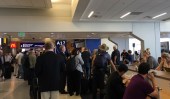
Unlike the probable majority of discombobulated Delta passengers, I had an ace in the hole: an American Airlines pilot son. In the midst of the Delta chaos, this was better than two hotels on Boardwalk. Although he was somewhere between Miami and San Juan, Puerto Rico on another plane himself, he was able to get me onto a flight to Dallas and subsequently thence to San Francisco in time for dinner.

The stories swirling around all those terminals, in all those airports throughout all that time could fill a bunch of books.

There was the woman in a tan polka-dot dress who spoke an unrecognizable language – something not quite Spanish – and no English. In the time she and I shared a waiting area at Gate A-17 at least three different passengers responded to her bewilderment in mysterious tongues, in attempts to help or understand. Yours truly tried pointing to our respective boarding passes (for cancelled flights) but was of zero help. An agent, one hopes and believes, eventually materialized and got her onto a plane flying in the right direction.

There was a mother with two small children and a baby in an over-the-shoulder baby-carrier who said, into her phone, “I couldn’t have left it at the hotel! It has to be in the car!” Oh please, I thought, let it be in the car where presumably her husband can find it and all will be well.

And there were more than a few snippets of conversation, as I was passing by: “yesterday… I know, but I couldn’t get there…” or “we need to postpone it to tomorrow, or Friday…”  Postponement was the order of the day.

What was missing, in the stories of frustration and anxiety I overheard, was this: anger. Anger was probably very much present in the first chaotic day or two. But as the global chaos settled down I was reminded of another time of airport chaos.

Home sweet home from the plane's window
Home sweet home from the plane’s window

It was a flight from San Francisco to Portland on September 14, 2001, on either the first or second day that commercial flights were back in the air after 9/11. Lines waiting to go through security stretched the length of the terminal, and moved at a snail’s pace. But the mood was all kindness and tolerance. We shared stories about friends lost or stranded, or about our own fortunes. We held places in line for people who needed a bathroom break, we brought each other lattes.

Delta’s momentary blip is in no way comparable to the tragedy of 9/11, and this writer saw only a tiny blip of the aftermath. But it is somehow reassuring to believe that the human spirit can survive small inconvenience as well as major chaos – with a little patience, grace and kindness. Considering the major chaos of these days, especially between now and election day, we’re going to need a lot of all three.


Power to the (Grassroots) People

Scary times, these. Advocates for reproductive justice, already battling restrictive laws in state after state, now have reason to fear an erratic potential president whose Supreme Court choices could disastrously affect generations of women.

COTF.1

People with hope, though, just keep working, one person/one voice at a time. Among grassroots efforts to preserve national sanity in general, and protect women in particular, a movement underway this summer is worth noting.

CallThemOutFL grew out of the creative minds of two young Florida expats, Arianne Keegan and Abigail DeAtley, high school friends from Delray Beach now living in New York. Thanks to statewide redistricting, every seat in the Florida state legislature, both Senate and House of Representatives, is up for election in 2016. This seemed, to Keegan and DeAtley, too good a chance to pass up. Their hope is to shift the balance of what has been an anti-choice legislative body they do not believe has the best interest (or support) of Florida women.COTF.3

“When we found out that Florida HB 1411 had passed, and was slated to go into effect on July 1,” Keegan says, “we wanted to educate folks, and also to spread the word.” HB 1411 adds further monetary restrictions to anti-abortion laws in the state which are among the most stringent in the nation. “We decided to launch a campaign urging individuals to contact their representatives and call them out on how they voted. We see this as an opportunity to let people know about the TRAP (Targeted Regulation of Abortion Providers) laws and how damaging they are, especially to underserved women.” (HB 1411 was challenged in court, and remains blocked as that process continues.)

The two held their first CTOF event last July 2 in Brooklyn. Some 20 supporters gathered at Molasses Books in Bushwick to discuss the issue, and the oppressive laws. They then wrote more than 100 messages to elected officials on postcards designed for the cause by graphic artist friends of the co-founders. Keegan and DeAtley have also enlisted fellow Florida ex-pats around the country – in Washington DC, New Orleans, Miami and elsewhere – and in a few overseas locations – to host similar events throughout the summer. Toolkits available for such happenings include postcards, factsheets, learning activities and a sample presentation designed to explain the issue and engage audience members in fighting against reproductive oppression. The kits also include specific information on Florida’s HB 1411.ctof5

On the CTOFwebsite is a wealth of information about the issue, in Florida and elsewhere. Will the innovative effort have any definitive impact? The votes aren’t in yet. But in this election year anything can happen.


Sewing Seeds of Peace & Justice

Rally 7.10.16-crowd

I have always drawn the line at public demonstrations. Writing letters to editors or legislators, signing petitions, calling representatives, even publishing blogs & the occasional tweet – those   reasonable, genteel efforts in behalf of justice – have satisfied my self-righteousness self-image just fine. Marching, picketing, that sort of in-your-face activity I have happily left to other more courageous friends.

Rally 7.10.16-G.L.

But now? Mass shootings, killings of seemingly innocent African Americans by police, sniper killings of police “in retaliation”? A dangerously polarized country facing a presidential choice between the two most unpopular candidates in history – one a widely mistrusted history-making woman and the other a scary narcissist egomaniac (IMHO)? No peace, little justice.

What can you do?

Rally 7.10.16-Do Justice

When a couple of guys who have become unlikely close friends decide to put together a rally on the steps of City Hall, you show up. One leads a mostly white, fairly traditional Presbyterian church in an upscale neighborhood, the other leads an African American Pentecostal congregation in a depressed area across town. Within a few days, at the end of a week that saw the shooting of an African American man in Minnesota and the killing of five policemen in Dallas, the two friends arranged an event to argue for sanity:

FAITH COMMUNITIES UNITED FOR JUSTICE AND PEACE. Nothing big, nothing political, nothing advertised as changing the world. A chance, though, for people from across the spectrums of race, politics and religion to show up and share their hope for a better world. For this writer, and strangers of assorted skin colors and garb (yarmulkes, hoodies, religious robes, flip flops) it was a chance to stand shoulder to shoulder, sign to sign, and catch one’s breath after recent weeks of tragedy and horror.

Rally 7.10.16-David Chiu

One of the ministers in attendance, who happens also to be a professionally trained singer, warmed up the crowd (which grew incrementally as the hour progressed) with a group sing-along to an old spiritual: I feel like going on. Though trials mount on every hand, I feel like going on.

An Asian American legislator told the crowd he had brought along his 4-month-old son. He and his wife have just bought a home in the depressed area. “so that my son can grow up,” he said, “with Black and Latino friends. I hope they will all be judged by their character.”

An interfaith leader quoted Martin Luther King, Jr’s phrase, “Returning violence for violence multiples violence.” He argued for turning this trend around – and drew applause when he said, “We need to support gun laws.”

A tall, young African American man holding an orange sign that read “LOVE & PEACE” spoke of his own father being shot by a policeman when the son was 16.

Rally 7.10.16-2 signs


A public official told of an incident several days earlier in which an armed man had been talked down from a threatening situation, “and no one was injured or killed.”

A rabbi quoted a Jewish prayer from Deuteronomy, “Justice, justice shall you pursue . . .”

One of the leaders of a Muslim organization that promotes interfaith cooperation and understanding spoke of the message of peace which is central to Islam.

Signs were waved – they carried words and phrases like: Walk Humbly. All Lives Matter. Light Overcomes Darkness. – and – Imagine all the people living life in peace.

Rally 7.10.16-Keith


When the crowd disbursed, stepping out of the shadow of the City Hall steps and back into the summer sunshine, there was a demonstrable sense of light overcoming darkness. The word is that rallies and demonstrations for peace were taking place across the country on the same day. Out of them all, perhaps, will emerge a few seeds of justice and compassion to push back against the anger and hostility that has claimed every news cycle of recent months.

Because, as another widely quoted saying also heard from the rally lectern goes, You have to give them something to hope for.

Willie Parker vs Reproductive Oppression

Dr. Willie Parker
Dr. Willie Parker

“The Racialization of Abortion,” Willie Parker titled his talk; “A Dirty Jedi Mind Trick.” He then spent about 45 lively, provocative minutes elaborating on the theme.

The occasion was a recent Grand Rounds presentation at the University of California, San Francisco School of Medicine, where he addressed a standing-room-only crowd of (mostly) young interns for an event that more commonly draws a smattering of attendees. But when Willie Parker comes to town, it’s a good idea to bring in extra chairs. Parker is an African American physician, a provider of abortion and reproductive health services to women who would otherwise be denied them, current board chair of Physicians for Reproductive Health, a ferocious defender of women’s rights and fearless citizen. He is also this writer’s personal hero.

Parker explained in his opening remarks that his “is heart work and head work. Dr. Martin Luther King said the heart can’t be right if the head is wrong. (King) also said we have guided missiles and misguided people.” On the podium, delivering a rapid-fire lecture in behalf of reproductive justice, Parker is akin to a guided missile consisting of equal parts passion, outrage and statistics. The youngest of six children whose mother sent them to church three times a week, he speaks with the cadence and conviction born of those roots.

“There are over six million pregnancies per year in the U.S.,” he says. “Half of them are unintended. Of the unintended pregnancies, half end in births; half in abortions. One in three women under 45 will have an abortion. While unintended pregnancies have fallen among the upper classes, they have increased 29% among the poor. Blacks and Latinos are disproportionately likely to have unintended pregnancies…”

And it is at this point that Parker’s inner preacher takes over. “People,” he says, “we’re gonna get ugly for Jesus.” It is his challenge to those who attack him, most often fundamentalist Christians, for protecting the reproductive rights of his mostly young, Black clients. Often they also accuse him of participating in “Black genocide.” It is this myth — that abortion is a government plot to eradicate the Black race – that leads to the Dirty Jedi Mind Trick theme.

“It is epidemiological mischief,” he explains. “They take data, put a spin on it that is not intended, and then start a ‘call-and-response’: You have white people saying abortion is racist, getting Black people to say Amen. They can put a cultural war in your framework. It’s important that we recognize the significance of this message, and debunk it.”

In addition to the epidemiological mischief there are outright lies. Former presidential candidate Herman Cain, an African American Tea Party Republican, said in one speech that 75% of abortion clinics were in Black neighborhoods, to encourage African American women not to have children. Parker says the correct figure, according to the Guttmacher Institute, is 9%.

“At its core,” Parker says of these efforts, “it is patriarchal and insulting. They assume a woman is not capable of making her own decisions about her own body.”

What’s needed now, to combat all this, Parker says, “is a new framework, to define this community problem as Reproductive Oppressionon. Reproductive oppression is the control and exploitation of women and girls and individuals through our bodies.” Parker cites the long history of reproductive oppression that includes “forced breeding during slavery, sterilizations, and human experimentation on Puerto Rican women for the contraceptive pill.

“Current examples of reproductive oppression,” he says, “include limiting access to reproductive healthcare, family caps in welfare, and federal and state laws restricting access to abortion.”

But there is hope. Parker cites Atlanta-based SisterSong and its formidable co-founder Loretta Ross as embodying the principals of reproductive justice. Parker lists these as:

1 – Every woman has the right to decide when to have children.

2 – Every woman has the right to decide if she will not have a child.

3 – Women and families (deserve) the resources to parent the children they already have.

4 – Every human being has the right to primary sexual pleasure.

Anti-abortion forces would certainly argue against at least the first two. Parker’s message to the young interns was that it’s not just argument, but twisted myths and dirty tricks that are being used to deny those rights. He maintains it’s the responsibility of the medical community, among others, to stand up for women who are suffering from being denied, to fight against reproductive oppression.

In all likelihood, Willie Parker will keep right on leading that battle.

  *   *   *   *

(Read Dr. Parker’s statement on the recent Supreme Court ruling against restrictive Texas abortion laws: http://prh.org/)


A Ramadan Birthday Dinner

Ramadan - dinner crowd

Dates, rice and eggplant moussaka for birthday dinner? It works.

A recent birthday of mine happened to coincide with a long-planned Ramadan Interfaith Iftar Dinner co-hosted by Pacifica Institute and Calvary Presbyterian Church in San Francisco. Since I was minimally involved in the planning and execution of the event, and maximally involved in the birthday, it made sense to combine the two. Plus, I got a lot of mileage out of responding to questions about birthday plans with news we were expecting 225 or so friends for dinner.

The eventual total number of guests will remain a mystery, because so many kept showing up without reservations and we were simply told not to turn anyone away. Attendees were Muslim and non-Muslim, Catholics, Protestants, Jews and Buddhists. (“You know the difference between a Buddhist and a non-Buddhist?” quipped Rev. Ron Kobata of the Buddhist Church of San Francisco; “The non-Buddhist thinks there is a difference.”)

This was not just a celebratory dinner, it was an Iftar dinner, the sunset meal at which Muslims break the fast they have observed since sunrise. To be clear about it, sunrise on June 8th in San Francisco was at 5:48 AM, and sunset was at 8:37. That is considerably longer than this weak-willed Christian generally goes without sustenance. Having had a perfectly good lunch, and  swiped a half-dozen or so dates while putting bowls on the tables, I still had to sneak a glass of milk from the kitchen to keep from fainting away at the welcome table.

Given that dinner would not be served until after the call to prayer at 8:37, the program preceded the meal. It included a video about Pacifica Institute, which was founded in 2003 by a group of Turkish Muslims dedicated to social justice, interfaith cooperation, relationship-building and partnership for the common good – any tiny advancement of which would make a pretty fine birthday present for anybody. Pacifica is aligned with the worldwide Hizmet Movement (“the Service”) which promotes service to humanity regardless of faith, tradition, gender or ethnicity.

Fatih Ferdi Ates giving the call to prayer

We also saw a video about how fasting strengthens one’s spirituality in multiple ways. Muslims observe the fast – abstaining from food, drink, smoking, sexual activity and bad behavior including lying or cursing – every day during the month of Ramadan; which does not exactly compare with giving up chocolate for Lent.

Keynote speaker Dr. Scott Alexander, Assistant Professor of Muslim Studies at Catholic Theological Union in Chicago, spoke to the evening’s theme: The Art of Living Together. “Sharing the joy of fasting,” he said, “fills us all with hope. It stands in opposition to the strident voices of hatred that want us to believe our troubles are the fault of others.” Alexander ended with a prayer that “God will allow others different from ourselves in all ways to touch our hearts.”

One of the co-leaders of the event, who served as MC along with Pacifica Institute’s Fatih Ferdi Ates, was Calvary member Robin Morjikian, whose father is Armenian. Ates, when thanking her, noted that the evening involved the daughter of an Armenian working with a group of Turkish Muslims on an event held at a Presbyterian church and featuring a keynote speech by a professor from a Catholic University. Buddhist Rev. Kobata presented awards to three honorees.

In lieu of birthday cake, dessert consisted of mixed fruit and baklava. I’m not sure how next year’s birthday will stack up.

Windows 10: A Horror Story

laptop computer crash

If you work on a PC that’s been around since last summer or longer, you know the relentless, obnoxious, uninvited pop-up boxes urging you to upgrade to Windows 10. Its hype has been such that you’d think Windows 10 includes an app for getting the Israelis talking to the Palestinians.

Downloader beware.

The upgrade message assures you that all of your files will be just where you left them. It’s easy, convenient, and free for a limited time! Plus, if you don’t like it, Windows 10 creates recovery files that allow you to roll back to your previous operating system any time within 30 days. Don’t believe it.

I wonder what in the world is in this good free deal for Microsoft? Could it perhaps translate into big bucks for Microsoft; i.e. Bill Gates and a few key employees and investors?

Windows 10 has its fans. Three of them are smart, computer-literate friends of mine who (along with several others) convinced me it would be wise to upgrade. Because, they argued, Microsoft will be discontinuing support for my old familiar Windows 7, and unless I upgrade I will miss out on ongoing security measures, etc.

Here is my experience. It is admittedly anecdotal, but throughout the past hellish week nearly a dozen friends have shared their own Windows 10 horror stories, including two who said it was downloaded without their request or consent. (Occasional pop-ups say Windows 10 will be installed in X-number of hours, and unless you catch it and specifically decline by checking three different boxes, it’s a done deal.) I admit to voluntarily signing on.

So at 2 AM on a recent Tuesday morning Windows 10 was downloaded onto my beloved four-year-old Lenovo ThinkPad laptop. At approximately 8 AM I entered digital purgatory.

For a few brief moments I enjoyed the crisp new look. Then I realized I could not access the two critical elements of computerdom on which my day depends: email, and Word documents. Not to worry. I’m only a few minutes away from the charming and super-capable Geek Squad folks at a nearby electronics place. I hereby salute & applaud my local Geek Squad. It took several exhausting hours – mainly because I tried to work with someone in Bangladesh who couldn’t restore my email – but the Geeks found my Word documents and a way I could send & receive email, even if files, address book etc were lost in cyberspace.

Two hours later it was all gone. Windows 10 was back in control, and denying access to anything. The next two days were essentially devoted to repeated trips to the Microsoft Store, where assorted other charming and super-capable geek types attempted to get Windows 10 the heck off of my weary laptop and roll things back to Windows 7. They could not. The only thing that eventually saved my life and laptop was a long ago purchase (and thank heavens for the auto-renew!) of Carbonite, which kept a copy of everything on my computer somewhere in its mysterious cloud. It took two straight days, but eventually I was back to where I was before the nightmare started.

Here is what Microsoft doesn’t tell you:

Your computer may NOT be compatible with Windows 10.

If you attempt to upgrade using the link furnished with the ubiquitous pop-up, the installation may not be “clean.” (This is what happened with my laptop; Windows 10 was sort-of installed, but not properly.) And you cannot simply re-install – or simply anything for that matter. So if you want to join the ranks of the Windows 10 fans, find a safe way to do so. Probably going to a Microsoft Store makes the best sense. The people at my local Microsoft Store were courteous and competent. They also kept bringing me bottles of cold water; I think they feared having a little old lady suffering a heart attack on their hands.

Your files may indeed be exactly where you left them (as you are repeatedly told,) but you may not be able to access them.

If you have a good anti-virus protection, you can get along just fine without whatever new security features my friends feared I would need.

And as for those “recovery files that allow you to roll back to your previous system within 30 days,” don’t count on it. I invested $149 in a package deal at the Microsoft Store so this could be done, but after two agonizing days of repeated trips we all conceded that the only hope was in the Carbonite cloud. If you really want to preserve the option of rolling back to your previous system, put every single piece of it into a cloud or onto a few flash drives.

Or buy a new PC and start from scratch. This I am doing with the nifty little Asus tablet the Microsoft Store folks set me up with so I could work during Hell Week. Of course by the end of the week I was loving it, so am spending the $300 to keep it for traveling. But I don’t expect to be able to do anything but the most rudimentary tasks on it for a very, very long time.

In the meantime I will be studying my brand new, 325-page Windows 10 for Seniors For Dummies. And I’m adding my Asus to my Carbonite account.


There’s Hope for Reproductive Justice

Art by Megan Smith
Art by Megan Smith

Let’s hear it – one more time – for the Millennials. Especially the youngest Millennials, just now reaching or approaching voting age. A generation unto themselves.

Invited to speak at a recent “Awareness into Action” day at Drew School, a private college preparatory day school in San Francisco, this writer went with some trepidation into a classroom set up for about ten high school students. Who – when she hasn’t been a high schooler in more than a half century – knows high school students today?

My workshop was on Reproductive Justice. Other choices the students could make included workshops on Mindfulness, Parks Conservancy, Anti-Racist Dialogue, LGBTQ issues and Immigration Law (to name a few.) I figured if 5 or 6 girls showed up it would be fine. By the time we were ready to start there were 14 girls and two brave (and handsome) guys around the table and sitting on chairs and tables in the back corner, plus one teacher keeping an eye on it all.

For openers, I’d written several facts on the whiteboard:

A woman dies of cervical cancer almost once every two hours. HPV vaccine prevents most cases of cervical cancer.

17 states mandate that women be given counseling before an abortion that includes information on at least one of the following: the purported link between abortion and breast cancer (5 states); the ability of a fetus to feel pain (12 states); long-term mental health consequences of abortion for the woman (7 states.) None of the above are true.

Then I told my own story. The story of a 22-year-old who had never had sex – after all, nice girls did not have sex before marriage in 1956. A victim of what would today clearly be workplace rape, I did all the dangerous things that women desperate to end an unwanted pregnancy are increasingly doing today. When nothing else worked, I had a back alley abortion by an untrained man who probably had not even washed his hands.

“I think,” I said to the roomful of attentive faces, “we’re going straight back to the dark ages.”

Not if these young people have anything to say about it.

Aware that they are among the lucky ones, they are concerned about the unlucky. They seemed a little taken aback by statistics like this one:

In 2006, 49% of pregnancies were unintended. The proportion of unintended pregnancies was highest (98%) among teens younger than 15.

. . . and by other data about how widespread is the denial of access to reproductive healthcare for poor women and girls (and men and boys) in more than half of the U.S. “It’s just wrong,” said one student.

So what do you think you can do to change things, I asked.

“Vote,” came the first answer, before I even finished the question.

“We have to learn to listen to people we disagree with,” said another student, who had been rather vocal in her description of political villains. “You may have to bite your tongue,” I said. “Yeah, I know,” she replied. “Because we have to learn how to have dialogue.”

“We just have to know the laws,” said another, “and work to change them.”

“We need to support these organizations, too,” commented another student, tapping the table with some of the materials I had distributed from groups like Advocates for Youth, Planned Parenthood and Sea Change.

For this writer, who lived through the worst of times, the workshop brought hope for the future of reproductive justice in the U.S. Returning to the worst of times is not on the agenda for these Millennials.


Anna Quindlen on form & feminism

Anna Quindlen (left) & Kelly Corrigan

Anna Quindlen, on tour with her new novel Miller’s Valley, sat down for a rollicking interview with author Kelly Corrigan recently at San Francisco’s Commonwealth Club. Within an hour they had traded profound thoughts and raucous asides – some printable and some not – on topics ranging from literary form to family histories to feminism, from death & dying to the prosecution of rapists.

A few random excerpts:

Re Miller’s Valley – which reviewers have described as “a quintessential small town story about a family you will never forget” – Quindlen said she felt early on that she wanted it to be written in the first person (Mimi, who grows from an 11-year-old into her sixties in the book, is the narrator) because she wanted to leave “some ambiguity at the end, and that’s only possible with a first person narrator. There is a kind of intimacy you can only develop through the first person.”

On how much of Miller’s Valley – and her seven earlier novels – is taken from her own life: “When I was a newspaper reporter people thought I made things up. Now I make things up and people think they’re real.”

On families, literary and otherwise: Corrigan, noting Quindlen’s untroubled childhood and long-lasting, happy marriage, asked if “people who have not lived through deep dysfunction” can still produce great writing. “I had a happy childhood,”Quindlen responded, “but I remember always feeling that there was no place for me in the world.” Then she listed three things that have made her the (highly acclaimed) writer she is: her mother’s illness and death – Quindlen, the eldest of five siblings, left college in her sophomore year to care for her cancer-stricken mother – the “good luck to be a street reporter in New York City,” and being a mom to her three now-grown children.

Corrigan followed with a family tale of her own. After calling her mother to tell her about an award just received, Corrigan was dismayed by her mother’s being “not very impressed.” So after a few moments of disappointment she called back to find out why. Her mother said, “I’m glad you called back. I’m jealous.” To which Quindlen added, “We all said, ‘I don’t want the kind of life my mother had.’”

Quindlen 4.11.16

On memoir (both authors have produced well-received memoirs) v fiction: “In memoirs there is stuff you can’t talk about,” Corrigan commented, “like jealousies, or sex with your husband. But in fiction we can be more honest about what hangs us up.”

“How’s feminism going?” Corrigan asked toward the end of the conversation. “We (feminists) are, like God, everywhere,” Quindlen replied. Concerning one major issue of the feminist movement, Corrigan mentioned data that “reported rapes are up.” Possibly, she added, because for so long rapes went unreported.” But Quindlen noted ruefully that “fairly recently, in New York, you couldn’t prosecute without a third party witness. “Someone had to walk in during the event, preferably a nun or a policeman.”

Asked to name her favorite rising feminist, Quiundlen paused only briefly before saying “Lena Dunham. She immediately used her fame to help others. Every book event she does is tied to the local Planned Parenthood.” Citing the oft-repeated feminist mantra Learn, Earn, Return, Quindlen said Dunham “is doing all three at the same time.” And Quindlen couldn’t resist getting in a plug for another woman she admires, “Hillary Rodham, as I like to call her, not using her slave name – is best qualified, and will make a great President.”


1 5 6 7 8 9 39