Treasures With A Thousand Faces

WHAT MATTERS AFTER ALL: ALMOST A CENTURY OF FRIENDS

(Written in response to a Medium.com invitation to write about one’s treasures)

What would you grab if you had ten minutes before a coming disaster?

In earthquake-prone, wildfire-wary California, this is a sometimes parlor game. More than once, I’ve used it as an icebreaker or had it come up in conversations with friends and strangers alike.

I think: My passport? My laptop? My cellphone? But invariably, I go back to the now-famous Guest Book Collection. I would grab the guest books.

When I married my Final Husband, sometimes referred to as the Last Best Husband, a few decades back, I moved from a lifetime on the east coast into the San Francisco Victorian he had bought twenty years earlier. He had had no siblings or close relatives, and though he’d been married before had never had children. But he had friends around the globe. I had more relatives — children, grandchildren, sisters, cousins — than could be easily counted, plus friends scattered everywhere myself.

We needed space. So the first major project we undertook was to convert the ground-level area behind the garage into a guest room with a small kitchen and bath. It was seldom empty for the next quarter-century.

A favorite niece started this tradition: as a wedding gift, she personalized a small notebook, transforming it into a guest book. It began life in the upstairs extra room of the Victorian, moving happily into the downstairs mini-suite within a year.

Guests were invariably greeted with a hug and an admonition: “If you leave without signing the Guest Book on the coffee table, you may never be invited back.” To a person, our guests obeyed.

They also quickly got creative. The book became the repository of reflections, photos, poems, cocktail napkins, ticket stubs, playbills, and more. As soon as Guest Book #1 was filled, it was succeeded by #2 — and by the time we downsized, the stack had grown to include Guest Book #6.

The little books came to tell the story of a happy marriage: illustrations by grandchildren, notes from favorite friends — they also grew to include pages for parties or special events, when I would invite everyone to sign with a name or a comment. My son and daughter-in-law came for my MFA graduation. A Parisian friend pasted in a photo from a trip we’d shared . . .

They’re just books, most costing less than $10. But they hold images and remembrances of literally hundreds of people I love.

And having those people in my heart? Priceless.

Solving the Abortion Rights Problem

A SIMPLE, EFFECTIVE PLAN ACCEPTABLE TO PRO-CHOICE AND ANTI-ABORTION SIDES ALIKE

Photo by James Wainscoat on Unsplash

I don’t know why nobody’s thought of this before.

Recent news of the Florida Solution (isn’t Florida coming up with great policies right and left?) to its peacock problem suggests the perfect answer to the testy abortion debates. Universal Vasectomy!

(We will set aside the peahen here. Peahens have never had access to reproductive choice so what do they know? We could ask growing numbers of women in choice-less states. But it’s mostly the peacocky guys making laws anyway, and they pay little or no attention to the reality of us peahenny women.)

Clearly, if Universal Vasectomy were put into place the whole abortion problem would go away, and women could set about accessing the reproductive care that they — and presumably peahens — deserve. 

This policy, as described in a New York Times article, “would allow peacocks to continue acting like dominant males, displaying their dazzling feathers and assembling their harems, though they could no longer fertilize eggs.” Does this make sense, or what?

The same issue of The Times carried another article which sums up the need for UV: An 89 year old man voting against Ohio’s sneaky attempt to restrict abortion was quoted thusly: “If men was having babies there wouldn’t be none of this nonsense.”

OK, how is this going to work, you ask. Easy peasey.

All we have to do is set up a national trap-and-release program for all males of the species. Each will then be given the choice — imagine! individual choice! — of either assuming full responsibility, in perpetuity, for any fertilized egg that may result from any future sexual adventure for the rest of his natural life — or, Snip! 

There will admittedly be costs involved, for things like reimbursement to physicians administering the simple procedure (I suggest that thousands of women MDs who have endured harassment or worse will eagerly sign up for the program.) Solution: take it out of the defense budget. Who’s going to notice a few billion there? Especially after the need for dazzling- feathers displays concurrenty diminishes, a peripheral benefit. 

Once this innovative program goes into effect in the U.S., countries around the globe will recognize it as widely satisfying and at the least cost-effective, and quickly follow.

Voila! World peace.

I rest my case.

Should You Eat That Eel?

AND OTHER NOT-SO-DIFFICULT LIFE CHOICES

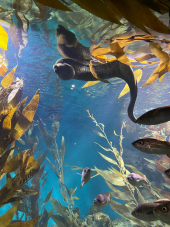
Not for dinner! An eel at the Academy of Sciences aquarium in San Francisco (Author photo)

The eel in the aquarium is among my favorites. He (or she, as the case may be) just has an enigmatic grace wondrous to behold. You can’t watch an eel and not calm down a little.

But take him home for dinner? Nahhh.My husband loved eel. He was prone to pay exorbitant prices for it; and to my protestations would say, “It’s only an Anguilliform!”

Which is true.

Eels are also catadromous, meaning they migrate from freshwater to salt; and they can swim forward or backward, all sensible traits. Two drops of eel blood, however, and you’re dead. This never increased my fondness, but it explains why raw eel isn’t a menu item. The blood cooks out; I still prefer not to think about it. And lobster is cheaper!

Still. An eel in an aquarium is a joy and a blessing. 

The Price of Politics Today

WHEN DID WE LET CRUELTY GO MAINSTREAM ?

KQED’s Marisa Lagos with Representative Adam Schiff, July 21 (Author photo)

“I can’t stand that millions of people hate you,” Eve Schiff said to her husband Adam not long ago. (Yep, Adam & Eve are married.) “You just have to accept it,” Schiff observed.

Why? When did hate become something to “accept and move on (from”) in the once kinder, gentler U.S.?

Not to mention cruelty. When the moderator kept to that topic Schiff told of another episode, something that bothers him a little more: a package came to his DC office containing two bullets; each had the name of one of Schiff’s young children written on it.Is that one more thing we simply accept?

“There’s nothing I can do about it,” Schiff said; “other than to get a new job. The first time I mentioned getting death threats to (former Speaker) Nancy Pelosi she said, ‘Welcome to the club.’” Pelosi knows a little more about this stuff than most of us would like, having had her 83-year-old husband bashed in the head in the middle of the night by a crazed guy who didn’t like her politics. He wanted, actually, to wait for Rep. Pelosi to come home (though she was in DC and crazy guy David DePape was at her San Francisco home) so he could break her kneecaps.

Surely it’s time for us kinder/gentler citizens to stand up for a return to civility. Even at the risk of getting knee-capped.

Decades ago, when my children were growing up (in the pre-internet age,) I was working as a freelance newspaper and magazine writer. I often covered city and county commission meetings or hearings on highly controversial issues. New highways, housing developments, policies that would directly affect communities and citizens alike. I remember more than a few events that came close to fistfights, and one that did get violent before police removed an inebriated objector. This was before anyone had to worry about guns.

I remember people calling other people names, swearing lifelong enmity, vowing to get an opponent removed from office or defeated at the polls.

But cruelty? Death threats? Anonymous messages suggesting terrible things might happen to families and children? Enough already.

Surely it’s time for the majority of us — and I know we are in the majority — to stand up for civility. Confrontation is out, since we have become a culture of guns and one friendly word can get your head blown off.

But we can write letters to editors. We can let those who support cruelty know that it won’t be tolerated. Calls and emails from outside a politician’s district might get tossed aside, but enough of them at least get his or her attention. Calls and emails to your own representatives might not get personal responses, but they get tallied. 

We can support the nonprofits working to protect and build the vote. VoteForward. GOTV (Get Out the Vote) campaigns. We can work hard to replace evildoers with civil-doers. 

We can vote.

Watching an Urban Mall Die

Downtown America stares into a challenging, unknown future

Westfield Mall’s main entrance on a Saturday afternoon

To be clear: I love San Francisco. I love Union Square. I love Market Street, the whole every-shifting stretch of it from the Ferry Building southward through the gritty blocks of too many drug deals and doorways inhabited by the down and out. Of course I particularly love the beautiful parks and hilltop views of the Pacific Ocean or San Francisco Bay, the museums, the stately homes and funky ones, the great food and most of all the people. San Francisco people, despite the influx of too many rich and techie, are still a wondrous mix of every color, creed and national origin — not to mention political opinion, which few citizens of San Francisco are shy about expressing. To be further clear, I never loved malls. I spent a lot of time in them in the 1970s and 80s, the glory days of retail when I was writing for (among other somewhat more interesting magazines) National Real Estate Investor and Shopping Center World. I would often spend a week or so before a major mall opening just hanging out, gathering details, interviewing store managers and PR people. Fun times for a writer!

Looking down on near-empty escalators from the top of Nordstrom’s multiple floors

In the glory days of malls there were innovations such as waterfalls and lush greenery. In downtown San Francisco, Westfield (originally San Francisco Centre) boasted a spiral escalator connecting the multiple floors of anchor store Nordstrom with the Market Street entry floor and a top-floor restaurant. On opening day in 1988 this was the nation’s largest Nordstrom store. And despite my anti-mall proclivities, I loved Nordstrom from the moment of my arrival in San Francisco in 1992. But it’s closing now. There’s a lot of sadness, though little surprise. Inside, there are theoretical sales designed to keep a few customers coming, but for the most part the closing is in full swing. Plywood sheeting and yellow tape are scattered everywhere. It’s hard to imagine that the smaller shops on each floor will survive. Or Westfield Mall in any form.

Many of the smaller shops have ‘gone dark’

Westfield Mall is hardly an exception. Since the glory days of the 1980s, when some 2,500 malls dotted the urban/suburban landscape, that number has dwindled to around 700. One estimate is that only about 150 will still be around in another decade. Which leaves both sadness and an uncertainty tinged with a tiny excitement. Something new will evolve. As in many other cases, the pandemic helped hammer in the nail of Westfield’s coffin. But more nails were provided by the city’s struggle to find solutions to homelessness and drugs on the street. Increased security presence can’t really stop the ever-growing problem of thievery.

Not-so-busy Security guys

I’m not saying goodbye, only farewell. Downtown San Francisco will return. And here’s a rebuttal, meanwhile, to all that bad press: The waterfront is still a wonder. The Ferry Building and its surroundings remain a great place to spend the day. The parks and museums and tree-shaded hillsides are still unequalled for urban strolling. Shopping areas like the Fillmore, Polk Street, Hayes Valley, Potrero, the Mission, the Castro are scattered everywhere and are still enchanting. The Presidio is a national treasure. History is just around every corner. Do you really travel the globe just to visit another mall exactly like the one at home? Downtown San Francisco won’t come back as it was. Change happens. Change doesn’t happen overnight. But when the city’s core does revive it may well be more interesting, more vibrant and more inviting than the 1980s mall scene ever imagined.

Walking out the door, into the cool, sunshiny summer air, I had no shopping bags but a lot of memories. Give us time. San Francisco has risen, all new, from the ashes before.

The Wild Witch Speaks

OR – How I want to be remembered

I come from several generations of mostly women — who may or may not be witches.

The youngest of four sisters, I grew up among aunts and great-aunts who were occasional role models and always sources of entertainment. My sisters and I welcomed ten more daughters into the next generation, although my father — one of five brothers himself — did eventually acquire two grandsons (including my own firstborn.)

By the time of my recent exhaustively celebrated 90th birthday, things had evened out a little: two nieces had had five sons (and no daughters) between them. The rest of that generation is a mixed bunch. Thirty-some of us gathered in Georgia not long ago to celebrate my own longevity and the life of my last remaining sister Helen, who died earlier this year at 95.

The night had cooled and frivolities settled down somewhat when my giant birthday cake was brought out. Son-in-law Paul, whose passions include all things culinary, creates these ten-pound wonders. I hope I was saying some thing profound for the moment, but in truth do not remember.

Profound or not, the moment was captured by my nephew Chris. A writer/poet/English teacher, Chris later found it reminded him of a piece by noted American poet Lucille Clifton. Photo and poem were thus framed and sent to me. Clifton (1936–2010) was a poet/writer/educator herself, and two-time Pulitzer finalist. I am proud to be in the same frame with her.

daughters by Lucille Clifton

woman who shines at the head

of my grandmother’s bed,

brilliant woman, i like to think

you whispered into her ear

instructions. i like to think

you are the oddness in us,

you are the arrow

that pierced our plain skin

and made us fancy women;

my wild witch gran, my magic mama,

and even these gaudy girls.

i like to think you gave us

extraordinary power and to

protect us, you became the name

we were cautioned to forget.

it is enough,

you must have murmured,

to remember that i was

and that you are. woman, i am

lucille, which stands for light,

daughter of thelma, daughter 

of georgia, daughter of

dazzling you. 


People-Watching at the Museum

VIEWERS CAN SOMETIMES BE AS INTERESTING AS THE ART ON VIEW

(View of the water, and Holocaust Memorial, from in front of the Legion of Honor Museum)

People-watching at its best: looking at strangers looking at art!

I visited San Francisco’s beautiful Legion of Honor Museum recently just before the opening of the next big show — The Tudors: Art and Majesty in Renaissance England opens June 24 to great fanfare. Between shows is a fine time to avoid the crowds, enjoy the rest of the art — and people-watch.

At this more leisurely time you can find a fascinating mix of the casual and the hard core viewer.

(Close examination of Mary Cassatt pastels)

The hard cores are easy to spot. They include members of the Close Examination school who push the boundaries of musuem-advised social distancing by studying selected works up close and personal. 

Also among the hard cores are the Group Discussion clumps. They are inclined to hang out in front of a particularly intricate work and discuss every possible tiny detail until you wonder if they might have rooted themselves to the floor.

(Intense group discussion underway)

Group discussion clumps are frowned upon (and generally impossible unless they are with a docent) in the major shows. But when the galleries are sparsely populated you’ll find these groups standing, pointing, arguing, laughing and enjoying the art, which is, after all, what museums should be about.

Somewhere within a hard core/casual mix are the families — who particularly enjoy a museum in between major shows because they have the place pretty much to themselves. If nobody’s around to bother you, it’s open season on shouting about displays and putting your nose to the glass.

(Introducing baby sister (barely visible) to ancient art)

But often the casual art watchers are the most fun of all to watch:

(Casual viewer taking an art break during a bike trip)

This one was biking to meet some friends but took a detour to see the small show of recent works-on-paper acquisitions. “It’s the best part of my day,” he said in a museum-quiet voice; “any time I can stop by the Legion.”

(Lone looker in the Porcelain Gallery)

Also having a lovely day was this solitary visitor to the Porcelain Gallery, studying the Worcester teapots. Having the whole place to oneself is a secret treat not common to museum-goers.

But for this people-watcher, here was the prize:

(A little art, a little fashion)

Carolyn Hadley, spotted in the museum cafe with her mom, had chosen a place mat to take home so she could continue art-watching at her leisure. It was hard to switch the eye from one artwork to the other. But Carolyn, in her museum-quality dress, holds the promise of a bright future for art and people-watching alike.

Old Age Needn’t Be the Pits

ONE 90-YEAR-OLD’S ARGUMENT FOR KINDNESS, GRATITUDE AND A DOSE OF ACTIVISM

Photo by Daphné Richard on Unsplash

Turning 90 — which I am now happily doing — is a mixed bag.

Things I’m happy to have skipped: Internet dating. Raves. Tik Tok. ChatGPT. Crowdsourcing. Being referred to as a Content Provider 😡.

Things I’m happy to have enjoyed: Big bands. The hula-hoop. TV before cable. The jitterbug. Trash-free cities and waterways. Patriotism before it got a bad name, and civil discourse before it was eliminated from our democracy.

I’ve recently read pearls of wisdom shared by folks turning 30 — or 50, or 20, or even 70. I was brought up to believe that age brought wisdom.

Nahhh. Age brings wrinkles.

At least my wrinkly brain still functions, as do my wrinkly feet. One can hardly ask for more. My advice to the under-90 set is that if you keep using your brains and your feet you’ll probably be fine. It is wise to appreciate them anew every day.

Things that make it worthwhile to be very old:

Kindness. Kindness should be #1 for any age, but mean old people are just the pits. Which brings up:

Attitude: Optimism works for me. Old people have a lot to be grumpy about (I do not.) But grumpy old people are the pits and then some.

Activism. When you’re emailing congressmen, out working for a cause, joining marches or writing postcards to voters you don’t notice arthritis.

Curiosity. Try to be at least as curious as you were 86 years ago.

Friends. Nobody doesn’t want to be friends with an unthreatening old person. (See above.) It is wise to have been collecting friends all along, but young friends are important because the others keep dying off.

Gratitude. On the worst day there’s something to be grateful for. By the time you get this old, just waking up is one.

Finitude. Specifically: I’m likely to die soon. (Hopefully not tomorrow; another few years on the planet would be okay.) But dying is not the worst thing that happens to anybody. It is wise to consider this reality and take appropriate action.

Faith. In god by whatever name, in Mother Nature, the celestial universe, doesn’t matter. It is not wise to think we humans are the be-all and end-all, an idea too depressing for any age. It is wise to consider the stars and clouds and oceans, and the fact that if we don’t take better care of our little planet whoever’s in charge is likely to give up on us.

That’s about all the nonagenarian wisdom I can come up with.

I’m grateful to you for reading.

1 … 14 15 16 17 18 … 124