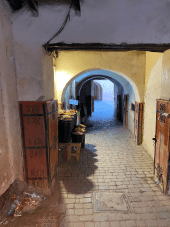
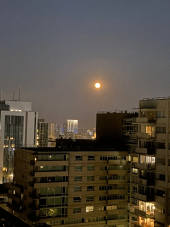
“You have to choose sides,” said my friend, on her way to a pro-Palestine rally.
I think there is too much choosing of sides.
You do not have to hate Israelis to believe that Palestinians need a homeland. Or hate Russians if you support Ukraine. You do not have to condone Hamas to pray that Israel tries to obey “the rules of war.”
You do not have to condone war to acknowledge the need for rules.
You only have to work and pray for leaders you believe will seek peace. For leaders entrusted with decision-making that is complex and difficult beyond belief. And to support those leaders through their flawed struggles.
You have to listen to people who disagree with you. To keep hope alive against all odds.
To do justice, be kind.
And pray the light will — eventually — overcome the darkness.
Contemplating the Pacific before Marathon Day 2006 (Author photo)
In the untroubled days of my long-ago, think 1940s, central Virginia childhood I was not what you’d call a stand-out athlete.
Back before Little League transformed playtime into organized sports, a kid needed to be agile at kick-the-can and ferocious at dodge ball. I was neither. Oh, I wasn’t the last one chosen, but I also wasn’t often captain.
Intricate heirarchies were built around who could climb highest in what tree; I would get to about the three-quarter mark and start thinking about broken bones, of which I had my share. In short, the time and place called for a degree of bravado I desperately wished for and basically lacked.
But I could run.
Early on I learned that running could win friends and influence social standing. So I was a clutz at catching (or hitting) softballs? Get me on base, somehow, and I could fly. Pinch runner was my best position.
Fleet feet were my secret weapon, largely because I, along with most of the other kids in town, went barefoot beginning on the first balmy day of springtime.
I was really good at going barefoot.
The farm kids, traditionally strongest of us all (child labor laws did not apply to family farms) had to wear boots because of what they were stepping in all day. But except for classes or formal occasions I spent roughly half the year barefoot. As a result, my feet were like leather on the bottom by April. Cinder tracks for Field Day relay races? No problem. Don’t believe those depictions of Hermes in sandals; bare feet can be a superpower.
When I got around to raising my own children, shoes were definitely in, and running was not yet. Well into the 1960s, if you’d been seen running around the neighborhood, by now I was in another small town near Atlanta, everyone would assume you had just robbed a bank. Or forgotten to turn the stove burner off. I kept up a passable tennis game, and team-sport skills served me well when the parents played the soccer kids. (The kids still always won.) I biked to freelance jobs; that was no fun.
Suddenly, beginning in the 1970s, running became A Thing. Hallelujah!
By now my children were looking at colleges, I was juggling several careers, my marriage was unraveling and life seemed to be coming at me with three questions for every answer. The search for answers began when, no longer barefoot, I laced up my sneakers and took off running.
In those early days of the running craze, it was possible to find a 5k or 10k neighborhood run every weekend, everywhere, rain or shine. There were fundraisers for nonprofits, celebrations of obscure holidays or just get-together excuses. We ran for T-shirts or free pizzas or occasional awards. It took a while for women and girls to turn out; I was in my early 40s when I took home an engraved plaque declaring me Oldest Female Finisher.
And again, running was my salvation.
The problems that seemed hopeless at 3 AM could dissolve into possible solutions while jogging around leafy streets at dawn. We formed running groups of friends who turned into supporters. I wrote my best articles in my head, ready to type on return.
I did not turn into a great winner (other than the Oldest Female Finisher and a few red ribbons) but running helped me win other battles. Several of them coalesced into my first Bay to Breakers race. In 1992, having won, or at least survived, a few of the dark-days problems cited above, I began a new life in a new marriage in a new city, San Francisco.
How about all those people behind #33911? Even if they’re mostly walking (Author photo)
Before leaving I had contracted to write a magazine article comparing the Peachtree Road Race, then featuring a lot of crazies, to the Bay to Breakers, featuring certified crazies by the dozens. Feeling duty bound to complete the race although I had not trained a single day, I pulled on a pair of worn, comfy sneakers and set out to walk it.
It could not be done.
At every other corner were singers and dancers, cheering (drinking) people, jazz bands and throbbing music. It was impossible not to dance — and run. After starting at the back of the mostly-walker crowd I broke out running whenever the route was not straight uphill. My knees were in revolt for the next three weeks, but I got the story in on time.
Speaking of hills. San Francisco quickly reduced me to a walker. Partly because my new home city was too beautiful to learn at a running pace and partly because very few consecutive blocks don’t involve mini-mountains, my running career ground to a stop. It stayed dormant while I traveled the globe with the excellent Final Husband, while I went back to school for an MFA and generally lived a blissfully happy life.
Suddenly I had passed my 70th birthday.
One day I woke up thinking everybody should run a marathon before turning 75, and I had never run a marathon. So I filled out the forms for the Nike Women’s with its Tiffany gold necklace prize, talked my daughters into joining me and began training (the three of us plus one young friend all in different states.)
I rediscovered the sheer joy of fast-paced movement and quickly remembered the benefit all those endorphins brought. Even doing the hills — I trained on segments of the planned route — brought back the old exhilaration. Clear head, clear thoughts, or sometimes no thoughts at all.
Four months into my marathon training a lump in my breast brought plans to a screeching halt. Instead of going on a training run I was being wheeled into surgery. It was mid-February.
That was the bad news. The good news was that no cancer cells were found in my lymph nodes, so I skipped radiation and the bad chemo, and went straight to the mild and manageable Tamoxifen.
By mid-March, my racing partners were reaching their projected times. I was feeling like a slug.
Until one morning when my husband said, casually, “I wonder if being lopsided would affect your running gait.” Which started me thinking about the gold necklace again, and the fact that the race was still more than two months off.
I traded a few messages with the race people, who assured me it would not be called cheating, under the circumstances, if I wimped back to a half-marathon. And more importantly, I could still have the necklace. Besides, it was paid for, and I am basically cheap.
I went back to training. There were always others doing the same thing. I got more than a few strange glances, the little old lady loping up and down the hills? Mostly I got thumbs-up signs.
Perseverance pays. By the time we four members of Team Gran assembled for dinner the night before the race we were equally pumped, if unequally prepared. Plus, the matching T-shirts had arrived on time.
#3911 nearing the finish line ahead of a clearly unhappy #3855 (Author photo)
The race, my first and last marathon, began on a chilly morning that quickly turned into a brilliant San Francisco day. I ran for some of the route, jogged other sections and walked a few uphills. People passed me — a lot of people passed me — often shouting words of encouragement, sometimes asking how old I was. My husband, who knew this town like the back of his hand, would pop up at unexpected places holding “Go, Team Gran” signs for us. (The team ran the first few yards together and then split into our respective time-slots.)
This is the best possible way to end a race: When I got to the half-marathon exit I felt like I could’ve gone on for miles. I still had sense enough to know I wouldn’t have made it to the end. The word ‘cancer’ had never crossed my mind.
At the pre-arranged meeting spot we four eventually picked up our formal certificates, the swag bag and the coveted Tiffany gold.
That necklace, the Oldest Female Finisher plaque and a few dozen ribbons, certificates and T-shirts have slowly disappeared.
I walk the city hills now, two or three miles of them on most days, but no longer break into a run for fear of breaking something else. But the pure delight, the thrill of spotting unexpected beauty, the clarity that fresh air brings, the joy of motion . . .
At a recent dinner party in San Francisco the conversation swung from gourmet recipes to trash politics to old Volvos — and back.
It was consistently engrossing, if not always optimistic, other than general agreement on the reliability of 1960s — 1970s Volvos. Guest ages ranged from twenties to geezers, including one nonagenarian. It was among this latter group, particularly, that there was dismay about the state of the union and the planet.
“If we don’t get really serious about addressing climate change,” remarked one among the elder group, “what else is going to matter? There won’t be any planet to care about.”
Wikipedia says that ice ages, “long period(s) of reduction in the temperature of Earth’s surface and atmosphere, resulting in the presence or expansion of continental and polar ice sheets and alpine glaciers” come around every 50,000 years, but I tend to believe this particular dinner guest even beyond my faith in Wikipedia. Therefore, I’m going with 70023.
Does anyone really plan to be around until 70023?
For my part, having reached a very advanced age already, I’d settle for another decade MAX.
October 2034 seems a perilous moment, assuming we get through 2024 unscathed. But 70024? Breathe deeply.
Somehow, contemplation of the universe — specifically including our lovely little Planet Earth — surviving just fine despite the degredations we inflict upon it for the next 68,000 years (please consider all calculations as right-brained approximations) is both encouraging and uplifting.
It also puts us humanoids in our places. Which is, insignificant.
I still think it’s incumbent upon us to try to save democracy, and address homelessness, and quit denying climate change, stuff like that.
Retreats, workshops, conferences and literary gatherings are everywhere today, blissfully in-person after the dark days of all-online (which doesn’t really cut it.) What’s the reason?
It’s all about inspiration.
Inspiration is to writers what thermals are to seagulls: you perch on the rock forever, or you soar into the unknown.
I learned this after being a writer (newspapers, magazines, & loving every minute) for about four decades.
It happened after my then new husband, Bud the Great Encourager, strolled into the kitchen with a scrap of paper advertising a 6-week workshop with a then little known writer named Anne Lamott.
“You should try writing stories for the grandchildren,” Bud said. “This would be a great place to start — and you’ll love the teacher.”
He did not lie.
By the end of those six weeks I had become convinced I could write anything in the world I chose, something readers of Lamott’s subsequent, wildly popular books will understand.
In those weeks I had been edited for craft, scene, dialog, you name it. I had met fellow writers who remain my friends and literary partners to this day.
And who doesn’t love Anne Lamott?
At the time (early 1990s) Lamott had published several novels and the nonfiction Operating Instructions (which I gave to every new mother I encountered for the next decade) and was at work on the widely acclaimed Bird by Bird.
Operating Instructions had to do with the birth of Lamott’s son Sam (in 1987.) After Bird byBirdcame Tender Mercies, and the books that have inspired generations of writers since.
Soon after that workshop came a two-week Napa Valley Writers’ Conference directed by the late great Jack Leggett in the mid-1990s. Leggett had retired to Napa after founding and directing the famed Iowa Writers Workshop that nurtured many of the best writers of the 20th century. I had met him briefly, soon after marrying his old friend Bud. (The two were equal encouragers.)
“You need to come to the Napa Valley Conference,” Leggett said, within moments of our being introduced. “Bud says you’re a really fine writer.”
Having never written anything much beyond newspaper and magazine articles and a few really bad books on commission when I needed the money, I said something clever like, “Uhhhh.” I had also never heard of the Napa Valley Writers’ Conference. But wisely I withheld that information and said, instead, “It sounds wonderful.”
It was. That literary gathering was all about craft: character development, dialog, scene, structure, language . . . Write, edit, critique, repeat.
By the end of that great adventure I had finished drafts of several short stories (Thanks, Annie workshop!) and begun work on what would be my first not-bad book, Dying Unafraid.
It was inspiration on steroids.
Well, it was also excellent teaching, a lot of advice and support from fellow conference attendees and hard work — all on the wings of inspiration.
Thirty years later I sneaked off, one recent weekend, to A Writing Room retreat to absorb a little inspiration and miscellaneous good stuff — and okay, it was an excuse to visit some old friends in Albuquerque & Santa Fe.
Writers’ gatherings have changed little over the years, if the few I’ve attended are any indication: good opportunities to meet and mingle with potential writing partners and kindred souls, limited opportunities to hobnob with the big name speakers, plenty of mutual support and food for thought.
And all for what? Some of us want to get published, or make money (good luck with that) or be on TV; most of us just want to be better writers. Workshops and retreats (in person and ubiquitously online) inspire us to try.
The Writing Room event presented all of the above, created anew for the 21st century. Inspiration with a distinctly 21st-century flair.
Full disclosure: I paid the fee but mostly audited the course; this is only a butterfly’s-eye view.
Writerly inspiration today is low on craft, high on introspection and self-discovery. Early sessions invited attendees — there were some 350 from across the U.S. and elsewhere, plus uncounted others participating online — to dig within for what’s most important and what it will cost to achieve.
We still want to be better writers, but today’s gatherings focus on mindfulness and the creative core, vulnerability and persistence — as tools for the journey.
My arms-length participation in the recent event had a lot to do with personal push-back against the weekend rules: No outside news, no politics, no communication with problematic friends and family members, and quit with the social media. Excellent advice for a few days of serious writing; problematic for my scattershot self.
After the event, though, I spoke with a number of attendees who had paid attention to the rules (except for the social media thing) and been far more serious about attendance and participation. They were, by and large, excited, uplifted, enthusiastic — and inspired.
Said one: “I was apprehensive about coming, but I’m going home feeling like I can achieve my goals. Yes, it’s been a memorable weekend.”
Several spoke of having gained confidence — in themselves and their future as writers. More than a few attendees were struggling with adversity, emotional distress or recent illness. (The stuff of great stories.) They’d been met with ovations.
One told me, “I have several hundred pages of a memoir, but had all but given up on ever finishing. When I shared about it this weekend, though, the response was really encouraging. It gave me the confidence I need.” She was “excited about sitting down and really getting to work on it.”
Co-hosted with author/creative guide Jacob Nordby, A Writing Room Retreat was led by artist/podcaster Sam Lamott.
For this writer, the inspiring words of the keynote speaker — Sam’s indomitable mom Anne Lamott — still rang true.
A recent Miss Manners column — you DO follow Miss Manners, don’t you? — featured her response to a Gentle Reader who had been called out for being, well, too polite. This was because Gentle Reader delivered a cupcake with an apology for a minor misdeed.
Excuse me?
If only I had a nickel for every cupcake apology/thankyou/etc I have delivered over the years. Not to mention the yellow tulips . . .
But Gentle Reader writes that he or she had been accused of etiquette that was “merely performative.” (Which, Miss Manners notes, is indeed what being polite is all about.)
I yearn for a return to politeness. Courtesy. Peformative etiquette. The right to deliver cupcakes when you need to apologize.
Considering the contentious times we live in, what if a hostile, angry anti-etiquette movement emerges? Protesters showing up at every sickroom door, accusing well-wishers of showing off by bringing cards or bouquets. Mass-produced Stand Up for Rudeness! signs.
They’re probably already at work. Don’t Be Glad, Be Mad! (I can think of a lot of others, mostly too impolite to print.)
The anti-etiquette folks believe our actions “should reflect our true feelings, however offensive they may be.” Or something like that. The bottom line is: courteous people are making the discourteous people mad.
We are in deep trouble, folks. Some true feelings really might need re-thinking. I’m particularly worried about ‘Honest Nastiness’ — protest posters for which are probably already in mass production.
My own true feelings are usually “Geez, I am really, really sorry for that stupid whatever;” nasty hasn’t ever worked for me. But what if the Honest Nastiness true believers organize? And join forces with random anti-cupcake people?
The inevitable next step? Those are the same folks who support open carry.
Which brings us to scenes of little old ladies (me, for example) delivering cupcakes to innocently wronged friends only to be confronted by crowds waving Pro-Rudeness signs — and packing heat.
There’s a fascinating history of the celebration, including “I am an American Day” which was made official by President Truman in 1951. (Some of it’s more nationalistic than comfortable today.)
So we don’t get a day off, or an excuse to go beach-bumming.
We get, instead, a chance to reflect on Bill of Rights items currently under threat. Reproductive justice, anyone? Freedom to enjoy life without guns everywhere? Gender equality?
Maybe you thought the Equal Rights Amendment (first proposed in 1923) had passed? Nahh. One would think that in 100 years we might get equal rights for, ahem, women; but the ERA is still being battered and batted around. One nonprofit is spearheading interfaith efforts to make it official.
Plenty of Good-Citizen work to do, or support, as part of your celebration.
MEMORIES OF MARRAKESH AND ITS UNFORGETTABLE MEDINA
I never really learned my way around.
But my brief stay in the Medina — ancient center of mesmerizing Marrakesh — was a time apart. A chance to live where people have lived and died, worked, played, loved and shared their stories for centuries.
Our AirB&B, a dozen turns into the narrow passageways, was pure 21st century: a renovated traditional Moroccan riad with indoor courtyard, a few beautiful rooms on several levels (accessible by narrow stone stairs,) the courtyard open to the skies, all the 21st century comforts one could want.
Ground level sitting room off the courtyard
Looking upward from the courtyard at dusk
Second level bedroom
And just outside our doorway, life went on — as life has gone on in the Medina for centuries. Families are families, whatever the time or place.
Marrakesh is a marvel of a city. I’d never been to Morocco before.
I loved roaming the streets (with an invaluable local guide!) — visiting the Koutoubia Mosque, the gardens, the palace, the desert-like Palmeraie with its palm trees and camels a stone’s throw from upscale modern homes and golf clubs.
But coming home, back into the 11th century Medina, was the best.
I don’t want to believe it’s gone.
Since the earthquake that has claimed several thousand lives across this part of the country, and left much of the Medina in rubbles, we’ve heard from only one of the three friends we made on that brief visit. A merchant who emailed that he is “All right, thank you, sister!”
We’re praying for the others. And that somehow the people of Morocco will rebuild.
I hope so. I hope the ancient marketplaces will again coexist with renovated riads that might welcome tourists like me again. And those visitors might have a chance to climb up to the rooftop for sunset tea . . .
Relaxing on the rooftop
Another rooftop view at sunset
Looking down into the courtyard gardens & fountain from the rooftop at dusk
. . . and marvel at the 21st century beauty created in the very heart of this 11th century city.
My heart is with their hearts, those citizens of the Marrakesh Medina
A SUMMERTIME OF MOON WATCHING COMES TO A SPECTACULAR CLOSE
The Super Blue Moon, after shining spectacularly over San Francisco Bay and the surrounding mountains and countryside, continued doing its spectacular thing as it soared majestically over my skyscraper neighbors. The sight above was glimpsed from the roof of my building.
A spectacular summer’s end for the moon.
My summer began with this moon over Decatur, encircling itself with a gauzy Georgia haze.
And later, an August moon shone over Montana’s Bridger Mountains, clearly trying to outdo itself.
Speaking of which . . . when it appeared above St Mary’s Cathedral, as seen in mid-summer from my balcony window, the moon or the phone or an eerie phenomenon (I choose that last) created a nifty blue dot as a prophecy of moons to come
And sure enough, the Super Blue Moon, in all its brilliance, rolled across the late August sky.