Look Up, Breathe In, Exhale

SOMETIMES YOU JUST NEED A BREAK FROM THE DAILY CHAOS

One of the stairways at Alamo Square Park (Author photo)

Visitors go to San Francisco’s Alamo Square Park to photograph the Victorian Painted Ladies houses, to gaze at spectacular views of downtown or the surrounding neighborhoods, to picnic or sunbathe or strengthen various muscle groups.

I go to the park to look up. Well, for all those other reasons too — but looking up is what does it for my heart and soul.

Try it.

Just look up. Walking cities, check out the floors above street-level on urban blocks — I learned that in the one college architecture class I had. It’s a way of noticing the building’s history, or figuring out what’s really going on up there, inside.

Or look higher!

(Author photo)

As a committed follower of the Cloud Appreciation Society (Member #45,662,) I have more cloud photos than you want to know about. I’m constantly on the lookout for a potential Cloud-of-the-Day photo that CAS might choose. Lovely way to start every day: with the daily Cloud in your inbox, along with an explanation of what, where and why it is, and often a few whimsical asides.

The London-based Cloud Appreciation Society people are among my favorite know-it-all’s on the planet.

(Author photo)

So after this flyaway photo, I’ll quit for now. But I hereby rest my case. The sky’s not just the limit, it’s the invitation to wonder. To exhale.

Here’s to an uplifting day ahead. Week ahead. Just look up.

(Because I Find WordPress more and more difficult to manage — after all these years of posting on WordPress — I don’t manage to get here often. You’re more than welcome to visit my Substack, franmorelandjohns.substack, com; it’s free. Meanwhile, thanks for reading any of these thoughts.)

When the Glaciers Melt Away . . .

WATCHING THE PASSAGE OF TIME AT THE ENDS OF THE EARTH

Svalbard 2019 (Author photo)

There were polar bears — though far fewer than we’d hoped; there were walruses and seals and the occasional reindeer or Arctic fox. But what took my breath away was the beauty: shimmering white and muted azure as far as the eye could see. 

I visited the Svalbard archipelago, between the coast of Norway and the North Pole, in June of 2019 on a trip sponsored by Climate One. Spotting wildlife and taking in the beauty of the scenery were high on everyone’s list, but the main purpose of the expedition was to see — up close and personal — what the warming climate is doing to this northernmost cap of planet earth. It is not pretty.

Everywhere were the signs of melting sea ice and shrinking glaciers. Probably the most dramatic moment of the entire trip came when we witnessed glacier calving, as a giant chunk of a nearby glacier sliced off and into the sea. (Climbing on land was its own additional reward.)

Hiking the Svalbard mountains (Author photo, 2019)

Today there’s an expedition underway — this one seriously scientific and definitely not for tourists — at the other end of the world. They are already gathering important data and with a little luck they’ll be able to leave instruments in place deep under the sea that can prove invaluable to climate scientists (and others) going forward.

I’ve been following independent journalist Miles O’Brien (you can too!) who is aboard the South Korean icebreaker Araon near the Thwaites Glacier in Antarctica. Thwaites is also known as the Doomsday Glacier, for reasons you probably don’t want to focus on right before you try to go to sleep. Hint: Thwaites is melting faster than we might wish, especially any of us living on a coast that would vanish under a ten-foot sea level rise.

It’s been several weeks since the Araon left New Zealand, and much success has been recorded, including arrival at Thwaites on a crystal clear day. But the weather didn’t cooperate long enough for helicopters stashed onboard to fly to the glacier itself and stay long enough for scientists to drill deep into the ice and position their instruments.

According to O’Brien’s latest interview with crew members, the window of opportunity will close in another three or four days. Those of us following along are crossing fingers and sending up prayers to the weather gods. The expedition won’t be a failure if scientists are unable to leave instruments on the glacier — but that’s the holy grail and everyone’s hope.

Remembering lessons of the North Pole seven years ago, and watching these fascinating scenes at the other pole in real time reinforces the bottom line to this observer: climate change is here; it’s happening. The more we know, the better we understand.

Meanwhile the current administration pushes ahead with policies to boost fossil fuels, cut funding for clean energy and renewables, eliminate environmental protections . . . as if there were no tomorrow.

Which will some day be true.

Comfort and Optimism for the Future

SMILE: THE ICE AGE IS COMING, READY OR NOT

Photo by Aaron Burden on Unsplash

At a recent dinner party in San Francisco the conversation swung from gourmet recipes to trash politics to old Volvos — and back.

It was consistently engrossing, if not always optimistic, other than general agreement on the reliability of 1960s — 1970s Volvos. Guest ages ranged from twenties to geezers, including one nonagenarian. It was among this latter group, particularly, that there was dismay about the state of the union and the planet.

“If we don’t get really serious about addressing climate change,” remarked one among the elder group, “what else is going to matter? There won’t be any planet to care about.”

Wrong. The universe is alive and well.

Photo by Jeremy Thomas on Unsplash

“We know when the next Ice Age is coming,” remarked another guest in a calm and quiet voice.

Turns out he is an engineer whose career involves space and galaxies and, in general, stuff incomprehensible to this right-brained reporter.

“Sixty-eight thousand years. We know when previous ice ages have occurred, and we can predict with some accuracy, the arrival of the next one.”

68,000. Added to 2023, that comes to the year 70023 if I am not mistaken.

Photo by NASA on Unsplash

Wikipedia says that ice ages, “long period(s) of reduction in the temperature of Earth’s surface and atmosphere, resulting in the presence or expansion of continental and polar ice sheets and alpine glaciers” come around every 50,000 years, but I tend to believe this particular dinner guest even beyond my faith in Wikipedia. Therefore, I’m going with 70023.

Does anyone really plan to be around until 70023?

For my part, having reached a very advanced age already, I’d settle for another decade MAX.

October 2034 seems a perilous moment, assuming we get through 2024 unscathed. But 70024? Breathe deeply.

Photo by Jeremy Bishop on Unsplash

Somehow, contemplation of the universe — specifically including our lovely little Planet Earth — surviving just fine despite the degredations we inflict upon it for the next 68,000 years (please consider all calculations as right-brained approximations) is both encouraging and uplifting.

It also puts us humanoids in our places. Which is, insignificant.

I still think it’s incumbent upon us to try to save democracy, and address homelessness, and quit denying climate change, stuff like that.

But I feel better now. Hope you do too.

PS, the dinner was delicious.

Super Moon, Super Blue Moon

A SUMMERTIME OF MOON WATCHING COMES TO A SPECTACULAR CLOSE

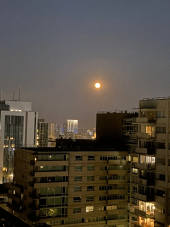
The Super Blue Moon, after shining spectacularly over San Francisco Bay and the surrounding mountains and countryside, continued doing its spectacular thing as it soared majestically over my skyscraper neighbors. The sight above was glimpsed from the roof of my building.

A spectacular summer’s end for the moon.

My summer began with this moon over Decatur, encircling itself with a gauzy Georgia haze.

And later, an August moon shone over Montana’s Bridger Mountains, clearly trying to outdo itself.

Speaking of which . . . when it appeared above St Mary’s Cathedral, as seen in mid-summer from my balcony window, the moon or the phone or an eerie phenomenon (I choose that last) created a nifty blue dot as a prophecy of moons to come

And sure enough, the Super Blue Moon, in all its brilliance, rolled across the late August sky.

Good night, moon.

On Being Kind to the Bees

Dennis Klicker on Unsplash

“I would recommend more intake of pure honey, nature’s pure food that we get from the bees.” This comment came from a faithful reader, after I wrote about tea with honey for throat issues. Faithful Reader Alvin Huie went on to mention the fact that honey has “the most nutrients, antioxidants, vitamins, etc” of many of the foods we consume.

A few minutes later I picked up my mail. It included an appeal from the good people at EarthJustice, pleading eloquently for help in saving the bees. I took this as an omen that bees of the world need a blog.

You have to love the people at EarthJustice, an environmental nonprofit with the pretty wonderful motto: Because the Earth Needs a Good Lawyer. Indeed. Bees too, apparently. It’s possible to find all sorts of opinions and data sets, depending on who (such as, agricultural products industries v environmental nonprofits) is furnishing the information. The banning of some bee-killing pesticides in the past may have somewhat slowed the scary decline in world bee populations, but I’ll go with this report from Earthday.org. Its March 2022 Fact Sheet says, among other things, that “there are 20,000 distinct bee species around the world, with 4,000 of them in the United States alone. From 2006-2015, approximately 25% fewer species were found. Under the best scenario, thousands of bee species have already become too rare.”

For an inside look into the world of bees I turned to Alvin – who happens to be an old friend and new(ish) neighbor. Now entering his 90s, Alvin is retired from an IT career and from active beekeeping (after 25+ years.) But he has kept track of all things bee-related since first getting hooked in 1994. “It’s a low-key hobby,” he says. And a lot of good fun. He attended week-long world bee conventions in S. Korea, Argentina, Ukraine and elsewhere. He reads bees books, introduces others to beekeeping and belongs to several apian organizations. There is a LOT to know and share about bees. To help with which there is Apimondia, an international federation of beekeepers’ organizations and related others that’s been around since 1895.  

Bees themselves however, bless their little apian hearts, don’t exactly enjoy lives of leisure and self-indulgence. According to their friend Alvin, the average worker bee lives about six weeks max. The drone, whose primary purpose is to mate with the queen – or help with temperature control by flapping his (larger) wings along with all the others – might live for around 30 days. But if he’s successful in beating out a few thousand fellow drones – they don’t fight about it! They just try to get closest to her – and mating with the queen, he immediately dies. What can I say? Queenie herself might live for a year or two, but during the springtime (her busiest season) she’s laying about 1500 eggs per day. All of this may be why you never hear people saying “it’s a bee’s life.”

Still. All those apian friends of ours – in the remaining 20,000 species – are critical to our survival. While we humans are hardly noticing, they are pollinating, without which activity we would lack most of the fruits, vegetables and other good things we live on. Or promoting biodiversity, or making honey or creating all that great wax we use. All of which requires, well, being as busy as bees for their entire lives.

You may want to thank a bee today.

Kindness for the New Year – Why not?

About that cup of kindness – –

Let’s take a cup for a few of the auld lang synes of 2017, in the highest hopes for this brand new year.

Planet earthA cup for the planet. Despite the best efforts of the Environmental Destruction Agency to foul the air and water, and similar efforts to open up our lands for desecration and private development, this fragile globe survives. You can Google “Good news for the planet” to boost your spirits. Here’s a toast to everyone who switches to solar, picks up litter, and pays attention to ways we can protect our grandchildren’s heritage.

A cup for women! Beginning with the inspirational Women’s March and marching through to the #MeToo movement, women have earned more than a little kindness yet. They won’t get much of it in the reproductive justice realm. You cannot confer rights on a fetus without denying rights of the woman carrying it.march - crowd Anti-abortion forces sneaked wording about rights of “the unborn” into the harsh new tax bill, so chalk one up for regression into the dark ages of womankind. But here’s a cup o’ kindness toast to every #MeToo, as well as to heroes like Willie Parker out there fighting to protect all women.

A cup for people of all faiths working together. There may be constant headlines, not to mention tweets, designed to set us against each other, but interfaith groups across the country are determined to keep respect and mutual support alive. Google “Interfaith work” in your city or state and find how many kindnesses are underway.

A cup for the hopeless. Remember those huddled masses yearning to breathe free? They’re still out there, in force: refugees and asylum-seekers, people mired in poverty or joblessness, sick children without healthcare, undocumented immigrants in families being torn apart. ENDURING FREEDOMBut if our government is turning its back on them, a multitude of individuals and organizations are working around the clock to get the lamp lifted again. Google “Help undocumented immigrants,” or “Fighting poverty in my community” for starters. Cups of kindness abound.

And a cup of kindness for kindness’ sake. A group of people with vastly diverse backgrounds and philosophies met just after New Year’s Day to talk about how to retain optimism – hope, at least – on all of the above in the face of current divisiveness and a mentally unbalanced president. Said one member of the group: “It helps to commit conscious acts of kindness throughout the day. Might be just a tiny thing, but it makes you feel better, and kindness can be contagious.” Pope Francis thinks so. In his New Year’s Eve homily he expressed optimism about ordinary people going about their lives doing ordinary acts of kindness. The “artisans of the common good,” he called them. So here’s a toast to every artisan of the common good. May we all join their ranks this year.

Footprints of kindness