Will fatherhood change Rev. Billy?

It’s true. The 50-something Reverend is a new father. Rev. Billy and his gorgeous wife  Savitri, today welcomed Lena Nightstar Talen into the world. If you Facebook friend him you can see her photos.

You may not have encountered Rev. Billy. He is, however, worth encountering. Minister of the Church of Stop Shopping, occasionally the Church of Stop the Bombing or most recently the Church of Life After Shopping, Reverend Billy got out of jail in time for his daughter’s arrival. He was incarcerated (something that happens with some regularity) for creating a mountain of toxic waste from Appalachia and dumping it in the NY lobby of JP Morgan Chase in protest against their financing of mountaintop mining.

Rev. Billy, a performance artist AKA Bill Talen, puts his energies where his beliefs are in ways most of us couldn’t imagine — and certainly couldn’t pull off. He ran unsuccessfully but with gusto for Mayor of New York in the last election. Long before the gun folks targeted Starbucks the Rev was targeting them for driving out the mom and pop stores. (That particular campaign, which included preaching a one-minute anti-Starbucks sermon in every Starbucks in Manhattan, got Starbucks’ attention, prompted a memo to their outlets and resulted in a book titled after that memo, What Should I Do If Reverend Billy Is In My Store.)

The Rev supports equality, gay rights and everyday folks; he laments consumerism, corporate culture, destruction of the environment and other popular evils. His laments, though, are considerably more activist than most. This is partly because he’s gifted and funny, and mostly because he truly believes that one should stand up for principles that matter. Check him out. You may not agree with his passions or his methods, but you won’t be bored.

About those passions, what Rev. Billy wants most is a better world for newcomers like Lena Nightstar. He’s entertaining, but he’s dead serious.

So no, I doubt that fatherhood will slow him down. Congratulations, Savitri & Bill.

iPad a pod too far for some

Delirious iFans are all over cyberspace these days with effusive praise for their new toy –

… an alternate computing reality in which the balance between content creation and consumption has shifted.

…a new computer that really plays to this new reality … shifts the priorities, … gets us more intimate with our media than we have ever been before…

…the iPad (has) finally given us a reason to think beyond our current relationship with computers.

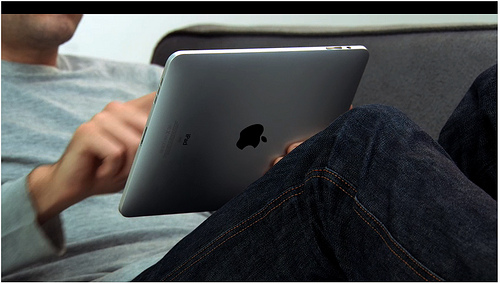
Light and slim and sexy, the iPad is not a machine, its analysts would have us understand, as much as “an experience.” Boasting a volume rocker and a sleep/power button and a switch that locks into either horizontal or portrait view.

The talk is all about the “responsive screen that lets us interact with the things we care about. (It) quickly becomes the way you want to consume the Internet.”

This writer hereby admits to a relationship with a ThinkPad X61 that is, at times, excessive and does occasionally drive the husband to the brink of tossing it out the window. But interaction with the things I care about tends to happen when I shut the machine off. Which leads me to believe I’ll remain PC Luddite and iPad resistant.

IPad’s interactivity raises computing bar.

Guns as art and in the world

At my granddaughter’s art school, student work features what struck me as an awful lot of weapons: handguns, automatic rifles, daggers. “Well, Gran,” she replied to my comment on this high degree of angst, “we are teenagers.”

OK, I know it’s been two generations and at least 70 light years since I was a freshman art student myself, but I do miss the landscapes, still lifes and quiet figure studies. And I lament the angst.

I draw NO parallel, absolutely NO parallel between the excellent training and remarkable students at today’s art schools and the angst-level of terrorism. It is still both unsettling and heart-wrenching to pick up today’s New York Times and be greeted by a front page photo of a pretty,  baby-faced, all-innocence young girl pointing a gun upwards behind her head while in the casual embrace of her boyfriend, who is holding a larger handgun.

The boyfriend, as it happens, is a handsome young Russian who was killed by government forces a few months ago. The young woman, hardly more than a child, blew herself up in a Moscow subway on Monday, killing a lot of other innocent human beings. What is striking, among all the other ironies and tragedies of this picture, is the wealth of warmth and promise that seems to shine out of those two faces… if you cover up the guns. But those faces, and the bodies to which they were attached, are now dead.

I am holding onto my Brady Campaign membership.

Abortion rights/ pro-choice, what's in a name?

Words matter. When the folks who seek to deny a woman’s right to control her own body co-opted that “pro-life” phrase, a disingenuous but highly successful sound bite was born. You support reproductive rights? You’re anti-life. Pro-death. It was a brilliant PR move, if not entirely accurate. “Pro-lifers” choose to ignore the millions of women who will suffer if abortion restrictions force them into unsafe, often life-threatening choices. You’re pro-choice? You want to save those lives.

Now, perhaps, a new clarification of terms by NPR Managing Director David Sweeney may nudge us toward more honest dialogue:

Last week, I wrote a post about how NPR identifies people who support or oppose abortion. It engendered a lively debate inside and outside NPR. Today, some top editors got together to review the 2005 policy and decided to no longer use “pro-choice” or “pro-life.”

Here’s the memo that was just distributed to all NPR staff:

“NPR News is revising the terms we use to describe people and groups involved in the abortion debate.

This updated policy is aimed at ensuring the words we speak and write are as clear, consistent and neutral as possible. This is important given that written text is such an integral part of our work.

On the air, we should use “abortion rights supporter(s)/advocate(s)” and “abortion rights opponent(s)” or derivations thereof (for example: “advocates of abortion rights”). It is acceptable to use the phrase “anti-abortion”, but do not use the term “pro-abortion rights”.

Digital News will continue to use the AP style book for online content, which mirrors the revised NPR policy.

Do not use “pro-life” and “pro-choice” in copy except when used in the name of a group. Of course, when the terms are used in an actuality they should remain.” [An actuality is a clip of tape of someone talking. So if a source uses those terms, NPR will not edit them out.]

It’s a small step in the right direction, and this space would like to offer three cheers to NPR. Thanks for acknowledging my right to be fiercely in support of women’s rights and reproductive rights — while I am also, equally, pro-life.

NPR Changes Abortion Language – NPR Ombudsman Blog : NPR.

1 … 4 5 6