
For a small-town girl, I am embarrassingly in love with cities. Their energy, their sometime sophistication, their proud histories, their devil-may-care attitude toward the constantly undulating (some fast, some pokey) throngs of their citizens as they go about doing whatever it is that city people incessantly do.
I fell for Prague the first step I took onto the first of its cobblestone bridges spanning the centuries of its brave survival of constant conquest and cultural assaults. A guide in the Prague Museum taught me a lesson worth a college semester with one proud sentence, “We do not have an army.” Thus giving this U.S.-raised citizen new insight into what armies can really mean.
In Bruges my husband and I discovered out-of-the-way museums and savored chocolate (ink-dark for him; pale for me) with our coffee while watching the canal boats. But mostly we wandered the endlessly wandering streets. It was in Bruges that we perfected the phrase employed for so many years throughout so many other cities, from Chicago to Shanghai: “Let’s just walk.”
I love Porto Alegre not just for being the city of my birth – the last sultry thing I ever did, I often say, was being born in Brazil – but for its mix of gentle warmth and cowboy swagger. On the single visit I made to the place where my father had helped start the Instituto Porto Alegre my husband and I were treated like royalty by representatives of that august institution. We were feted with meat-heavy banquets, tours and an organ concert and sent off with a bouquet of flowers; what’s not to love about a city offering that to a stranger?
Paris. Well, Paris.
 My experience of China was one two-week excursion with the Oakland Museum Art Guild, which clearly makes me an expert on all things Chinese including its cities. So. While I loved the bustle (and the leafy former French Concession) of Shanghai, and marveled at the frenetic pace of both Shanghai and Beijing, Dunhuang stole my heart. Maybe because it’s been around since – oh, 2,000 B.C., there was something casually settled about Dunhuang. Everyone seemed to move more slowly, wrapped in the desert air, smilingly unconcerned with invading tourists, of whom there were not so many as elsewhere. When I asked one colorfully-dressed woman, through several bungled words and a lot of stupid gestures, if I might take a picture of her adorable tiny daughter, she grinned, pulled me to her side and insisted in a flurry of rapid-fire instructions to a passerby that he take a picture of the three of us, the toddler nestled happily in my arms. How could I not love Dunhuang?
I was in St. Petersburg at the end of a river trip from Moscow that had been pure joy and a time of revelation. But I had OD’d on castles. Plus, I really wanted to see the Dostoevsky Museum, which was not on the agenda for my tour group. So I set out on my own, equipped with a map by which I planned to count bridges and a total ignorance of the Cyrillic alphabet. My secret weapon was the ability to approach perfect strangers, point to my map and say, “Dostoevsky Musee?” in my most beseeching Southern accent. Six or seven instructors in I wound up with a polite gentleman who suggested, in severe Slavic gestures, that it would be best if he lead me there. I would never otherwise have found the nondescript entry into the apartment where the great man himself lived his last months, a small but remarkable museum that leaves one feeling as if Fyodor just stepped out for a drink. I was mesmerized by St. Petersburg.
Though I will always leave, and find, my heart in San Francisco, it can get a little fickle about New York. A recent visit coincided with the Twin Towers memorial lights of 9/11, and visits to two of my favorite museums in the world: the Whitney & the Morgan Library, and a stroll of the High Line from end to end and back.
 A discussion about New Yorkers could’ve been a discussion of city people anywhere. My New Yorker friend argued that his compatriots are rude and insensitive. I said, “I can stand at the top, or the bottom, of any flight of stairs anywhere with my carry-on bag, and within 30 seconds someone will appear and ask, ‘Would you like help with that, ma’am?’ Never fails. People are people, just more densely so in cities.
Oceans and beaches and mountains and parks remain full of wonder for me; cities are full of wondrous humankind.
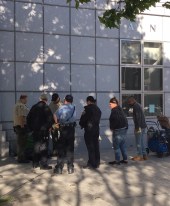 I had 45 minutes before meeting a friend at the Symphony. Bored in downtown San Francisco on a brilliantly sunlit late afternoon, at the Main Library right across from City Hall. Couldn’t go for coffee, because a friend and I were catching a quick dinner in between pre-concert talk and concert. Couldn’t hang out in the library (Duh!!) because I was still drinking my mint tea. Wondering how to entertain myself, I ventured outside, surveyed the scene and found:
 Some friends were vouching for her. Nevertheless, the rifle was confiscated and the lady admonished not to walk around downtown with an assault weapon.
 Around the corner, two extremely agile skateboarders were having a contest, enthusiastically applauded by a small audience.
 (In my city’s defense, San Francisco continues to make heroic attempts to address homelessness and mental health issues but the need overwhelms the problem. Thanks a lot, Ronald Reagan.)
 His evening attire included strips of multi-colored blinking lights. The ladies on either side politely made way for him. Before the conductor came onstage he unplugged himself and all was calm.


 My favorite Thanksgiving thing has been – for the past 14 years – the San Francisco Interfaith Service. This year it was hosted (every year it’s a different faith community) by the Fifth Church of Christ, Scientist in the city’s Tenderloin District, primary locale of the homeless and the down-and-out.
  (The Christian Scientists have been in their historic building there since 1923, and after endless years of negotiating have recently gotten the green light from the city to build a multi-use high-rise including below-market housing on the site, keeping the façade and interior details –with the church itself staying put.)

 (Another passerby said he had already called the emergency line to get help.) One can at least give thanks for helpers.


 And his adoring base. It’s also hard to watch what’s happening to other people’s grandchildren at our borders. Or the disappearance of decency and civility that we wish for our grandchildren’s world.
 There was, also, a note of very good news at the opening of the TRUMP PAPERS show. A soft-spoken young girl, about 10, was quietly creating her own art work on a ledge at the back of the gallery. A note lying among her drawings informed the curious that they were for sale for $1 (four or five digits less than most of the works available at the Jack Fischer Galleries) and that all proceeds were for immigrant children. Her name was Mila. I paid double the asking price for my selection, which is shown below. Maybe her words will eventually drown out all these others. Go see the show if you can.


 The official Ethiopian language is Amharic, but more than 80 languages are spoken. None of them are easy for English-speakers – although this writer is proud to have mastered the Amharic word for “good morning” (which I cannot spell.) This may be as far as I go. Ethiopia is also the only country in Africa with its own indigenous alphabet, but there are 33 main alphabets with each containing a row of seven different pronunciations . . . The Ethiopians I know speak English with beautiful accents.


 Robert Reich