
“Six die, 53 ill at nursing home,” reads the San Francisco Chronicle headline. It follows a similar, recent headline, “Coronavirus: 27 test positive at Orinda nursing home,” and seemingly endless others: “New cases in Alameda County facility,” “Another death at Gateway Manor”. . . These are the sorts of headlines that the management of my particular senior housing community most fears, and that strike a little dread in the aging hearts of my neighbors and myself. I live in a 12-story assisted living building near downtown San Francisco. It includes some 90 apartments housing singles and a few couples with a median age of, say, 87. That is a random number, chosen only because it puts me in the younger half. I generally refer to our place as the Geezer House, but the marketing materials use slightly more refined wordage. Those materials do not lie: this is not the ritziest senior living place in town, but it would fall in the “upscale” category.
There are hundreds of senior living facilities in the San Francisco Bay Area, ranging from minimum-care to rehab to lifecare to nursing home; all of us are, to one degree or another, the scariest target populations for COVID-19’s quiver of poison arrows. At the center are the nursing homes, source of the horror stories that seem to increase daily; my community is somewhere around the second ring out from the bullseye. Though we are somewhat less vulnerable than nursing homes, if one COVID-19 virus particle managed to sneak into our building it would be Katie-bar-the-door. We’ve had practice runs, with flu or norovirus, but those moved in slowly, two or three new cases per day until the mini-epidemic retreated. With COVID-19 we’re staring down a mystery virus that, in neighboring senior facilities at least, seems to move in and take over in a blinding flash.
Extreme measures are underway to prevent that from happening in my building. Think San Quentin, but with better food. We began with Mayor London Breed’s shelter-in-place decree on March 16; this being San Francisco, Mayor Breed got a three-day jump on Governor Gavin Newsom’s March 19 statewide order. Life in geezer houses took a sharp turn toward confinement at that point. I encountered the new reality head-on when innocently heading out to drop some mail in the box across the street. “If you step out that door,” my friend the concierge remarked, “you must first sign this document.” He handed me a paper declaring that I “understand that by departing (the facility) I am violating Public Health Order No. C19-09, enforced by the San Francisco Police Department” and that I “may be excluded from (the facility) and not re-admitted.” I thought better of mailing my letters.
 There is a stillness here. Sometimes it’s eerily pleasant, the silence broken by birdsong in nearby trees. But often it is ominous. Having worked as a hospice volunteer and with other end-of-life organizations, I know the sudden stillness that is death, and others here have experienced it when losing a loved one. So here we are, in a place where most of us have come planning to stay until we die – and we’d just prefer not to be thinking about it in the middle of a pandemic. Listening to the stillness, watching the quiet streets no longer bustling with cars and people – manages to equate with death and become just a tiny bit stressful.
Life in confinement turns out to be something for which many of us were remarkably ill prepared, and there’s little comfort in knowing we share that woeful lack with millions of fellow citizens and certainly the Trump administration. Comfort is in short supply under social distance guidelines. Most of us here were children during World War II, memories of which have a certain nostalgia: there was shared sacrifice then too, but it felt noble rather than resentful. And there were Mr. Roosevelt’s fireside chats.

I don’t remember the first of these, which was given a few months before I was born, but I well remember some of the last, during the war, when we’d gather around the big Philco radio to hear that deep, cultured voice. Grammatically perfect, unfailingly calm and reassuring. It’s hard not to yearn for such a voice when listening to our current president’s egotistical bombast and vulgar, vicious divisiveness. I think the memories of very different times accentuate the vague feeling among residents of senior living facilities that we are imprisoned against our will.
On the upside for my fellow inmates here and me, our fortress is pretty posh. Three good meals delivered daily in compostable containers, creature comforts like views of the San Bruno mountains to the south, or the San Francisco sunsets from our west windows. On the downside, it is possible to spend days at a time without seeing another human being, other than the masked person who shows up every day to take your temperature. For those of us still mobile there are decidedly other upsides: a small exercise room with treadmill, weights etc, and an outdoor terrace on the second floor (barred gate at the bottom of its stairs.) Walking from one end of the terrace to the other requires 180 steps. The exercise room being too small to accommodate more than one socially-distanced person, I get my best exercise walking from the 7th floor to the 3rd to see if anyone is on the treadmill. Eight or ten of us are also known to go walking at the same time, appropriately distanced, and thereafter to hang out for also distanced but at least human-to-human, conversation – though it does include frequent remarks in the “Did you see who that gurney came for?” category. Some of us are more obsessive than others about checking the case/death numbers posted every morning at 9 by the San Francisco Department of Public Health; everyone talks less and less about when the country may “open up.” Or about politics at all, for that matter. Political discussions pretty much begin and end with “What about Trump saying . . .” This place is not a bastion of conservatism.
What’s not heard a lot? Complaints. If we chafe at confinement, we’re grateful to wake up without a fever. Most of us have friends or family in New York, Atlanta, New Orleans or Seattle and we worry about them far more than they need worry about us. All of us have friends or family who are doctors, nurses, first responders and others on the front lines. Somehow, gratitude seems to edge out the fear in our geezerly hearts.

This essay also appears on Medium.com, a fine site committed to the exchange of ideas, knowledge and perspectives, on which I’ll be posting in the future. But I’ll still be holding forth right here on franjohns.net. So stick around!


 You don’t really have to be as old as I am to remember the


 But mostly we wandered the endlessly wandering streets. It was in Bruges that we perfected the phrase employed for so many years throughout so many other cities, from Chicago to Shanghai: “Let’s just walk.”
 My experience of China was one two-week excursion with the Oakland Museum Art Guild, which clearly makes me an expert on all things Chinese including its cities. So. While I loved the bustle (and the leafy former French Concession) of Shanghai, and marveled at the frenetic pace of both Shanghai and Beijing, Dunhuang stole my heart. Maybe because it’s been around since – oh, 2,000 B.C., there was something casually settled about Dunhuang. Everyone seemed to move more slowly, wrapped in the desert air, smilingly unconcerned with invading tourists, of whom there were not so many as elsewhere. When I asked one colorfully-dressed woman, through several bungled words and a lot of stupid gestures, if I might take a picture of her adorable tiny daughter, she grinned, pulled me to her side and insisted in a flurry of rapid-fire instructions to a passerby that he take a picture of the three of us, the toddler nestled happily in my arms. How could I not love Dunhuang?
 So I set out on my own, equipped with a map by which I planned to count bridges and a total ignorance of the Cyrillic alphabet. My secret weapon was the ability to approach perfect strangers, point to my map and say, “Dostoevsky Musee?” in my most beseeching Southern accent. Six or seven instructors in I wound up with a polite gentleman who suggested, in severe Slavic gestures, that it would be best if he lead me there. I would never otherwise have found the nondescript entry into the apartment where the great man himself lived his last months, a small but remarkable museum that leaves one feeling as if Fyodor just stepped out for a drink. I was mesmerized by St. Petersburg.
 A discussion about New Yorkers could’ve been a discussion of city people anywhere. My New Yorker friend argued that his compatriots are rude and insensitive. I said, “I can stand at the top, or the bottom, of any flight of stairs anywhere with my carry-on bag, and within 30 seconds someone will appear and ask, ‘Would you like help with that, ma’am?’ Never fails. People are people, just more densely so in cities.
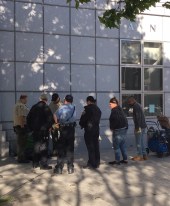 I had 45 minutes before meeting a friend at the Symphony. Bored in downtown San Francisco on a brilliantly sunlit late afternoon, at the Main Library right across from City Hall. Couldn’t go for coffee, because a friend and I were catching a quick dinner in between pre-concert talk and concert. Couldn’t hang out in the library (Duh!!) because I was still drinking my mint tea. Wondering how to entertain myself, I ventured outside, surveyed the scene and found:
 Some friends were vouching for her. Nevertheless, the rifle was confiscated and the lady admonished not to walk around downtown with an assault weapon.
 Around the corner, two extremely agile skateboarders were having a contest, enthusiastically applauded by a small audience.
 (In my city’s defense, San Francisco continues to make heroic attempts to address homelessness and mental health issues but the need overwhelms the problem. Thanks a lot, Ronald Reagan.)
 His evening attire included strips of multi-colored blinking lights. The ladies on either side politely made way for him. Before the conductor came onstage he unplugged himself and all was calm.


 My favorite Thanksgiving thing has been – for the past 14 years – the San Francisco Interfaith Service. This year it was hosted (every year it’s a different faith community) by the Fifth Church of Christ, Scientist in the city’s Tenderloin District, primary locale of the homeless and the down-and-out.
  (The Christian Scientists have been in their historic building there since 1923, and after endless years of negotiating have recently gotten the green light from the city to build a multi-use high-rise including below-market housing on the site, keeping the façade and interior details –with the church itself staying put.)

 (Another passerby said he had already called the emergency line to get help.) One can at least give thanks for helpers.


 And his adoring base. It’s also hard to watch what’s happening to other people’s grandchildren at our borders. Or the disappearance of decency and civility that we wish for our grandchildren’s world.
 There was, also, a note of very good news at the opening of the TRUMP PAPERS show. A soft-spoken young girl, about 10, was quietly creating her own art work on a ledge at the back of the gallery. A note lying among her drawings informed the curious that they were for sale for $1 (four or five digits less than most of the works available at the Jack Fischer Galleries) and that all proceeds were for immigrant children. Her name was Mila. I paid double the asking price for my selection, which is shown below. Maybe her words will eventually drown out all these others. Go see the show if you can.